
GULLIVER’S TRAVELS
into several
REMOTE NATIONS OF THE WORLD
BY JONATHAN SWIFT,are robot building kits good for child development D.D.,
dean of st. patrick’s, dublin.
[First published in1726–7.]

Contents
| THE PUBLISHER TO THE READER. |
| A LETTER FROM CAPTAIN GULLIVER TO HIS COUSIN SYMPSON. |
| PART I. A VOYAGE TO LILLIPUT. |
| PART II. A VOYAGE TO BROBDINGNAG. |
| PART III. A VOYAGE TO LAPUTA, BALNIBARBI, GLUBBDUBDRIB, LUGGNAGG AND JAPAN. |
| PART IV. A VOYAGE TO THE COUNTRY OF THE HOUYHNHNMS. |
THE PUBLISHER TO THE READER.
[As given in the original edition.]
The author of these Travels, Mr. Lemuel Gulliver, is my ancient and intimatefriend; there is likewise some relation between us on the mother’s side.About three years ago, Mr. Gulliver growing weary of the concourse of curiouspeople coming to him at his house in Redriff, made a small purchase of land,with a convenient house, near Newark, in Nottinghamshire, his native country;where he now lives retired, yet in good esteem among his neighbours.
Although Mr. Gulliver was born in Nottinghamshire, where his father dwelt, yetI have heard him say his family came from Oxfordshire; to confirm which, I haveobserved in the churchyard at Banbury in that county, several tombs andmonuments of the Gullivers.
Before he quitted Redriff, he left the custody of the following papers in myhands, with the liberty to dispose of them as I should think fit. I havecarefully perused them three times. The style is very plain and simple; and theonly fault I find is, that the author, after the manner of travellers, is alittle too circumstantial. There is an air of truth apparent through the whole;and indeed the author was so distinguished for his veracity, that it became asort of proverb among his neighbours at Redriff, when any one affirmed a thing,to say, it was as true as if Mr. Gulliver had spoken it.
By the advice of several worthy persons, to whom, with the author’spermission, I communicated these papers, I now venture to send them into theworld, hoping they may be, at least for some time, a better entertainment toour young noblemen, than the common scribbles of politics and party.
This volume would have been at least twice as large, if I had not made bold tostrike out innumerable passages relating to the winds and tides, as well as tothe variations and bearings in the several voyages, together with the minutedescriptions of the management of the ship in storms, in the style of sailors;likewise the account of longitudes and latitudes; wherein I have reason toapprehend, that Mr. Gulliver may be a little dissatisfied. But I was resolvedto fit the work as much as possible to the general capacity of readers.However, if my own ignorance in sea affairs shall have led me to commit somemistakes, I alone am answerable for them. And if any traveller hath a curiosityto see the whole work at large, as it came from the hands of the author, I willbe ready to gratify him.
As for any further particulars relating to the author, the reader will receivesatisfaction from the first pages of the book.
RICHARD SYMPSON.
A LETTER FROM CAPTAIN GULLIVER TO HIS COUSINSYMPSON.
Written in the Year 1727.
I hope you will be ready to own publicly, whenever you shall be called to it,that by your great and frequent urgency you prevailed on me to publish a veryloose and uncorrect account of my travels, with directions to hire some younggentleman of either university to put them in order, and correct the style, asmy cousin Dampier did, by my advice, in his book called “A Voyage roundthe world.” But I do not remember I gave you power to consent that anything should be omitted, and much less that any thing should be inserted;therefore, as to the latter, I do here renounce every thing of that kind;particularly a paragraph about her majesty Queen Anne, of most pious andglorious memory; although I did reverence and esteem her more than any of humanspecies. But you, or your interpolator, ought to have considered, that it wasnot my inclination, so was it not decent to praise any animal of ourcomposition before my master Houyhnhnm: And besides, the fact wasaltogether false; for to my knowledge, being in England during some part of hermajesty’s reign, she did govern by a chief minister; nay even by twosuccessively, the first whereof was the lord of Godolphin, and the second thelord of Oxford; so that you have made me say the thing that was not. Likewisein the account of the academy of projectors, and several passages of mydiscourse to my master Houyhnhnm, you have either omitted some materialcircumstances, or minced or changed them in such a manner, that I do hardlyknow my own work. When I formerly hinted to you something of this in a letter,you were pleased to answer that you were afraid of giving offence; that peoplein power were very watchful over the press, and apt not only to interpret, butto punish every thing which looked like an innuendo(as I think you callit). But, pray how could that which I spoke so many years ago, and at aboutfive thousand leagues distance, in another reign, be applied to any of theYahoos, who now are said to govern the herd; especially at a time when Ilittle thought, or feared, the unhappiness of living under them? Have not I themost reason to complain, when I see these very Yahooscarried byHouyhnhnmsin a vehicle, as if they were brutes, and those the rationalcreatures? And indeed to avoid so monstrous and detestable a sight was oneprincipal motive of my retirement hither.
Thus much I thought proper to tell you in relation to yourself, and to thetrust I reposed in you.
I do, in the next place, complain of my own great want of judgment, in beingprevailed upon by the entreaties and false reasoning of you and some others,very much against my own opinion, to suffer my travels to be published. Praybring to your mind how often I desired you to consider, when you insisted onthe motive of public good, that the Yahooswere a species of animalsutterly incapable of amendment by precept or example: and so it has proved;for, instead of seeing a full stop put to all abuses and corruptions, at leastin this little island, as I had reason to expect; behold, after above sixmonths warning, I cannot learn that my book has produced one single effectaccording to my intentions. I desired you would let me know, by a letter, whenparty and faction were extinguished; judges learned and upright; pleadershonest and modest, with some tincture of common sense, and Smithfield blazingwith pyramids of law books; the young nobility’s education entirelychanged; the physicians banished; the female Yahoosabounding in virtue,honour, truth, and good sense; courts and levees of great ministers thoroughlyweeded and swept; wit, merit, and learning rewarded; all disgracers of thepress in prose and verse condemned to eat nothing but their own cotton, andquench their thirst with their own ink. These, and a thousand otherreformations, I firmly counted upon by your encouragement; as indeed they wereplainly deducible from the precepts delivered in my book. And it must be owned,that seven months were a sufficient time to correct every vice and folly towhich Yahoosare subject, if their natures had been capable of the leastdisposition to virtue or wisdom. Yet, so far have you been from answering myexpectation in any of your letters; that on the contrary you are loading ourcarrier every week with libels, and keys, and reflections, and memoirs, andsecond parts; wherein I see myself accused of reflecting upon great state folk;of degrading human nature (for so they have still the confidence to style it),and of abusing the female sex. I find likewise that the writers of thosebundles are not agreed among themselves; for some of them will not allow me tobe the author of my own travels; and others make me author of books to which Iam wholly a stranger.
I find likewise that your printer has been so careless as to confound thetimes, and mistake the dates, of my several voyages and returns; neitherassigning the true year, nor the true month, nor day of the month: and I hearthe original manuscript is all destroyed since the publication of my book;neither have I any copy left: however, I have sent you some corrections, whichyou may insert, if ever there should be a second edition: and yet I cannotstand to them; but shall leave that matter to my judicious and candid readersto adjust it as they please.
I hear some of our sea Yahoosfind fault with my sea-language, as notproper in many parts, nor now in use. I cannot help it. In my first voyages,while I was young, I was instructed by the oldest mariners, and learned tospeak as they did. But I have since found that the sea Yahoosare apt,like the land ones, to become new-fangled in their words, which the latterchange every year; insomuch, as I remember upon each return to my own countrytheir old dialect was so altered, that I could hardly understand the new. And Iobserve, when any Yahoocomes from London out of curiosity to visit meat my house, we neither of us are able to deliver our conceptions in a mannerintelligible to the other.
If the censure of the Yahooscould any way affect me, I should havegreat reason to complain, that some of them are so bold as to think my book oftravels a mere fiction out of mine own brain, and have gone so far as to drophints, that the Houyhnhnmsand Yahooshave no more existence thanthe inhabitants of Utopia.
Indeed I must confess, that as to the people of Lilliput,Brobdingrag(for so the word should have been spelt, and not erroneouslyBrobdingnag), and Laputa, I have never yet heard of anyYahooso presumptuous as to dispute their being, or the facts I haverelated concerning them; because the truth immediately strikes every readerwith conviction. And is there less probability in my account of theHouyhnhnmsor Yahoos, when it is manifest as to the latter, thereare so many thousands even in this country, who only differ from their brotherbrutes in Houyhnhnmland, because they use a sort of jabber, and do notgo naked? I wrote for their amendment, and not their approbation. The unitedpraise of the whole race would be of less consequence to me, than the neighingof those two degenerate HouyhnhnmsI keep in my stable; because fromthese, degenerate as they are, I still improve in some virtues without anymixture of vice.
Do these miserable animals presume to think, that I am so degenerated as todefend my veracity? Yahooas I am, it is well known through allHouyhnhnmland, that, by the instructions and example of my illustriousmaster, I was able in the compass of two years (although I confess with theutmost difficulty) to remove that infernal habit of lying, shuffling,deceiving, and equivocating, so deeply rooted in the very souls of all myspecies; especially the Europeans.
I have other complaints to make upon this vexatious occasion; but I forbeartroubling myself or you any further. I must freely confess, that since my lastreturn, some corruptions of my Yahoonature have revived in me byconversing with a few of your species, and particularly those of my own family,by an unavoidable necessity; else I should never have attempted so absurd aproject as that of reforming the Yahoorace in this kingdom; but I havenow done with all such visionary schemes for ever.
April2, 1727
PART I. A VOYAGE TO LILLIPUT.
CHAPTER I.
The author gives some account of himself and family. His first inducements totravel. He is shipwrecked, and swims for his life, gets safe on shore in thecountry of Lilliput; is made a prisoner, and carried up the country.
My father had a small estate in Nottinghamshire; I was the third of five sons.He sent me to Emanuel College in Cambridge at fourteen years old, where Iresided three years, and applied myself close to my studies; but the charge ofmaintaining me, although I had a very scanty allowance, being too great for anarrow fortune, I was bound apprentice to Mr. James Bates, an eminent surgeonin London, with whom I continued four years. My father now and then sending mesmall sums of money, I laid them out in learning navigation, and other parts ofthe mathematics, useful to those who intend to travel, as I always believed itwould be, some time or other, my fortune to do. When I left Mr. Bates, I wentdown to my father: where, by the assistance of him and my uncle John, and someother relations, I got forty pounds, and a promise of thirty pounds a year tomaintain me at Leyden: there I studied physic two years and seven months,knowing it would be useful in long voyages.
Soon after my return from Leyden, I was recommended by my good master, Mr.Bates, to be surgeon to the Swallow, Captain Abraham Pannel, commander; withwhom I continued three years and a half, making a voyage or two into theLevant, and some other parts. When I came back I resolved to settle in London;to which Mr. Bates, my master, encouraged me, and by him I was recommended toseveral patients. I took part of a small house in the Old Jewry; and beingadvised to alter my condition, I married Mrs. Mary Burton, second daughter toMr. Edmund Burton, hosier, in Newgate-street, with whom I received four hundredpounds for a portion.
But my good master Bates dying in two years after, and I having few friends, mybusiness began to fail; for my conscience would not suffer me to imitate thebad practice of too many among my brethren. Having therefore consulted with mywife, and some of my acquaintance, I determined to go again to sea. I wassurgeon successively in two ships, and made several voyages, for six years, tothe East and West Indies, by which I got some addition to my fortune. My hoursof leisure I spent in reading the best authors, ancient and modern, beingalways provided with a good number of books; and when I was ashore, inobserving the manners and dispositions of the people, as well as learning theirlanguage; wherein I had a great facility, by the strength of my memory.
The last of these voyages not proving very fortunate, I grew weary of the sea,and intended to stay at home with my wife and family. I removed from the OldJewry to Fetter Lane, and from thence to Wapping, hoping to get business amongthe sailors; but it would not turn to account. After three years expectationthat things would mend, I accepted an advantageous offer from Captain WilliamPrichard, master of the Antelope, who was making a voyage to the South Sea. Weset sail from Bristol, May 4, 1699, and our voyage was at first veryprosperous.
It would not be proper, for some reasons, to trouble the reader with theparticulars of our adventures in those seas; let it suffice to inform him, thatin our passage from thence to the East Indies, we were driven by a violentstorm to the north-west of Van Diemen’s Land. By an observation, we foundourselves in the latitude of 30 degrees 2 minutes south. Twelve of our crewwere dead by immoderate labour and ill food; the rest were in a very weakcondition. On the 5th of November, which was the beginning of summer in thoseparts, the weather being very hazy, the seamen spied a rock within half acable’s length of the ship; but the wind was so strong, that we weredriven directly upon it, and immediately split. Six of the crew, of whom I wasone, having let down the boat into the sea, made a shift to get clear of theship and the rock. We rowed, by my computation, about three leagues, till wewere able to work no longer, being already spent with labour while we were inthe ship. We therefore trusted ourselves to the mercy of the waves, and inabout half an hour the boat was overset by a sudden flurry from the north. Whatbecame of my companions in the boat, as well as of those who escaped on therock, or were left in the vessel, I cannot tell; but conclude they were alllost. For my own part, I swam as fortune directed me, and was pushed forward bywind and tide. I often let my legs drop, and could feel no bottom; but when Iwas almost gone, and able to struggle no longer, I found myself within mydepth; and by this time the storm was much abated. The declivity was so small,that I walked near a mile before I got to the shore, which I conjectured wasabout eight o’clock in the evening. I then advanced forward near half amile, but could not discover any sign of houses or inhabitants; at least I wasin so weak a condition, that I did not observe them. I was extremely tired, andwith that, and the heat of the weather, and about half a pint of brandy that Idrank as I left the ship, I found myself much inclined to sleep. I lay down onthe grass, which was very short and soft, where I slept sounder than ever Iremembered to have done in my life, and, as I reckoned, about nine hours; forwhen I awaked, it was just day-light. I attempted to rise, but was not able tostir: for, as I happened to lie on my back, I found my arms and legs werestrongly fastened on each side to the ground; and my hair, which was long andthick, tied down in the same manner. I likewise felt several slender ligaturesacross my body, from my arm-pits to my thighs. I could only look upwards; thesun began to grow hot, and the light offended my eyes. I heard a confused noiseabout me; but in the posture I lay, could see nothing except the sky. In alittle time I felt something alive moving on my left leg, which advancinggently forward over my breast, came almost up to my chin; when, bending my eyesdownwards as much as I could, I perceived it to be a human creature not sixinches high, with a bow and arrow in his hands, and a quiver at his back. Inthe mean time, I felt at least forty more of the same kind (as I conjectured)following the first. I was in the utmost astonishment, and roared so loud, thatthey all ran back in a fright; and some of them, as I was afterwards told, werehurt with the falls they got by leaping from my sides upon the ground. However,they soon returned, and one of them, who ventured so far as to get a full sightof my face, lifting up his hands and eyes by way of admiration, cried out in ashrill but distinct voice, Hekinah degul: the others repeated the samewords several times, but then I knew not what they meant. I lay all this while,as the reader may believe, in great uneasiness. At length, struggling to getloose, I had the fortune to break the strings, and wrench out the pegs thatfastened my left arm to the ground; for, by lifting it up to my face, Idiscovered the methods they had taken to bind me, and at the same time with aviolent pull, which gave me excessive pain, I a little loosened the stringsthat tied down my hair on the left side, so that I was just able to turn myhead about two inches. But the creatures ran off a second time, before I couldseize them; whereupon there was a great shout in a very shrill accent, andafter it ceased I heard one of them cry aloud Tolgo phonac; when in aninstant I felt above a hundred arrows discharged on my left hand, which,pricked me like so many needles; and besides, they shot another flight into theair, as we do bombs in Europe, whereof many, I suppose, fell on my body,(though I felt them not), and some on my face, which I immediately covered withmy left hand. When this shower of arrows was over, I fell a groaning with griefand pain; and then striving again to get loose, they discharged another volleylarger than the first, and some of them attempted with spears to stick me inthe sides; but by good luck I had on a buff jerkin, which they could notpierce. I thought it the most prudent method to lie still, and my design was tocontinue so till night, when, my left hand being already loose, I could easilyfree myself: and as for the inhabitants, I had reason to believe I might be amatch for the greatest army they could bring against me, if they were all ofthe same size with him that I saw. But fortune disposed otherwise of me. Whenthe people observed I was quiet, they discharged no more arrows; but, by thenoise I heard, I knew their numbers increased; and about four yards from me,over against my right ear, I heard a knocking for above an hour, like that ofpeople at work; when turning my head that way, as well as the pegs and stringswould permit me, I saw a stage erected about a foot and a half from the ground,capable of holding four of the inhabitants, with two or three ladders to mountit: from whence one of them, who seemed to be a person of quality, made me along speech, whereof I understood not one syllable. But I should havementioned, that before the principal person began his oration, he cried outthree times, Langro dehul san(these words and the former wereafterwards repeated and explained to me); whereupon, immediately, about fiftyof the inhabitants came and cut the strings that fastened the left side of myhead, which gave me the liberty of turning it to the right, and of observingthe person and gesture of him that was to speak. He appeared to be of a middleage, and taller than any of the other three who attended him, whereof one was apage that held up his train, and seemed to be somewhat longer than my middlefinger; the other two stood one on each side to support him. He acted everypart of an orator, and I could observe many periods of threatenings, and othersof promises, pity, and kindness. I answered in a few words, but in the mostsubmissive manner, lifting up my left hand, and both my eyes to the sun, ascalling him for a witness; and being almost famished with hunger, having noteaten a morsel for some hours before I left the ship, I found the demands ofnature so strong upon me, that I could not forbear showing my impatience(perhaps against the strict rules of decency) by putting my finger frequentlyto my mouth, to signify that I wanted food. The hurgo(for so they calla great lord, as I afterwards learnt) understood me very well. He descendedfrom the stage, and commanded that several ladders should be applied to mysides, on which above a hundred of the inhabitants mounted and walked towardsmy mouth, laden with baskets full of meat, which had been provided and sentthither by the king’s orders, upon the first intelligence he received ofme. I observed there was the flesh of several animals, but could notdistinguish them by the taste. There were shoulders, legs, and loins, shapedlike those of mutton, and very well dressed, but smaller than the wings of alark. I ate them by two or three at a mouthful, and took three loaves at atime, about the bigness of musket bullets. They supplied me as fast as theycould, showing a thousand marks of wonder and astonishment at my bulk andappetite. I then made another sign, that I wanted drink. They found by myeating that a small quantity would not suffice me; and being a most ingeniouspeople, they slung up, with great dexterity, one of their largest hogsheads,then rolled it towards my hand, and beat out the top; I drank it off at adraught, which I might well do, for it did not hold half a pint, and tastedlike a small wine of Burgundy, but much more delicious. They brought me asecond hogshead, which I drank in the same manner, and made signs for more; butthey had none to give me. When I had performed these wonders, they shouted forjoy, and danced upon my breast, repeating several times as they did at first,Hekinah degul. They made me a sign that I should throw down the twohogsheads, but first warning the people below to stand out of the way, cryingaloud, Borach mevolah; and when they saw the vessels in the air, therewas a universal shout of Hekinah degul. I confess I was often tempted,while they were passing backwards and forwards on my body, to seize forty orfifty of the first that came in my reach, and dash them against the ground. Butthe remembrance of what I had felt, which probably might not be the worst theycould do, and the promise of honour I made them—for so I interpreted mysubmissive behaviour—soon drove out these imaginations. Besides, I nowconsidered myself as bound by the laws of hospitality, to a people who hadtreated me with so much expense and magnificence. However, in my thoughts Icould not sufficiently wonder at the intrepidity of these diminutive mortals,who durst venture to mount and walk upon my body, while one of my hands was atliberty, without trembling at the very sight of so prodigious a creature as Imust appear to them. After some time, when they observed that I made no moredemands for meat, there appeared before me a person of high rank from hisimperial majesty. His excellency, having mounted on the small of my right leg,advanced forwards up to my face, with about a dozen of his retinue; andproducing his credentials under the signet royal, which he applied close to myeyes, spoke about ten minutes without any signs of anger, but with a kind ofdeterminate resolution, often pointing forwards, which, as I afterwards found,was towards the capital city, about half a mile distant; whither it was agreedby his majesty in council that I must be conveyed. I answered in few words, butto no purpose, and made a sign with my hand that was loose, putting it to theother (but over his excellency’s head for fear of hurting him or histrain) and then to my own head and body, to signify that I desired my liberty.It appeared that he understood me well enough, for he shook his head by way ofdisapprobation, and held his hand in a posture to show that I must be carriedas a prisoner. However, he made other signs to let me understand that I shouldhave meat and drink enough, and very good treatment. Whereupon I once morethought of attempting to break my bonds; but again, when I felt the smart oftheir arrows upon my face and hands, which were all in blisters, and many ofthe darts still sticking in them, and observing likewise that the number of myenemies increased, I gave tokens to let them know that they might do with mewhat they pleased. Upon this, the hurgoand his train withdrew, withmuch civility and cheerful countenances. Soon after I heard a general shout,with frequent repetitions of the words Peplom selan; and I felt greatnumbers of people on my left side relaxing the cords to such a degree, that Iwas able to turn upon my right, and to ease myself with making water; which Ivery plentifully did, to the great astonishment of the people; who,conjecturing by my motion what I was going to do, immediately opened to theright and left on that side, to avoid the torrent, which fell with such noiseand violence from me. But before this, they had daubed my face and both myhands with a sort of ointment, very pleasant to the smell, which, in a fewminutes, removed all the smart of their arrows. These circumstances, added tothe refreshment I had received by their victuals and drink, which were verynourishing, disposed me to sleep. I slept about eight hours, as I wasafterwards assured; and it was no wonder, for the physicians, by theemperor’s order, had mingled a sleepy potion in the hogsheads of wine.
It seems, that upon the first moment I was discovered sleeping on the ground,after my landing, the emperor had early notice of it by an express; anddetermined in council, that I should be tied in the manner I have related,(which was done in the night while I slept;) that plenty of meat and drinkshould be sent to me, and a machine prepared to carry me to the capital city.
This resolution perhaps may appear very bold and dangerous, and I am confidentwould not be imitated by any prince in Europe on the like occasion. However, inmy opinion, it was extremely prudent, as well as generous: for, supposing thesepeople had endeavoured to kill me with their spears and arrows, while I wasasleep, I should certainly have awaked with the first sense of smart, whichmight so far have roused my rage and strength, as to have enabled me to breakthe strings wherewith I was tied; after which, as they were not able to makeresistance, so they could expect no mercy.
These people are most excellent mathematicians, and arrived to a greatperfection in mechanics, by the countenance and encouragement of the emperor,who is a renowned patron of learning. This prince has several machines fixed onwheels, for the carriage of trees and other great weights. He often builds hislargest men of war, whereof some are nine feet long, in the woods where thetimber grows, and has them carried on these engines three or four hundred yardsto the sea. Five hundred carpenters and engineers were immediately set at workto prepare the greatest engine they had. It was a frame of wood raised threeinches from the ground, about seven feet long, and four wide, moving upontwenty-two wheels. The shout I heard was upon the arrival of this engine,which, it seems, set out in four hours after my landing. It was broughtparallel to me, as I lay. But the principal difficulty was to raise and placeme in this vehicle. Eighty poles, each of one foot high, were erected for thispurpose, and very strong cords, of the bigness of packthread, were fastened byhooks to many bandages, which the workmen had girt round my neck, my hands, mybody, and my legs. Nine hundred of the strongest men were employed to draw upthese cords, by many pulleys fastened on the poles; and thus, in less thanthree hours, I was raised and slung into the engine, and there tied fast. Allthis I was told; for, while the operation was performing, I lay in a profoundsleep, by the force of that soporiferous medicine infused into my liquor.Fifteen hundred of the emperor’s largest horses, each about four inchesand a half high, were employed to draw me towards the metropolis, which, as Isaid, was half a mile distant.
About four hours after we began our journey, I awaked by a very ridiculousaccident; for the carriage being stopped a while, to adjust something that wasout of order, two or three of the young natives had the curiosity to see how Ilooked when I was asleep; they climbed up into the engine, and advancing verysoftly to my face, one of them, an officer in the guards, put the sharp end ofhis half-pike a good way up into my left nostril, which tickled my nose like astraw, and made me sneeze violently; whereupon they stole off unperceived, andit was three weeks before I knew the cause of my waking so suddenly. We made along march the remaining part of the day, and, rested at night with fivehundred guards on each side of me, half with torches, and half with bows andarrows, ready to shoot me if I should offer to stir. The next morning atsunrise we continued our march, and arrived within two hundred yards of thecity gates about noon. The emperor, and all his court, came out to meet us; buthis great officers would by no means suffer his majesty to endanger his personby mounting on my body.
At the place where the carriage stopped there stood an ancient temple, esteemedto be the largest in the whole kingdom; which, having been polluted some yearsbefore by an unnatural murder, was, according to the zeal of those people,looked upon as profane, and therefore had been applied to common use, and allthe ornaments and furniture carried away. In this edifice it was determined Ishould lodge. The great gate fronting to the north was about four feet high,and almost two feet wide, through which I could easily creep. On each side ofthe gate was a small window, not above six inches from the ground: into that onthe left side, the king’s smith conveyed fourscore and eleven chains,like those that hang to a lady’s watch in Europe, and almost as large,which were locked to my left leg with six-and-thirty padlocks. Over againstthis temple, on the other side of the great highway, at twenty feet distance,there was a turret at least five feet high. Here the emperor ascended, withmany principal lords of his court, to have an opportunity of viewing me, as Iwas told, for I could not see them. It was reckoned that above a hundredthousand inhabitants came out of the town upon the same errand; and, in spiteof my guards, I believe there could not be fewer than ten thousand at severaltimes, who mounted my body by the help of ladders. But a proclamation was soonissued, to forbid it upon pain of death. When the workmen found it wasimpossible for me to break loose, they cut all the strings that bound me;whereupon I rose up, with as melancholy a disposition as ever I had in my life.But the noise and astonishment of the people, at seeing me rise and walk, arenot to be expressed. The chains that held my left leg were about two yardslong, and gave me not only the liberty of walking backwards and forwards in asemicircle, but, being fixed within four inches of the gate, allowed me tocreep in, and lie at my full length in the temple.
CHAPTER II.
The emperor of Lilliput, attended by several of the nobility, comes to see theauthor in his confinement. The emperor’s person and habit described.Learned men appointed to teach the author their language. He gains favour byhis mild disposition. His pockets are searched, and his sword and pistols takenfrom him.
When I found myself on my feet, I looked about me, and must confess I neverbeheld a more entertaining prospect. The country around appeared like acontinued garden, and the enclosed fields, which were generally forty feetsquare, resembled so many beds of flowers. These fields were intermingled withwoods of half a stang,[301]and the tallest trees, as I could judge, appeared to be seven feet high. Iviewed the town on my left hand, which looked like the painted scene of a cityin a theatre.
I had been for some hours extremely pressed by the necessities of nature; whichwas no wonder, it being almost two days since I had last disburdened myself. Iwas under great difficulties between urgency and shame. The best expedient Icould think of, was to creep into my house, which I accordingly did; andshutting the gate after me, I went as far as the length of my chain wouldsuffer, and discharged my body of that uneasy load. But this was the only timeI was ever guilty of so uncleanly an action; for which I cannot but hope thecandid reader will give some allowance, after he has maturely and impartiallyconsidered my case, and the distress I was in. From this time my constantpractice was, as soon as I rose, to perform that business in open air, at thefull extent of my chain; and due care was taken every morning before companycame, that the offensive matter should be carried off in wheel-barrows, by twoservants appointed for that purpose. I would not have dwelt so long upon acircumstance that, perhaps, at first sight, may appear not very momentous, if Ihad not thought it necessary to justify my character, in point of cleanliness,to the world; which, I am told, some of my maligners have been pleased, uponthis and other occasions, to call in question.
When this adventure was at an end, I came back out of my house, having occasionfor fresh air. The emperor was already descended from the tower, and advancingon horseback towards me, which had like to have cost him dear; for the beast,though very well trained, yet wholly unused to such a sight, which appeared asif a mountain moved before him, reared up on its hinder feet: but that prince,who is an excellent horseman, kept his seat, till his attendants ran in, andheld the bridle, while his majesty had time to dismount. When he alighted, hesurveyed me round with great admiration; but kept beyond the length of mychain. He ordered his cooks and butlers, who were already prepared, to give mevictuals and drink, which they pushed forward in a sort of vehicles uponwheels, till I could reach them. I took these vehicles and soon emptied themall; twenty of them were filled with meat, and ten with liquor; each of theformer afforded me two or three good mouthfuls; and I emptied the liquor of tenvessels, which was contained in earthen vials, into one vehicle, drinking itoff at a draught; and so I did with the rest. The empress, and young princes ofthe blood of both sexes, attended by many ladies, sat at some distance in theirchairs; but upon the accident that happened to the emperor’s horse, theyalighted, and came near his person, which I am now going to describe. He istaller by almost the breadth of my nail, than any of his court; which alone isenough to strike an awe into the beholders. His features are strong andmasculine, with an Austrian lip and arched nose, his complexion olive, hiscountenance erect, his body and limbs well proportioned, all his motionsgraceful, and his deportment majestic. He was then past his prime, beingtwenty-eight years and three quarters old, of which he had reigned about sevenin great felicity, and generally victorious. For the better convenience ofbeholding him, I lay on my side, so that my face was parallel to his, and hestood but three yards off: however, I have had him since many times in my hand,and therefore cannot be deceived in the description. His dress was very plainand simple, and the fashion of it between the Asiatic and the European; but hehad on his head a light helmet of gold, adorned with jewels, and a plume on thecrest. He held his sword drawn in his hand to defend himself, if I shouldhappen to break loose; it was almost three inches long; the hilt and scabbardwere gold enriched with diamonds. His voice was shrill, but very clear andarticulate; and I could distinctly hear it when I stood up. The ladies andcourtiers were all most magnificently clad; so that the spot they stood uponseemed to resemble a petticoat spread upon the ground, embroidered with figuresof gold and silver. His imperial majesty spoke often to me, and I returnedanswers: but neither of us could understand a syllable. There were several ofhis priests and lawyers present (as I conjectured by their habits), who werecommanded to address themselves to me; and I spoke to them in as many languagesas I had the least smattering of, which were High and Low Dutch, Latin, French,Spanish, Italian, and Lingua Franca, but all to no purpose. After about twohours the court retired, and I was left with a strong guard, to prevent theimpertinence, and probably the malice of the rabble, who were very impatient tocrowd about me as near as they durst; and some of them had the impudence toshoot their arrows at me, as I sat on the ground by the door of my house,whereof one very narrowly missed my left eye. But the colonel ordered six ofthe ringleaders to be seized, and thought no punishment so proper as to deliverthem bound into my hands; which some of his soldiers accordingly did, pushingthem forward with the butt-ends of their pikes into my reach. I took them allin my right hand, put five of them into my coat-pocket; and as to the sixth, Imade a countenance as if I would eat him alive. The poor man squalled terribly,and the colonel and his officers were in much pain, especially when they saw metake out my penknife: but I soon put them out of fear; for, looking mildly, andimmediately cutting the strings he was bound with, I set him gently on theground, and away he ran. I treated the rest in the same manner, taking them oneby one out of my pocket; and I observed both the soldiers and people werehighly delighted at this mark of my clemency, which was represented very muchto my advantage at court.
Towards night I got with some difficulty into my house, where I lay on theground, and continued to do so about a fortnight; during which time, theemperor gave orders to have a bed prepared for me. Six hundred beds of thecommon measure were brought in carriages, and worked up in my house; a hundredand fifty of their beds, sewn together, made up the breadth and length; andthese were four double: which, however, kept me but very indifferently from thehardness of the floor, that was of smooth stone. By the same computation, theyprovided me with sheets, blankets, and coverlets, tolerable enough for one whohad been so long inured to hardships.
As the news of my arrival spread through the kingdom, it brought prodigiousnumbers of rich, idle, and curious people to see me; so that the villages werealmost emptied; and great neglect of tillage and household affairs must haveensued, if his imperial majesty had not provided, by several proclamations andorders of state, against this inconveniency. He directed that those who hadalready beheld me should return home, and not presume to come within fiftyyards of my house, without license from the court; whereby the secretaries ofstate got considerable fees.
In the mean time the emperor held frequent councils, to debate what courseshould be taken with me; and I was afterwards assured by a particular friend, aperson of great quality, who was as much in the secret as any, that the courtwas under many difficulties concerning me. They apprehended my breaking loose;that my diet would be very expensive, and might cause a famine. Sometimes theydetermined to starve me; or at least to shoot me in the face and hands withpoisoned arrows, which would soon despatch me; but again they considered, thatthe stench of so large a carcass might produce a plague in the metropolis, andprobably spread through the whole kingdom. In the midst of these consultations,several officers of the army went to the door of the great council-chamber, andtwo of them being admitted, gave an account of my behaviour to the sixcriminals above-mentioned; which made so favourable an impression in the breastof his majesty and the whole board, in my behalf, that an imperial commissionwas issued out, obliging all the villages, nine hundred yards round the city,to deliver in every morning six beeves, forty sheep, and other victuals for mysustenance; together with a proportionable quantity of bread, and wine, andother liquors; for the due payment of which, his majesty gave assignments uponhis treasury:—for this prince lives chiefly upon his own demesnes;seldom, except upon great occasions, raising any subsidies upon his subjects,who are bound to attend him in his wars at their own expense. An establishmentwas also made of six hundred persons to be my domestics, who had board-wagesallowed for their maintenance, and tents built for them very conveniently oneach side of my door. It was likewise ordered, that three hundred tailorsshould make me a suit of clothes, after the fashion of the country; that six ofhis majesty’s greatest scholars should be employed to instruct me intheir language; and lastly, that the emperor’s horses, and those of thenobility and troops of guards, should be frequently exercised in my sight, toaccustom themselves to me. All these orders were duly put in execution; and inabout three weeks I made a great progress in learning their language; duringwhich time the emperor frequently honoured me with his visits, and was pleasedto assist my masters in teaching me. We began already to converse together insome sort; and the first words I learnt, were to express my desire “thathe would please give me my liberty;” which I every day repeated on myknees. His answer, as I could comprehend it, was, “that this must be awork of time, not to be thought on without the advice of his council, and thatfirst I must lumos kelmin pesso desmar lon emposo;” that is, sweara peace with him and his kingdom. However, that I should be used with allkindness. And he advised me to “acquire, by my patience and discreetbehaviour, the good opinion of himself and his subjects.” He desired“I would not take it ill, if he gave orders to certain proper officers tosearch me; for probably I might carry about me several weapons, which mustneeds be dangerous things, if they answered the bulk of so prodigious aperson.” I said, “His majesty should be satisfied; for I was readyto strip myself, and turn up my pockets before him.” This I deliveredpart in words, and part in signs. He replied, “that, by the laws of thekingdom, I must be searched by two of his officers; that he knew this could notbe done without my consent and assistance; and he had so good an opinion of mygenerosity and justice, as to trust their persons in my hands; that whateverthey took from me, should be returned when I left the country, or paid for atthe rate which I would set upon them.” I took up the two officers in myhands, put them first into my coat-pockets, and then into every other pocketabout me, except my two fobs, and another secret pocket, which I had no mindshould be searched, wherein I had some little necessaries that were of noconsequence to any but myself. In one of my fobs there was a silver watch, andin the other a small quantity of gold in a purse. These gentlemen, having pen,ink, and paper, about them, made an exact inventory of every thing they saw;and when they had done, desired I would set them down, that they might deliverit to the emperor. This inventory I afterwards translated into English, and is,word for word, as follows:
“Imprimis: In the right coat-pocket of the greatman-mountain” (for so I interpret the words quinbus flestrin,)“after the strictest search, we found only one great piece ofcoarse-cloth, large enough to be a foot-cloth for your majesty’s chiefroom of state. In the left pocket we saw a huge silver chest, with a cover ofthe same metal, which we, the searchers, were not able to lift. We desired itshould be opened, and one of us stepping into it, found himself up to the midleg in a sort of dust, some part whereof flying up to our faces set us both asneezing for several times together. In his right waistcoat-pocket we found aprodigious bundle of white thin substances, folded one over another, about thebigness of three men, tied with a strong cable, and marked with black figures;which we humbly conceive to be writings, every letter almost half as large asthe palm of our hands. In the left there was a sort of engine, from the back ofwhich were extended twenty long poles, resembling the pallisados before yourmajesty’s court: wherewith we conjecture the man-mountain combs his head;for we did not always trouble him with questions, because we found it a greatdifficulty to make him understand us. In the large pocket, on the right side ofhis middle cover” (so I translate the word ranfulo, by which theymeant my breeches,) “we saw a hollow pillar of iron, about the length ofa man, fastened to a strong piece of timber larger than the pillar; and uponone side of the pillar, were huge pieces of iron sticking out, cut into strangefigures, which we know not what to make of. In the left pocket, another engineof the same kind. In the smaller pocket on the right side, were several roundflat pieces of white and red metal, of different bulk; some of the white, whichseemed to be silver, were so large and heavy, that my comrade and I couldhardly lift them. In the left pocket were two black pillars irregularly shaped:we could not, without difficulty, reach the top of them, as we stood at thebottom of his pocket. One of them was covered, and seemed all of a piece: butat the upper end of the other there appeared a white round substance, abouttwice the bigness of our heads. Within each of these was enclosed a prodigiousplate of steel; which, by our orders, we obliged him to show us, because weapprehended they might be dangerous engines. He took them out of their cases,and told us, that in his own country his practice was to shave his beard withone of these, and cut his meat with the other. There were two pockets which wecould not enter: these he called his fobs; they were two large slits cut intothe top of his middle cover, but squeezed close by the pressure of his belly.Out of the right fob hung a great silver chain, with a wonderful kind of engineat the bottom. We directed him to draw out whatever was at the end of thatchain; which appeared to be a globe, half silver, and half of some transparentmetal; for, on the transparent side, we saw certain strange figures circularlydrawn, and thought we could touch them, till we found our fingers stopped bythe lucid substance. He put this engine into our ears, which made an incessantnoise, like that of a water-mill: and we conjecture it is either some unknownanimal, or the god that he worships; but we are more inclined to the latteropinion, because he assured us, (if we understood him right, for he expressedhimself very imperfectly) that he seldom did any thing without consulting it.He called it his oracle, and said, it pointed out the time for every action ofhis life. From the left fob he took out a net almost large enough for afisherman, but contrived to open and shut like a purse, and served him for thesame use: we found therein several massy pieces of yellow metal, which, if theybe real gold, must be of immense value.
“Having thus, in obedience to your majesty’s commands, diligentlysearched all his pockets, we observed a girdle about his waist made of the hideof some prodigious animal, from which, on the left side, hung a sword of thelength of five men; and on the right, a bag or pouch divided into two cells,each cell capable of holding three of your majesty’s subjects. In one ofthese cells were several globes, or balls, of a most ponderous metal, about thebigness of our heads, and requiring a strong hand to lift them: the other cellcontained a heap of certain black grains, but of no great bulk or weight, forwe could hold above fifty of them in the palms of our hands.
“This is an exact inventory of what we found about the body of theman-mountain, who used us with great civility, and due respect to yourmajesty’s commission. Signed and sealed on the fourth day of theeighty-ninth moon of your majesty’s auspicious reign.
Clefrin Frelock, Marsi Frelock.”
When this inventory was read over to the emperor, he directedme, although in very gentle terms, to deliver up the several particulars. Hefirst called for my scimitar, which I took out, scabbard and all. In the meantime he ordered three thousand of his choicest troops (who then attended him)to surround me at a distance, with their bows and arrows just ready todischarge; but I did not observe it, for my eyes were wholly fixed upon hismajesty. He then desired me to draw my scimitar, which, although it had gotsome rust by the sea water, was, in most parts, exceeding bright. I did so, andimmediately all the troops gave a shout between terror and surprise; for thesun shone clear, and the reflection dazzled their eyes, as I waved the scimitarto and fro in my hand. His majesty, who is a most magnanimous prince, was lessdaunted than I could expect: he ordered me to return it into the scabbard, andcast it on the ground as gently as I could, about six feet from the end of mychain. The next thing he demanded was one of the hollow iron pillars; by whichhe meant my pocket pistols. I drew it out, and at his desire, as well as Icould, expressed to him the use of it; and charging it only with powder, which,by the closeness of my pouch, happened to escape wetting in the sea (aninconvenience against which all prudent mariners take special care to provide,)I first cautioned the emperor not to be afraid, and then I let it off in theair. The astonishment here was much greater than at the sight of my scimitar.Hundreds fell down as if they had been struck dead; and even the emperor,although he stood his ground, could not recover himself for some time. Idelivered up both my pistols in the same manner as I had done my scimitar, andthen my pouch of powder and bullets; begging him that the former might be keptfrom fire, for it would kindle with the smallest spark, and blow up hisimperial palace into the air. I likewise delivered up my watch, which theemperor was very curious to see, and commanded two of his tallest yeomen of theguards to bear it on a pole upon their shoulders, as draymen in England do abarrel of ale. He was amazed at the continual noise it made, and the motion ofthe minute-hand, which he could easily discern; for their sight is much moreacute than ours: he asked the opinions of his learned men about it, which werevarious and remote, as the reader may well imagine without my repeating;although indeed I could not very perfectly understand them. I then gave up mysilver and copper money, my purse, with nine large pieces of gold, and somesmaller ones; my knife and razor, my comb and silver snuff-box, my handkerchiefand journal-book. My scimitar, pistols, and pouch, were conveyed in carriagesto his majesty’s stores; but the rest of my goods were returned me.
I had as I before observed, one private pocket, which escaped their search,wherein there was a pair of spectacles (which I sometimes use for the weaknessof my eyes,) a pocket perspective, and some other little conveniences; which,being of no consequence to the emperor, I did not think myself bound in honourto discover, and I apprehended they might be lost or spoiled if I ventured themout of my possession.
CHAPTER III.
The author diverts the emperor, and his nobility of both sexes, in a veryuncommon manner. The diversions of the court of Lilliput described. The authorhas his liberty granted him upon certain conditions.
My gentleness and good behaviour had gained so far on the emperor and hiscourt, and indeed upon the army and people in general, that I began to conceivehopes of getting my liberty in a short time. I took all possible methods tocultivate this favourable disposition. The natives came, by degrees, to be lessapprehensive of any danger from me. I would sometimes lie down, and let five orsix of them dance on my hand; and at last the boys and girls would venture tocome and play at hide-and-seek in my hair. I had now made a good progress inunderstanding and speaking the language. The emperor had a mind one day toentertain me with several of the country shows, wherein they exceed all nationsI have known, both for dexterity and magnificence. I was diverted with none somuch as that of the rope-dancers, performed upon a slender white thread,extended about two feet, and twelve inches from the ground. Upon which I shalldesire liberty, with the reader’s patience, to enlarge a little.
This diversion is only practised by those persons who are candidates for greatemployments, and high favour at court. They are trained in this art from theiryouth, and are not always of noble birth, or liberal education. When a greatoffice is vacant, either by death or disgrace (which often happens) five orsix of those candidates petition the emperor to entertain his majesty and thecourt with a dance on the rope; and whoever jumps the highest, without falling,succeeds in the office. Very often the chief ministers themselves are commandedto show their skill, and to convince the emperor that they have not lost theirfaculty. Flimnap, the treasurer, is allowed to cut a caper on the straightrope, at least an inch higher than any other lord in the whole empire. I haveseen him do the summerset several times together, upon a trencher fixed on arope which is no thicker than a common packthread in England. My friendReldresal, principal secretary for private affairs, is, in my opinion, if I amnot partial, the second after the treasurer; the rest of the great officers aremuch upon a par.
These diversions are often attended with fatal accidents, whereof great numbersare on record. I myself have seen two or three candidates break a limb. But thedanger is much greater, when the ministers themselves are commanded to showtheir dexterity; for, by contending to excel themselves and their fellows, theystrain so far that there is hardly one of them who has not received a fall, andsome of them two or three. I was assured that, a year or two before my arrival,Flimnap would infallibly have broke his neck, if one of the king’scushions, that accidentally lay on the ground, had not weakened the force ofhis fall.
There is likewise another diversion, which is only shown before the emperor andempress, and first minister, upon particular occasions. The emperor lays on thetable three fine silken threads of six inches long; one is blue, the other red,and the third green. These threads are proposed as prizes for those personswhom the emperor has a mind to distinguish by a peculiar mark of his favour.The ceremony is performed in his majesty’s great chamber of state, wherethe candidates are to undergo a trial of dexterity very different from theformer, and such as I have not observed the least resemblance of in any othercountry of the new or old world. The emperor holds a stick in his hands, bothends parallel to the horizon, while the candidates advancing, one by one,sometimes leap over the stick, sometimes creep under it, backward and forward,several times, according as the stick is advanced or depressed. Sometimes theemperor holds one end of the stick, and his first minister the other; sometimesthe minister has it entirely to himself. Whoever performs his part with mostagility, and holds out the longest in leaping and creeping, is rewarded withthe blue-coloured silk; the red is given to the next, and the green to thethird, which they all wear girt twice round about the middle; and you see fewgreat persons about this court who are not adorned with one of these girdles.
The horses of the army, and those of the royal stables, having been daily ledbefore me, were no longer shy, but would come up to my very feet withoutstarting. The riders would leap them over my hand, as I held it on the ground;and one of the emperor’s huntsmen, upon a large courser, took my foot,shoe and all; which was indeed a prodigious leap. I had the good fortune todivert the emperor one day after a very extraordinary manner. I desired hewould order several sticks of two feet high, and the thickness of an ordinarycane, to be brought me; whereupon his majesty commanded the master of his woodsto give directions accordingly; and the next morning six woodmen arrived withas many carriages, drawn by eight horses to each. I took nine of these sticks,and fixing them firmly in the ground in a quadrangular figure, two feet and ahalf square, I took four other sticks, and tied them parallel at each corner,about two feet from the ground; then I fastened my handkerchief to the ninesticks that stood erect; and extended it on all sides, till it was tight as thetop of a drum; and the four parallel sticks, rising about five inches higherthan the handkerchief, served as ledges on each side. When I had finished mywork, I desired the emperor to let a troop of his best horses twenty-four innumber, come and exercise upon this plain. His majesty approved of theproposal, and I took them up, one by one, in my hands, ready mounted and armed,with the proper officers to exercise them. As soon as they got into order theydivided into two parties, performed mock skirmishes, discharged blunt arrows,drew their swords, fled and pursued, attacked and retired, and in shortdiscovered the best military discipline I ever beheld. The parallel stickssecured them and their horses from falling over the stage; and the emperor wasso much delighted, that he ordered this entertainment to be repeated severaldays, and once was pleased to be lifted up and give the word of command; andwith great difficulty persuaded even the empress herself to let me hold her inher close chair within two yards of the stage, when she was able to take a fullview of the whole performance. It was my good fortune, that no ill accidenthappened in these entertainments; only once a fiery horse, that belonged to oneof the captains, pawing with his hoof, struck a hole in my handkerchief, andhis foot slipping, he overthrew his rider and himself; but I immediatelyrelieved them both, and covering the hole with one hand, I set down the troopwith the other, in the same manner as I took them up. The horse that fell wasstrained in the left shoulder, but the rider got no hurt; and I repaired myhandkerchief as well as I could: however, I would not trust to the strength ofit any more, in such dangerous enterprises.
About two or three days before I was set at liberty, as I was entertaining thecourt with this kind of feat, there arrived an express to inform his majesty,that some of his subjects, riding near the place where I was first taken up,had seen a great black substance lying on the ground, very oddly shaped,extending its edges round, as wide as his majesty’s bedchamber, andrising up in the middle as high as a man; that it was no living creature, asthey at first apprehended, for it lay on the grass without motion; and some ofthem had walked round it several times; that, by mounting upon eachother’s shoulders, they had got to the top, which was flat and even, and,stamping upon it, they found that it was hollow within; that they humblyconceived it might be something belonging to the man-mountain; and if hismajesty pleased, they would undertake to bring it with only five horses. Ipresently knew what they meant, and was glad at heart to receive thisintelligence. It seems, upon my first reaching the shore after our shipwreck, Iwas in such confusion, that before I came to the place where I went to sleep,my hat, which I had fastened with a string to my head while I was rowing, andhad stuck on all the time I was swimming, fell off after I came to land; thestring, as I conjecture, breaking by some accident, which I never observed, butthought my hat had been lost at sea. I entreated his imperial majesty to giveorders it might be brought to me as soon as possible, describing to him the useand the nature of it: and the next day the waggoners arrived with it, but notin a very good condition; they had bored two holes in the brim, within an inchand half of the edge, and fastened two hooks in the holes; these hooks weretied by a long cord to the harness, and thus my hat was dragged along for abovehalf an English mile; but, the ground in that country being extremely smoothand level, it received less damage than I expected.
Two days after this adventure, the emperor, having ordered that part of hisarmy which quarters in and about his metropolis, to be in readiness, took afancy of diverting himself in a very singular manner. He desired I would standlike a Colossus, with my legs as far asunder as I conveniently could. He thencommanded his general (who was an old experienced leader, and a great patron ofmine) to draw up the troops in close order, and march them under me; the footby twenty-four abreast, and the horse by sixteen, with drums beating, coloursflying, and pikes advanced. This body consisted of three thousand foot, and athousand horse. His majesty gave orders, upon pain of death, that every soldierin his march should observe the strictest decency with regard to my person;which however could not prevent some of the younger officers from turning uptheir eyes as they passed under me: and, to confess the truth, my breeches wereat that time in so ill a condition, that they afforded some opportunities forlaughter and admiration.
I had sent so many memorials and petitions for my liberty, that his majesty atlength mentioned the matter, first in the cabinet, and then in a full council;where it was opposed by none, except Skyresh Bolgolam, who was pleased, withoutany provocation, to be my mortal enemy. But it was carried against him by thewhole board, and confirmed by the emperor. That minister was galbet, oradmiral of the realm, very much in his master’s confidence, and a personwell versed in affairs, but of a morose and sour complexion. However, he was atlength persuaded to comply; but prevailed that the articles and conditions uponwhich I should be set free, and to which I must swear, should be drawn up byhimself. These articles were brought to me by Skyresh Bolgolam in personattended by two under-secretaries, and several persons of distinction. Afterthey were read, I was demanded to swear to the performance of them; first inthe manner of my own country, and afterwards in the method prescribed by theirlaws; which was, to hold my right foot in my left hand, and to place the middlefinger of my right hand on the crown of my head, and my thumb on the tip of myright ear. But because the reader may be curious to have some idea of the styleand manner of expression peculiar to that people, as well as to know thearticle upon which I recovered my liberty, I have made a translation of thewhole instrument, word for word, as near as I was able, which I here offer tothe public.
“Golbasto Momarem Evlame Gurdilo Shefin Mully Ully Gue, most mightyEmperor of Lilliput, delight and terror of the universe, whose dominions extendfive thousand blustrugs(about twelve miles in circumference) to theextremities of the globe; monarch of all monarchs, taller than the sons of men;whose feet press down to the centre, and whose head strikes against the sun; atwhose nod the princes of the earth shake their knees; pleasant as the spring,comfortable as the summer, fruitful as autumn, dreadful as winter: his mostsublime majesty proposes to the man-mountain, lately arrived at our celestialdominions, the following articles, which, by a solemn oath, he shall be obligedto perform:—
“1st, The man-mountain shall not depart from our dominions, without ourlicense under our great seal.
“2d, He shall not presume to come into our metropolis, without ourexpress order; at which time, the inhabitants shall have two hours warning tokeep within doors.
“3d, The said man-mountain shall confine his walks to our principal highroads, and not offer to walk, or lie down, in a meadow or field of corn.
“4th, As he walks the said roads, he shall take the utmost care not totrample upon the bodies of any of our loving subjects, their horses, orcarriages, nor take any of our subjects into his hands without their ownconsent.
“5th, If an express requires extraordinary despatch, the man-mountainshall be obliged to carry, in his pocket, the messenger and horse a six daysjourney, once in every moon, and return the said messenger back (if sorequired) safe to our imperial presence.
“6th, He shall be our ally against our enemies in the island of Blefuscu,and do his utmost to destroy their fleet, which is now preparing to invade us.
“7th, That the said man-mountain shall, at his times of leisure, beaiding and assisting to our workmen, in helping to raise certain great stones,towards covering the wall of the principal park, and other our royal buildings.
“8th, That the said man-mountain shall, in two moons’ time, deliverin an exact survey of the circumference of our dominions, by a computation ofhis own paces round the coast.
“Lastly, That, upon his solemn oath to observe all the above articles,the said man-mountain shall have a daily allowance of meat and drink sufficientfor the support of 1724 of our subjects, with free access to our royal person,and other marks of our favour. Given at our palace at Belfaborac, the twelfthday of the ninety-first moon of our reign.”
I swore and subscribed to these articles with great cheerfulness and content,although some of them were not so honourable as I could have wished; whichproceeded wholly from the malice of Skyresh Bolgolam, the high-admiral:whereupon my chains were immediately unlocked, and I was at full liberty. Theemperor himself, in person, did me the honour to be by at the whole ceremony. Imade my acknowledgements by prostrating myself at his majesty’s feet: buthe commanded me to rise; and after many gracious expressions, which, to avoidthe censure of vanity, I shall not repeat, he added, “that he hoped Ishould prove a useful servant, and well deserve all the favours he had alreadyconferred upon me, or might do for the future.”
The reader may please to observe, that, in the last article of the recovery ofmy liberty, the emperor stipulates to allow me a quantity of meat and drinksufficient for the support of 1724 Lilliputians. Some time after, asking afriend at court how they came to fix on that determinate number, he told methat his majesty’s mathematicians, having taken the height of my body bythe help of a quadrant, and finding it to exceed theirs in the proportion oftwelve to one, they concluded from the similarity of their bodies, that minemust contain at least 1724 of theirs, and consequently would require as muchfood as was necessary to support that number of Lilliputians. By which thereader may conceive an idea of the ingenuity of that people, as well as theprudent and exact economy of so great a prince.
CHAPTER IV.
Mildendo, the metropolis of Lilliput, described, together with theemperor’s palace. A conversation between the author and a principalsecretary, concerning the affairs of that empire. The author’s offers toserve the emperor in his wars.
The first request I made, after I had obtained my liberty, was, that I mighthave license to see Mildendo, the metropolis; which the emperor easily grantedme, but with a special charge to do no hurt either to the inhabitants or theirhouses. The people had notice, by proclamation, of my design to visit the town.The wall which encompassed it is two feet and a half high, and at least eleveninches broad, so that a coach and horses may be driven very safely round it;and it is flanked with strong towers at ten feet distance. I stepped over thegreat western gate, and passed very gently, and sidling, through the twoprincipal streets, only in my short waistcoat, for fear of damaging the roofsand eaves of the houses with the skirts of my coat. I walked with the utmostcircumspection, to avoid treading on any stragglers who might remain in thestreets, although the orders were very strict, that all people should keep intheir houses, at their own peril. The garret windows and tops of houses were socrowded with spectators, that I thought in all my travels I had not seen a morepopulous place. The city is an exact square, each side of the wall being fivehundred feet long. The two great streets, which run across and divide it intofour quarters, are five feet wide. The lanes and alleys, which I could notenter, but only view them as I passed, are from twelve to eighteen inches. Thetown is capable of holding five hundred thousand souls: the houses are fromthree to five stories: the shops and markets well provided.
The emperor’s palace is in the centre of the city where the two greatstreets meet. It is enclosed by a wall of two feet high, and twenty feetdistance from the buildings. I had his majesty’s permission to step overthis wall; and, the space being so wide between that and the palace, I couldeasily view it on every side. The outward court is a square of forty feet, andincludes two other courts: in the inmost are the royal apartments, which I wasvery desirous to see, but found it extremely difficult; for the great gates,from one square into another, were but eighteen inches high, and seven incheswide. Now the buildings of the outer court were at least five feet high, and itwas impossible for me to stride over them without infinite damage to the pile,though the walls were strongly built of hewn stone, and four inches thick. Atthe same time the emperor had a great desire that I should see the magnificenceof his palace; but this I was not able to do till three days after, which Ispent in cutting down with my knife some of the largest trees in the royalpark, about a hundred yards distant from the city. Of these trees I made twostools, each about three feet high, and strong enough to bear my weight. Thepeople having received notice a second time, I went again through the city tothe palace with my two stools in my hands. When I came to the side of the outercourt, I stood upon one stool, and took the other in my hand; this I liftedover the roof, and gently set it down on the space between the first and secondcourt, which was eight feet wide. I then stept over the building veryconveniently from one stool to the other, and drew up the first after me with ahooked stick. By this contrivance I got into the inmost court; and, lying downupon my side, I applied my face to the windows of the middle stories, whichwere left open on purpose, and discovered the most splendid apartments that canbe imagined. There I saw the empress and the young princes, in their severallodgings, with their chief attendants about them. Her imperial majesty waspleased to smile very graciously upon me, and gave me out of the window herhand to kiss.
But I shall not anticipate the reader with further descriptions of this kind,because I reserve them for a greater work, which is now almost ready for thepress; containing a general description of this empire, from its firsterection, through a long series of princes; with a particular account of theirwars and politics, laws, learning, and religion; their plants and animals;their peculiar manners and customs, with other matters very curious and useful;my chief design at present being only to relate such events and transactions ashappened to the public or to myself during a residence of about nine months inthat empire.
One morning, about a fortnight after I had obtained my liberty, Reldresal,principal secretary (as they style him) for private affairs, came to my houseattended only by one servant. He ordered his coach to wait at a distance, anddesired I would give him an hour’s audience; which I readily consentedto, on account of his quality and personal merits, as well as of the many goodoffices he had done me during my solicitations at court. I offered to lie downthat he might the more conveniently reach my ear, but he chose rather to let mehold him in my hand during our conversation. He began with compliments on myliberty; said “he might pretend to some merit in it;” but, however,added, “that if it had not been for the present situation of things atcourt, perhaps I might not have obtained it so soon. For,” said he,“as flourishing a condition as we may appear to be in to foreigners, welabour under two mighty evils: a violent faction at home, and the danger of aninvasion, by a most potent enemy, from abroad. As to the first, you are tounderstand, that for about seventy moons past there have been two strugglingparties in this empire, under the names of TramecksanandSlamecksan, from the high and low heels of their shoes, by which theydistinguish themselves. It is alleged, indeed, that the high heels are mostagreeable to our ancient constitution; but, however this be, his majesty hasdetermined to make use only of low heels in the administration of thegovernment, and all offices in the gift of the crown, as you cannot butobserve; and particularly that his majesty’s imperial heels are lower atleast by a drurrthan any of his court (drurris a measure aboutthe fourteenth part of an inch). The animosities between these two parties runso high, that they will neither eat, nor drink, nor talk with each other. Wecompute the Tramecksan, or high heels, to exceed us in number; but thepower is wholly on our side. We apprehend his imperial highness, the heir tothe crown, to have some tendency towards the high heels; at least we canplainly discover that one of his heels is higher than the other, which giveshim a hobble in his gait. Now, in the midst of these intestine disquiets, weare threatened with an invasion from the island of Blefuscu, which is the othergreat empire of the universe, almost as large and powerful as this of hismajesty. For as to what we have heard you affirm, that there are other kingdomsand states in the world inhabited by human creatures as large as yourself, ourphilosophers are in much doubt, and would rather conjecture that you droppedfrom the moon, or one of the stars; because it is certain, that a hundredmortals of your bulk would in a short time destroy all the fruits and cattle ofhis majesty’s dominions: besides, our histories of six thousand moonsmake no mention of any other regions than the two great empires of Lilliput andBlefuscu. Which two mighty powers have, as I was going to tell you, beenengaged in a most obstinate war for six-and-thirty moons past. It began uponthe following occasion. It is allowed on all hands, that the primitive way ofbreaking eggs, before we eat them, was upon the larger end; but his presentmajesty’s grandfather, while he was a boy, going to eat an egg, andbreaking it according to the ancient practice, happened to cut one of hisfingers. Whereupon the emperor his father published an edict, commanding allhis subjects, upon great penalties, to break the smaller end of their eggs. Thepeople so highly resented this law, that our histories tell us, there have beensix rebellions raised on that account; wherein one emperor lost his life, andanother his crown. These civil commotions were constantly fomented by themonarchs of Blefuscu; and when they were quelled, the exiles always fled forrefuge to that empire. It is computed that eleven thousand persons have atseveral times suffered death, rather than submit to break their eggs at thesmaller end. Many hundred large volumes have been published upon thiscontroversy: but the books of the Big-endians have been long forbidden, and thewhole party rendered incapable by law of holding employments. During the courseof these troubles, the emperors of Blefuscu did frequently expostulate by theirambassadors, accusing us of making a schism in religion, by offending against afundamental doctrine of our great prophet Lustrog, in the fifty-fourth chapterof the Blundecral (which is their Alcoran). This, however, is thought to be amere strain upon the text; for the words are these: ‘that all truebelievers break their eggs at the convenient end.’ And which is theconvenient end, seems, in my humble opinion to be left to every man’sconscience, or at least in the power of the chief magistrate to determine. Now,the Big-endian exiles have found so much credit in the emperor ofBlefuscu’s court, and so much private assistance and encouragement fromtheir party here at home, that a bloody war has been carried on between the twoempires for six-and-thirty moons, with various success; during which time wehave lost forty capital ships, and a much greater number of smaller vessels,together with thirty thousand of our best seamen and soldiers; and the damagereceived by the enemy is reckoned to be somewhat greater than ours. However,they have now equipped a numerous fleet, and are just preparing to make adescent upon us; and his imperial majesty, placing great confidence in yourvalour and strength, has commanded me to lay this account of his affairs beforeyou.”
I desired the secretary to present my humble duty to the emperor; and to lethim know, “that I thought it would not become me, who was a foreigner, tointerfere with parties; but I was ready, with the hazard of my life, to defendhis person and state against all invaders.”
CHAPTER V.
The author, by an extraordinary stratagem, prevents an invasion. A high titleof honour is conferred upon him. Ambassadors arrive from the emperor ofBlefuscu, and sue for peace. The empress’s apartment on fire by anaccident; the author instrumental in saving the rest of the palace.
The empire of Blefuscu is an island situated to the north-east of Lilliput,from which it is parted only by a channel of eight hundred yards wide. I hadnot yet seen it, and upon this notice of an intended invasion, I avoidedappearing on that side of the coast, for fear of being discovered, by some ofthe enemy’s ships, who had received no intelligence of me; allintercourse between the two empires having been strictly forbidden during thewar, upon pain of death, and an embargo laid by our emperor upon all vesselswhatsoever. I communicated to his majesty a project I had formed of seizing theenemy’s whole fleet; which, as our scouts assured us, lay at anchor inthe harbour, ready to sail with the first fair wind. I consulted the mostexperienced seamen upon the depth of the channel, which they had often plumbed;who told me, that in the middle, at high-water, it was seventyglumgluffsdeep, which is about six feet of European measure; and therest of it fifty glumgluffsat most. I walked towards the north-eastcoast, over against Blefuscu, where, lying down behind a hillock, I took out mysmall perspective glass, and viewed the enemy’s fleet at anchor,consisting of about fifty men of war, and a great number of transports: I thencame back to my house, and gave orders (for which I had a warrant) for a greatquantity of the strongest cable and bars of iron. The cable was about as thickas packthread and the bars of the length and size of a knitting-needle. Itrebled the cable to make it stronger, and for the same reason I twisted threeof the iron bars together, bending the extremities into a hook. Having thusfixed fifty hooks to as many cables, I went back to the north-east coast, andputting off my coat, shoes, and stockings, walked into the sea, in my leathernjerkin, about half an hour before high water. I waded with what haste I could,and swam in the middle about thirty yards, till I felt ground. I arrived at thefleet in less than half an hour. The enemy was so frightened when they saw me,that they leaped out of their ships, and swam to shore, where there could notbe fewer than thirty thousand souls. I then took my tackling, and, fastening ahook to the hole at the prow of each, I tied all the cords together at the end.While I was thus employed, the enemy discharged several thousand arrows, manyof which stuck in my hands and face, and, beside the excessive smart, gave memuch disturbance in my work. My greatest apprehension was for my eyes, which Ishould have infallibly lost, if I had not suddenly thought of an expedient. Ikept, among other little necessaries, a pair of spectacles in a private pocket,which, as I observed before, had escaped the emperor’s searchers. These Itook out and fastened as strongly as I could upon my nose, and thus armed, wenton boldly with my work, in spite of the enemy’s arrows, many of whichstruck against the glasses of my spectacles, but without any other effect,further than a little to discompose them. I had now fastened all the hooks,and, taking the knot in my hand, began to pull; but not a ship would stir, forthey were all too fast held by their anchors, so that the boldest part of myenterprise remained. I therefore let go the cord, and leaving the hooks fixedto the ships, I resolutely cut with my knife the cables that fastened theanchors, receiving about two hundred shots in my face and hands; then I took upthe knotted end of the cables, to which my hooks were tied, and with great easedrew fifty of the enemy’s largest men of war after me.
The Blefuscudians, who had not the least imagination of what I intended, wereat first confounded with astonishment. They had seen me cut the cables, andthought my design was only to let the ships run adrift or fall foul on eachother: but when they perceived the whole fleet moving in order, and saw mepulling at the end, they set up such a scream of grief and despair as it isalmost impossible to describe or conceive. When I had got out of danger, Istopped awhile to pick out the arrows that stuck in my hands and face; andrubbed on some of the same ointment that was given me at my first arrival, as Ihave formerly mentioned. I then took off my spectacles, and waiting about anhour, till the tide was a little fallen, I waded through the middle with mycargo, and arrived safe at the royal port of Lilliput.
The emperor and his whole court stood on the shore, expecting the issue of thisgreat adventure. They saw the ships move forward in a large half-moon, butcould not discern me, who was up to my breast in water. When I advanced to themiddle of the channel, they were yet more in pain, because I was under water tomy neck. The emperor concluded me to be drowned, and that the enemy’sfleet was approaching in a hostile manner: but he was soon eased of his fears;for the channel growing shallower every step I made, I came in a short timewithin hearing, and holding up the end of the cable, by which the fleet wasfastened, I cried in a loud voice, “Long live the most puissant king ofLilliput!” This great prince received me at my landing with all possibleencomiums, and created me a nardacupon the spot, which is the highesttitle of honour among them.
His majesty desired I would take some other opportunity of bringing all therest of his enemy’s ships into his ports. And so unmeasureable is theambition of princes, that he seemed to think of nothing less than reducing thewhole empire of Blefuscu into a province, and governing it, by a viceroy; ofdestroying the Big-endian exiles, and compelling that people to break thesmaller end of their eggs, by which he would remain the sole monarch of thewhole world. But I endeavoured to divert him from this design, by manyarguments drawn from the topics of policy as well as justice; and I plainlyprotested, “that I would never be an instrument of bringing a free andbrave people into slavery.” And, when the matter was debated in council,the wisest part of the ministry were of my opinion.
This open bold declaration of mine was so opposite to the schemes and politicsof his imperial majesty, that he could never forgive me. He mentioned it in avery artful manner at council, where I was told that some of the wisestappeared, at least by their silence, to be of my opinion; but others, who weremy secret enemies, could not forbear some expressions which, by a side-wind,reflected on me. And from this time began an intrigue between his majesty and ajunto of ministers, maliciously bent against me, which broke out in less thantwo months, and had like to have ended in my utter destruction. Of so littleweight are the greatest services to princes, when put into the balance with arefusal to gratify their passions.
About three weeks after this exploit, there arrived a solemn embassy fromBlefuscu, with humble offers of a peace, which was soon concluded, uponconditions very advantageous to our emperor, wherewith I shall not trouble thereader. There were six ambassadors, with a train of about five hundred persons,and their entry was very magnificent, suitable to the grandeur of their master,and the importance of their business. When their treaty was finished, wherein Idid them several good offices by the credit I now had, or at least appeared tohave, at court, their excellencies, who were privately told how much I had beentheir friend, made me a visit in form. They began with many compliments upon myvalour and generosity, invited me to that kingdom in the emperor theirmaster’s name, and desired me to show them some proofs of my prodigiousstrength, of which they had heard so many wonders; wherein I readily obligedthem, but shall not trouble the reader with the particulars.
When I had for some time entertained their excellencies, to their infinitesatisfaction and surprise, I desired they would do me the honour to present mymost humble respects to the emperor their master, the renown of whose virtueshad so justly filled the whole world with admiration, and whose royal person Iresolved to attend, before I returned to my own country. Accordingly, the nexttime I had the honour to see our emperor, I desired his general license to waiton the Blefuscudian monarch, which he was pleased to grant me, as I couldperceive, in a very cold manner; but could not guess the reason, till I had awhisper from a certain person, “that Flimnap and Bolgolam had representedmy intercourse with those ambassadors as a mark of disaffection;” fromwhich I am sure my heart was wholly free. And this was the first time I beganto conceive some imperfect idea of courts and ministers.
It is to be observed, that these ambassadors spoke to me, by an interpreter,the languages of both empires differing as much from each other as any two inEurope, and each nation priding itself upon the antiquity, beauty, and energyof their own tongue, with an avowed contempt for that of their neighbour; yetour emperor, standing upon the advantage he had got by the seizure of theirfleet, obliged them to deliver their credentials, and make their speech, in theLilliputian tongue. And it must be confessed, that from the great intercourseof trade and commerce between both realms, from the continual reception ofexiles which is mutual among them, and from the custom, in each empire, to sendtheir young nobility and richer gentry to the other, in order to polishthemselves by seeing the world, and understanding men and manners; there arefew persons of distinction, or merchants, or seamen, who dwell in the maritimeparts, but what can hold conversation in both tongues; as I found some weeksafter, when I went to pay my respects to the emperor of Blefuscu, which, in themidst of great misfortunes, through the malice of my enemies, proved a veryhappy adventure to me, as I shall relate in its proper place.
The reader may remember, that when I signed those articles upon which Irecovered my liberty, there were some which I disliked, upon account of theirbeing too servile; neither could anything but an extreme necessity have forcedme to submit. But being now a nardacof the highest rank in that empire,such offices were looked upon as below my dignity, and the emperor (to do himjustice), never once mentioned them to me. However, it was not long before Ihad an opportunity of doing his majesty, at least as I then thought, a mostsignal service. I was alarmed at midnight with the cries of many hundred peopleat my door; by which, being suddenly awaked, I was in some kind of terror. Iheard the word Burglumrepeated incessantly: several of theemperor’s court, making their way through the crowd, entreated me to comeimmediately to the palace, where her imperial majesty’s apartment was onfire, by the carelessness of a maid of honour, who fell asleep while she wasreading a romance. I got up in an instant; and orders being given to clear theway before me, and it being likewise a moonshine night, I made a shift to getto the palace without trampling on any of the people. I found they had alreadyapplied ladders to the walls of the apartment, and were well provided withbuckets, but the water was at some distance. These buckets were about the sizeof large thimbles, and the poor people supplied me with them as fast as theycould: but the flame was so violent that they did little good. I might easilyhave stifled it with my coat, which I unfortunately left behind me for haste,and came away only in my leathern jerkin. The case seemed wholly desperate anddeplorable; and this magnificent palace would have infallibly been burnt downto the ground, if, by a presence of mind unusual to me, I had not suddenlythought of an expedient. I had, the evening before, drunk plentifully of a mostdelicious wine called glimigrim, (the Blefuscudians call itflunec, but ours is esteemed the better sort,) which is very diuretic.By the luckiest chance in the world, I had not discharged myself of any part ofit. The heat I had contracted by coming very near the flames, and by labouringto quench them, made the wine begin to operate by urine; which I voided in sucha quantity, and applied so well to the proper places, that in three minutes thefire was wholly extinguished, and the rest of that noble pile, which had costso many ages in erecting, preserved from destruction.
It was now day-light, and I returned to my house without waiting tocongratulate with the emperor: because, although I had done a very eminentpiece of service, yet I could not tell how his majesty might resent the mannerby which I had performed it: for, by the fundamental laws of the realm, it iscapital in any person, of what quality soever, to make water within theprecincts of the palace. But I was a little comforted by a message from hismajesty, “that he would give orders to the grand justiciary for passingmy pardon in form:” which, however, I could not obtain; and I wasprivately assured, “that the empress, conceiving the greatest abhorrenceof what I had done, removed to the most distant side of the court, firmlyresolved that those buildings should never be repaired for her use: and, in thepresence of her chief confidents could not forbear vowing revenge.”
CHAPTER VI.
Of the inhabitants of Lilliput; their learning, laws, and customs; the mannerof educating their children. The author’s way of living in that country.His vindication of a great lady.
Although I intend to leave the description of this empire to a particulartreatise, yet, in the mean time, I am content to gratify the curious readerwith some general ideas. As the common size of the natives is somewhat undersix inches high, so there is an exact proportion in all other animals, as wellas plants and trees: for instance, the tallest horses and oxen are between fourand five inches in height, the sheep an inch and half, more or less: theirgeese about the bigness of a sparrow, and so the several gradations downwardstill you come to the smallest, which to my sight, were almost invisible; butnature has adapted the eyes of the Lilliputians to all objects proper for theirview: they see with great exactness, but at no great distance. And, to show thesharpness of their sight towards objects that are near, I have been muchpleased with observing a cook pulling a lark, which was not so large as acommon fly; and a young girl threading an invisible needle with invisible silk.Their tallest trees are about seven feet high: I mean some of those in thegreat royal park, the tops whereof I could but just reach with my fistclenched. The other vegetables are in the same proportion; but this I leave tothe reader’s imagination.
I shall say but little at present of their learning, which, for many ages, hasflourished in all its branches among them: but their manner of writing is verypeculiar, being neither from the left to the right, like the Europeans, norfrom the right to the left, like the Arabians, nor from up to down, like theChinese, but aslant, from one corner of the paper to the other, like ladies inEngland.
They bury their dead with their heads directly downward, because they hold anopinion, that in eleven thousand moons they are all to rise again; in whichperiod the earth (which they conceive to be flat) will turn upside down, and bythis means they shall, at their resurrection, be found ready standing on theirfeet. The learned among them confess the absurdity of this doctrine; but thepractice still continues, in compliance to the vulgar.
There are some laws and customs in this empire very peculiar; and if they werenot so directly contrary to those of my own dear country, I should be temptedto say a little in their justification. It is only to be wished they were aswell executed. The first I shall mention, relates to informers. All crimesagainst the state, are punished here with the utmost severity; but, if theperson accused makes his innocence plainly to appear upon his trial, theaccuser is immediately put to an ignominious death; and out of his goods orlands the innocent person is quadruply recompensed for the loss of his time,for the danger he underwent, for the hardship of his imprisonment, and for allthe charges he has been at in making his defence; or, if that fund bedeficient, it is largely supplied by the crown. The emperor also confers on himsome public mark of his favour, and proclamation is made of his innocencethrough the whole city.
They look upon fraud as a greater crime than theft, and therefore seldom failto punish it with death; for they allege, that care and vigilance, with a verycommon understanding, may preserve a man’s goods from thieves, buthonesty has no defence against superior cunning; and, since it is necessarythat there should be a perpetual intercourse of buying and selling, and dealingupon credit, where fraud is permitted and connived at, or has no law to punishit, the honest dealer is always undone, and the knave gets the advantage. Iremember, when I was once interceding with the emperor for a criminal who hadwronged his master of a great sum of money, which he had received by order andran away with; and happening to tell his majesty, by way of extenuation, thatit was only a breach of trust, the emperor thought it monstrous in me to offeras a defence the greatest aggravation of the crime; and truly I had little tosay in return, farther than the common answer, that different nations haddifferent customs; for, I confess, I was heartily ashamed.[330]
Although we usually call reward and punishment the two hinges upon which allgovernment turns, yet I could never observe this maxim to be put in practice byany nation except that of Lilliput. Whoever can there bring sufficient proof,that he has strictly observed the laws of his country for seventy-three moons,has a claim to certain privileges, according to his quality or condition oflife, with a proportionable sum of money out of a fund appropriated for thatuse: he likewise acquires the title of snilpall, or legal, which isadded to his name, but does not descend to his posterity. And these peoplethought it a prodigious defect of policy among us, when I told them that ourlaws were enforced only by penalties, without any mention of reward. It is uponthis account that the image of Justice, in their courts of judicature, isformed with six eyes, two before, as many behind, and on each side one, tosignify circumspection; with a bag of gold open in her right hand, and a swordsheathed in her left, to show she is more disposed to reward than to punish.
In choosing persons for all employments, they have more regard to good moralsthan to great abilities; for, since government is necessary to mankind, theybelieve, that the common size of human understanding is fitted to some stationor other; and that Providence never intended to make the management of publicaffairs a mystery to be comprehended only by a few persons of sublime genius,of which there seldom are three born in an age: but they suppose truth,justice, temperance, and the like, to be in every man’s power; thepractice of which virtues, assisted by experience and a good intention, wouldqualify any man for the service of his country, except where a course of studyis required. But they thought the want of moral virtues was so far from beingsupplied by superior endowments of the mind, that employments could never beput into such dangerous hands as those of persons so qualified; and, at least,that the mistakes committed by ignorance, in a virtuous disposition, wouldnever be of such fatal consequence to the public weal, as the practices of aman, whose inclinations led him to be corrupt, and who had great abilities tomanage, to multiply, and defend his corruptions.
In like manner, the disbelief of a Divine Providence renders a man incapable ofholding any public station; for, since kings avow themselves to be the deputiesof Providence, the Lilliputians think nothing can be more absurd than for aprince to employ such men as disown the authority under which he acts.
In relating these and the following laws, I would only be understood to meanthe original institutions, and not the most scandalous corruptions, into whichthese people are fallen by the degenerate nature of man. For, as to thatinfamous practice of acquiring great employments by dancing on the ropes, orbadges of favour and distinction by leaping over sticks and creeping underthem, the reader is to observe, that they were first introduced by thegrandfather of the emperor now reigning, and grew to the present height by thegradual increase of party and faction.
Ingratitude is among them a capital crime, as we read it to have been in someother countries: for they reason thus; that whoever makes ill returns to hisbenefactor, must needs be a common enemy to the rest of mankind, from whom hehas received no obligation, and therefore such a man is not fit to live.
Their notions relating to the duties of parents and children differ extremelyfrom ours. For, since the conjunction of male and female is founded upon thegreat law of nature, in order to propagate and continue the species, theLilliputians will needs have it, that men and women are joined together, likeother animals, by the motives of concupiscence; and that their tendernesstowards their young proceeds from the like natural principle: for which reasonthey will never allow that a child is under any obligation to his father forbegetting him, or to his mother for bringing him into the world; which,considering the miseries of human life, was neither a benefit in itself, norintended so by his parents, whose thoughts, in their love encounters, wereotherwise employed. Upon these, and the like reasonings, their opinion is, thatparents are the last of all others to be trusted with the education of theirown children; and therefore they have in every town public nurseries, where allparents, except cottagers and labourers, are obliged to send their infants ofboth sexes to be reared and educated, when they come to the age of twentymoons, at which time they are supposed to have some rudiments of docility.These schools are of several kinds, suited to different qualities, and bothsexes. They have certain professors well skilled in preparing children for sucha condition of life as befits the rank of their parents, and their owncapacities, as well as inclinations. I shall first say something of the malenurseries, and then of the female.
The nurseries for males of noble or eminent birth, are provided with grave andlearned professors, and their several deputies. The clothes and food of thechildren are plain and simple. They are bred up in the principles of honour,justice, courage, modesty, clemency, religion, and love of their country; theyare always employed in some business, except in the times of eating andsleeping, which are very short, and two hours for diversions consisting ofbodily exercises. They are dressed by men till four years of age, and then areobliged to dress themselves, although their quality be ever so great; and thewomen attendant, who are aged proportionably to ours at fifty, perform only themost menial offices. They are never suffered to converse with servants, but gotogether in smaller or greater numbers to take their diversions, and always inthe presence of a professor, or one of his deputies; whereby they avoid thoseearly bad impressions of folly and vice, to which our children are subject.Their parents are suffered to see them only twice a year; the visit is to lastbut an hour; they are allowed to kiss the child at meeting and parting; but aprofessor, who always stands by on those occasions, will not suffer them towhisper, or use any fondling expressions, or bring any presents of toys,sweetmeats, and the like.
The pension from each family for the education and entertainment of a child,upon failure of due payment, is levied by the emperor’s officers.
The nurseries for children of ordinary gentlemen, merchants, traders, andhandicrafts, are managed proportionably after the same manner; only thosedesigned for trades are put out apprentices at eleven years old, whereas thoseof persons of quality continue in their exercises till fifteen, which answersto twenty-one with us: but the confinement is gradually lessened for the lastthree years.
In the female nurseries, the young girls of quality are educated much like themales, only they are dressed by orderly servants of their own sex; but alwaysin the presence of a professor or deputy, till they come to dress themselves,which is at five years old. And if it be found that these nurses ever presumeto entertain the girls with frightful or foolish stories, or the common folliespractised by chambermaids among us, they are publicly whipped thrice about thecity, imprisoned for a year, and banished for life to the most desolate part ofthe country. Thus the young ladies are as much ashamed of being cowards andfools as the men, and despise all personal ornaments, beyond decency andcleanliness: neither did I perceive any difference in their education made bytheir difference of sex, only that the exercises of the females were notaltogether so robust; and that some rules were given them relating to domesticlife, and a smaller compass of learning was enjoined them: for their maxim is,that among peoples of quality, a wife should be always a reasonable andagreeable companion, because she cannot always be young. When the girls aretwelve years old, which among them is the marriageable age, their parents orguardians take them home, with great expressions of gratitude to theprofessors, and seldom without tears of the young lady and her companions.
In the nurseries of females of the meaner sort, the children are instructed inall kinds of works proper for their sex, and their several degrees: thoseintended for apprentices are dismissed at seven years old, the rest are kept toeleven.
The meaner families who have children at these nurseries, are obliged, besidestheir annual pension, which is as low as possible, to return to the steward ofthe nursery a small monthly share of their gettings, to be a portion for thechild; and therefore all parents are limited in their expenses by the law. Forthe Lilliputians think nothing can be more unjust, than for people, insubservience to their own appetites, to bring children into the world, andleave the burthen of supporting them on the public. As to persons of quality,they give security to appropriate a certain sum for each child, suitable totheir condition; and these funds are always managed with good husbandry and themost exact justice.
The cottagers and labourers keep their children at home, their business beingonly to till and cultivate the earth, and therefore their education is oflittle consequence to the public: but the old and diseased among them aresupported by hospitals; for begging is a trade unknown in this empire.
And here it may, perhaps, divert the curious reader, to give some account of mydomestics, and my manner of living in this country, during a residence of ninemonths, and thirteen days. Having a head mechanically turned, and beinglikewise forced by necessity, I had made for myself a table and chairconvenient enough, out of the largest trees in the royal park. Two hundredsempstresses were employed to make me shirts, and linen for my bed and table,all of the strongest and coarsest kind they could get; which, however, theywere forced to quilt together in several folds, for the thickest was somedegrees finer than lawn. Their linen is usually three inches wide, and threefeet make a piece. The sempstresses took my measure as I lay on the ground, onestanding at my neck, and another at my mid-leg, with a strong cord extended,that each held by the end, while a third measured the length of the cord with arule of an inch long. Then they measured my right thumb, and desired no more;for by a mathematical computation, that twice round the thumb is once round thewrist, and so on to the neck and the waist, and by the help of my old shirt,which I displayed on the ground before them for a pattern, they fitted meexactly. Three hundred tailors were employed in the same manner to make meclothes; but they had another contrivance for taking my measure. I kneeleddown, and they raised a ladder from the ground to my neck; upon this ladder oneof them mounted, and let fall a plumb-line from my collar to the floor, whichjust answered the length of my coat: but my waist and arms I measured myself.When my clothes were finished, which was done in my house (for the largest oftheirs would not have been able to hold them), they looked like the patch-workmade by the ladies in England, only that mine were all of a colour.
I had three hundred cooks to dress my victuals, in little convenient huts builtabout my house, where they and their families lived, and prepared me two dishesa-piece. I took up twenty waiters in my hand, and placed them on the table: ahundred more attended below on the ground, some with dishes of meat, and somewith barrels of wine and other liquors slung on their shoulders; all which thewaiters above drew up, as I wanted, in a very ingenious manner, by certaincords, as we draw the bucket up a well in Europe. A dish of their meat was agood mouthful, and a barrel of their liquor a reasonable draught. Their muttonyields to ours, but their beef is excellent. I have had a sirloin so large,that I have been forced to make three bites of it; but this is rare. Myservants were astonished to see me eat it, bones and all, as in our country wedo the leg of a lark. Their geese and turkeys I usually ate at a mouthful, andI confess they far exceed ours. Of their smaller fowl I could take up twenty orthirty at the end of my knife.
One day his imperial majesty, being informed of my way of living, desired“that himself and his royal consort, with the young princes of the bloodof both sexes, might have the happiness,” as he was pleased to call it,“of dining with me.” They came accordingly, and I placed them inchairs of state, upon my table, just over against me, with their guards aboutthem. Flimnap, the lord high treasurer, attended there likewise with his whitestaff; and I observed he often looked on me with a sour countenance, which Iwould not seem to regard, but ate more than usual, in honour to my dearcountry, as well as to fill the court with admiration. I have some privatereasons to believe, that this visit from his majesty gave Flimnap anopportunity of doing me ill offices to his master. That minister had alwaysbeen my secret enemy, though he outwardly caressed me more than was usual tothe moroseness of his nature. He represented to the emperor “the lowcondition of his treasury; that he was forced to take up money at a greatdiscount; that exchequer bills would not circulate under nine per cent. belowpar; that I had cost his majesty above a million and a half ofsprugs” (their greatest gold coin, about the bigness of a spangle)“and, upon the whole, that it would be advisable in the emperor to takethe first fair occasion of dismissing me.”
I am here obliged to vindicate the reputation of an excellent lady, who was aninnocent sufferer upon my account. The treasurer took a fancy to be jealous ofhis wife, from the malice of some evil tongues, who informed him that her gracehad taken a violent affection for my person; and the court scandal ran for sometime, that she once came privately to my lodging. This I solemnly declare to bea most infamous falsehood, without any grounds, further than that her grace waspleased to treat me with all innocent marks of freedom and friendship. I ownshe came often to my house, but always publicly, nor ever without three more inthe coach, who were usually her sister and young daughter, and some particularacquaintance; but this was common to many other ladies of the court. And Istill appeal to my servants round, whether they at any time saw a coach at mydoor, without knowing what persons were in it. On those occasions, when aservant had given me notice, my custom was to go immediately to the door, and,after paying my respects, to take up the coach and two horses very carefully inmy hands (for, if there were six horses, the postillion always unharnessedfour,) and place them on a table, where I had fixed a movable rim quite round,of five inches high, to prevent accidents. And I have often had four coachesand horses at once on my table, full of company, while I sat in my chair,leaning my face towards them; and when I was engaged with one set, the coachmenwould gently drive the others round my table. I have passed many an afternoonvery agreeably in these conversations. But I defy the treasurer, or his twoinformers (I will name them, and let them make the best of it) Clustril andDrunlo, to prove that any person ever came to me incognito, except thesecretary Reldresal, who was sent by express command of his imperial majesty,as I have before related. I should not have dwelt so long upon this particular,if it had not been a point wherein the reputation of a great lady is so nearlyconcerned, to say nothing of my own; though I then had the honour to be anardac, which the treasurer himself is not; for all the world knows,that he is only a glumglum, a title inferior by one degree, as that of amarquis is to a duke in England; yet I allow he preceded me in right of hispost. These false informations, which I afterwards came to the knowledge of byan accident not proper to mention, made the treasurer show his lady for sometime an ill countenance, and me a worse; and although he was at last undeceivedand reconciled to her, yet I lost all credit with him, and found my interestdecline very fast with the emperor himself, who was, indeed, too much governedby that favourite.
CHAPTER VII.
The author, being informed of a design to accuse him of high-treason, makes hisescape to Blefuscu. His reception there.
Before I proceed to give an account of my leaving this kingdom, it may beproper to inform the reader of a private intrigue which had been for two monthsforming against me.
I had been hitherto, all my life, a stranger to courts, for which I wasunqualified by the meanness of my condition. I had indeed heard and read enoughof the dispositions of great princes and ministers, but never expected to havefound such terrible effects of them, in so remote a country, governed, as Ithought, by very different maxims from those in Europe.
When I was just preparing to pay my attendance on the emperor of Blefuscu, aconsiderable person at court (to whom I had been very serviceable, at a timewhen he lay under the highest displeasure of his imperial majesty) came to myhouse very privately at night, in a close chair, and, without sending his name,desired admittance. The chairmen were dismissed; I put the chair, with hislordship in it, into my coat-pocket: and, giving orders to a trusty servant, tosay I was indisposed and gone to sleep, I fastened the door of my house, placedthe chair on the table, according to my usual custom, and sat down by it. Afterthe common salutations were over, observing his lordship’s countenancefull of concern, and inquiring into the reason, he desired “I would hearhim with patience, in a matter that highly concerned my honour and mylife.” His speech was to the following effect, for I took notes of it assoon as he left me:—
“You are to know,” said he, “that several committees ofcouncil have been lately called, in the most private manner, on your account;and it is but two days since his majesty came to a full resolution.
“You are very sensible that Skyresh Bolgolam” (galbet, orhigh-admiral) “has been your mortal enemy, almost ever since yourarrival. His original reasons I know not; but his hatred is increased sinceyour great success against Blefuscu, by which his glory as admiral is muchobscured. This lord, in conjunction with Flimnap the high-treasurer, whoseenmity against you is notorious on account of his lady, Limtoc the general,Lalcon the chamberlain, and Balmuff the grand justiciary, have preparedarticles of impeachment against you, for treason and other capitalcrimes.”
This preface made me so impatient, being conscious of my own merits andinnocence, that I was going to interrupt him; when he entreated me to besilent, and thus proceeded:—
“Out of gratitude for the favours you have done me, I procuredinformation of the whole proceedings, and a copy of the articles; wherein Iventure my head for your service.
“‘Articles of Impeachment againstQUINBUSFLESTRIN, (the Man-Mountain.)
Article I.
“‘Whereas, by a statute made in the reign of his imperial majestyCalin Deffar Plune, it is enacted, that, whoever shall make water within theprecincts of the royal palace, shall be liable to the pains and penalties ofhigh-treason; notwithstanding, the said Quinbus Flestrin, in open breach of thesaid law, under colour of extinguishing the fire kindled in the apartment ofhis majesty’s most dear imperial consort, did maliciously, traitorously,and devilishly, by discharge of his urine, put out the said fire kindled in thesaid apartment, lying and being within the precincts of the said royal palace,against the statute in that case provided, etc. against the duty, etc.
Article II.
“‘That the said Quinbus Flestrin, having brought the imperial fleetof Blefuscu into the royal port, and being afterwards commanded by his imperialmajesty to seize all the other ships of the said empire of Blefuscu, and reducethat empire to a province, to be governed by a viceroy from hence, and todestroy and put to death, not only all the Big-endian exiles, but likewise allthe people of that empire who would not immediately forsake the Big-endianheresy, he, the said Flestrin, like a false traitor against his mostauspicious, serene, imperial majesty, did petition to be excused from the saidservice, upon pretence of unwillingness to force the consciences, or destroythe liberties and lives of an innocent people.
Article III.
“‘That, whereas certain ambassadors arrived from the Court ofBlefuscu, to sue for peace in his majesty’s court, he, the said Flestrin,did, like a false traitor, aid, abet, comfort, and divert, the saidambassadors, although he knew them to be servants to a prince who was lately anopen enemy to his imperial majesty, and in an open war against his saidmajesty.
Article IV.
“‘That the said Quinbus Flestrin, contrary to the duty of afaithful subject, is now preparing to make a voyage to the court and empire ofBlefuscu, for which he has received only verbal license from his imperialmajesty; and, under colour of the said license, does falsely and traitorouslyintend to take the said voyage, and thereby to aid, comfort, and abet theemperor of Blefuscu, so lately an enemy, and in open war with his imperialmajesty aforesaid.’
“There are some other articles; but these are the most important, ofwhich I have read you an abstract.
“In the several debates upon this impeachment, it must be confessed thathis majesty gave many marks of his great lenity; often urging the services youhad done him, and endeavouring to extenuate your crimes. The treasurer andadmiral insisted that you should be put to the most painful and ignominiousdeath, by setting fire to your house at night, and the general was to attendwith twenty thousand men, armed with poisoned arrows, to shoot you on the faceand hands. Some of your servants were to have private orders to strew apoisonous juice on your shirts and sheets, which would soon make you tear yourown flesh, and die in the utmost torture. The general came into the sameopinion; so that for a long time there was a majority against you; but hismajesty resolving, if possible, to spare your life, at last brought off thechamberlain.
“Upon this incident, Reldresal, principal secretary for private affairs,who always approved himself your true friend, was commanded by the emperor todeliver his opinion, which he accordingly did; and therein justified the goodthoughts you have of him. He allowed your crimes to be great, but that stillthere was room for mercy, the most commendable virtue in a prince, and forwhich his majesty was so justly celebrated. He said, the friendship between youand him was so well known to the world, that perhaps the most honourable boardmight think him partial; however, in obedience to the command he had received,he would freely offer his sentiments. That if his majesty, in consideration ofyour services, and pursuant to his own merciful disposition, would please tospare your life, and only give orders to put out both your eyes, he humblyconceived, that by this expedient justice might in some measure be satisfied,and all the world would applaud the lenity of the emperor, as well as the fairand generous proceedings of those who have the honour to be his counsellors.That the loss of your eyes would be no impediment to your bodily strength, bywhich you might still be useful to his majesty; that blindness is an additionto courage, by concealing dangers from us; that the fear you had for your eyes,was the greatest difficulty in bringing over the enemy’s fleet, and itwould be sufficient for you to see by the eyes of the ministers, since thegreatest princes do no more.
“This proposal was received with the utmost disapprobation by the wholeboard. Bolgolam, the admiral, could not preserve his temper, but, rising up infury, said, he wondered how the secretary durst presume to give his opinion forpreserving the life of a traitor; that the services you had performed were, byall true reasons of state, the great aggravation of your crimes; that you, whowere able to extinguish the fire by discharge of urine in her majesty’sapartment (which he mentioned with horror), might, at another time, raise aninundation by the same means, to drown the whole palace; and the same strengthwhich enabled you to bring over the enemy’s fleet, might serve, upon thefirst discontent, to carry it back; that he had good reasons to think you werea Big-endian in your heart; and, as treason begins in the heart, before itappears in overt acts, so he accused you as a traitor on that account, andtherefore insisted you should be put to death.
“The treasurer was of the same opinion: he showed to what straits hismajesty’s revenue was reduced, by the charge of maintaining you, whichwould soon grow insupportable; that the secretary’s expedient of puttingout your eyes, was so far from being a remedy against this evil, that it wouldprobably increase it, as is manifest from the common practice of blinding somekind of fowls, after which they fed the faster, and grew sooner fat; that hissacred majesty and the council, who are your judges, were, in their ownconsciences, fully convinced of your guilt, which was a sufficient argument tocondemn you to death, without the formal proofs required by the strict letterof the law.
“But his imperial majesty, fully determined against capital punishment,was graciously pleased to say, that since the council thought the loss of youreyes too easy a censure, some other way may be inflicted hereafter. And yourfriend the secretary, humbly desiring to be heard again, in answer to what thetreasurer had objected, concerning the great charge his majesty was at inmaintaining you, said, that his excellency, who had the sole disposal of theemperor’s revenue, might easily provide against that evil, by graduallylessening your establishment; by which, for want of sufficient food, you wouldgrow weak and faint, and lose your appetite, and consequently, decay, andconsume in a few months; neither would the stench of your carcass be then sodangerous, when it should become more than half diminished; and immediatelyupon your death five or six thousand of his majesty’s subjects might, intwo or three days, cut your flesh from your bones, take it away by cart-loads,and bury it in distant parts, to prevent infection, leaving the skeleton as amonument of admiration to posterity.
“Thus, by the great friendship of the secretary, the whole affair wascompromised. It was strictly enjoined, that the project of starving you bydegrees should be kept a secret; but the sentence of putting out your eyes wasentered on the books; none dissenting, except Bolgolam the admiral, who, beinga creature of the empress, was perpetually instigated by her majesty to insistupon your death, she having borne perpetual malice against you, on account ofthat infamous and illegal method you took to extinguish the fire in herapartment.
“In three days your friend the secretary will be directed to come to yourhouse, and read before you the articles of impeachment; and then to signify thegreat lenity and favour of his majesty and council, whereby you are onlycondemned to the loss of your eyes, which his majesty does not question youwill gratefully and humbly submit to; and twenty of his majesty’ssurgeons will attend, in order to see the operation well performed, bydischarging very sharp-pointed arrows into the balls of your eyes, as you lieon the ground.
“I leave to your prudence what measures you will take; and to avoidsuspicion, I must immediately return in as private a manner as I came.”
His lordship did so; and I remained alone, under many doubts and perplexitiesof mind.
It was a custom introduced by this prince and his ministry (very different, asI have been assured, from the practice of former times,) that after the courthad decreed any cruel execution, either to gratify the monarch’sresentment, or the malice of a favourite, the emperor always made a speech tohis whole council, expressing his great lenity and tenderness, as qualitiesknown and confessed by all the world. This speech was immediately publishedthroughout the kingdom; nor did any thing terrify the people so much as thoseencomiums on his majesty’s mercy; because it was observed, that the morethese praises were enlarged and insisted on, the more inhuman was thepunishment, and the sufferer more innocent. Yet, as to myself, I must confess,having never been designed for a courtier, either by my birth or education, Iwas so ill a judge of things, that I could not discover the lenity and favourof this sentence, but conceived it (perhaps erroneously) rather to be rigorousthan gentle. I sometimes thought of standing my trial, for, although I couldnot deny the facts alleged in the several articles, yet I hoped they wouldadmit of some extenuation. But having in my life perused many state-trials,which I ever observed to terminate as the judges thought fit to direct, I durstnot rely on so dangerous a decision, in so critical a juncture, and againstsuch powerful enemies. Once I was strongly bent upon resistance, for, while Ihad liberty the whole strength of that empire could hardly subdue me, and Imight easily with stones pelt the metropolis to pieces; but I soon rejectedthat project with horror, by remembering the oath I had made to the emperor,the favours I received from him, and the high title of nardacheconferred upon me. Neither had I so soon learned the gratitude of courtiers, topersuade myself, that his majesty’s present severities acquitted me ofall past obligations.
At last, I fixed upon a resolution, for which it is probable I may incur somecensure, and not unjustly; for I confess I owe the preserving of my eyes, andconsequently my liberty, to my own great rashness and want of experience;because, if I had then known the nature of princes and ministers, which I havesince observed in many other courts, and their methods of treating criminalsless obnoxious than myself, I should, with great alacrity and readiness, havesubmitted to so easy a punishment. But hurried on by the precipitancy of youth,and having his imperial majesty’s license to pay my attendance upon theemperor of Blefuscu, I took this opportunity, before the three days wereelapsed, to send a letter to my friend the secretary, signifying my resolutionof setting out that morning for Blefuscu, pursuant to the leave I had got; and,without waiting for an answer, I went to that side of the island where ourfleet lay. I seized a large man of war, tied a cable to the prow, and, liftingup the anchors, I stripped myself, put my clothes (together with my coverlet,which I carried under my arm) into the vessel, and, drawing it after me,between wading and swimming arrived at the royal port of Blefuscu, where thepeople had long expected me: they lent me two guides to direct me to thecapital city, which is of the same name. I held them in my hands, till I camewithin two hundred yards of the gate, and desired them “to signify myarrival to one of the secretaries, and let him know, I there waited hismajesty’s command.” I had an answer in about an hour, “thathis majesty, attended by the royal family, and great officers of the court, wascoming out to receive me.” I advanced a hundred yards. The emperor andhis train alighted from their horses, the empress and ladies from theircoaches, and I did not perceive they were in any fright or concern. I lay onthe ground to kiss his majesty’s and the empress’s hands. I toldhis majesty, “that I was come according to my promise, and with thelicense of the emperor my master, to have the honour of seeing so mighty amonarch, and to offer him any service in my power, consistent with my duty tomy own prince;” not mentioning a word of my disgrace, because I hadhitherto no regular information of it, and might suppose myself wholly ignorantof any such design; neither could I reasonably conceive that the emperor woulddiscover the secret, while I was out of his power; wherein, however, it soonappeared I was deceived.
I shall not trouble the reader with the particular account of my reception atthis court, which was suitable to the generosity of so great a prince; nor ofthe difficulties I was in for want of a house and bed, being forced to lie onthe ground, wrapped up in my coverlet.
CHAPTER VIII.
The author, by a lucky accident, finds means to leave Blefuscu; and, after somedifficulties, returns safe to his native country.
Three days after my arrival, walking out of curiosity to the north-east coastof the island, I observed, about half a league off in the sea, somewhat thatlooked like a boat overturned. I pulled off my shoes and stockings, and,wading two or three hundred yards, I found the object to approach nearer byforce of the tide; and then plainly saw it to be a real boat, which I supposedmight by some tempest have been driven from a ship. Whereupon, I returnedimmediately towards the city, and desired his imperial majesty to lend metwenty of the tallest vessels he had left, after the loss of his fleet, andthree thousand seamen, under the command of his vice-admiral. This fleet sailedround, while I went back the shortest way to the coast, where I firstdiscovered the boat. I found the tide had driven it still nearer. The seamenwere all provided with cordage, which I had beforehand twisted to a sufficientstrength. When the ships came up, I stripped myself, and waded till I camewithin a hundred yards of the boat, after which I was forced to swim till Igot up to it. The seamen threw me the end of the cord, which I fastened to ahole in the fore-part of the boat, and the other end to a man of war; but Ifound all my labour to little purpose; for, being out of my depth, I was notable to work. In this necessity I was forced to swim behind, and push the boatforward, as often as I could, with one of my hands; and the tide favouring me,I advanced so far that I could just hold up my chin and feel the ground. Irested two or three minutes, and then gave the boat another shove, and so on,till the sea was no higher than my arm-pits; and now, the most laborious partbeing over, I took out my other cables, which were stowed in one of the ships,and fastened them first to the boat, and then to nine of the vessels whichattended me; the wind being favourable, the seamen towed, and I shoved, untilwe arrived within forty yards of the shore; and, waiting till the tide was out,I got dry to the boat, and by the assistance of two thousand men, with ropesand engines, I made a shift to turn it on its bottom, and found it was butlittle damaged.
I shall not trouble the reader with the difficulties I was under, by the helpof certain paddles, which cost me ten days making, to get my boat to the royalport of Blefuscu, where a mighty concourse of people appeared upon my arrival,full of wonder at the sight of so prodigious a vessel. I told the emperor“that my good fortune had thrown this boat in my way, to carry me to someplace whence I might return into my native country; and begged hismajesty’s orders for getting materials to fit it up, together with hislicense to depart;” which, after some kind expostulations, he was pleasedto grant.
I did very much wonder, in all this time, not to have heard of any expressrelating to me from our emperor to the court of Blefuscu. But I was afterwardgiven privately to understand, that his imperial majesty, never imagining I hadthe least notice of his designs, believed I was only gone to Blefuscu inperformance of my promise, according to the license he had given me, which waswell known at our court, and would return in a few days, when the ceremony wasended. But he was at last in pain at my long absence; and after consulting withthe treasurer and the rest of that cabal, a person of quality was dispatchedwith the copy of the articles against me. This envoy had instructions torepresent to the monarch of Blefuscu, “the great lenity of his master,who was content to punish me no farther than with the loss of my eyes; that Ihad fled from justice; and if I did not return in two hours, I should bedeprived of my title of nardac, and declared a traitor.” The envoyfurther added, “that in order to maintain the peace and amity betweenboth empires, his master expected that his brother of Blefuscu would giveorders to have me sent back to Lilliput, bound hand and foot, to be punished asa traitor.”
The emperor of Blefuscu, having taken three days to consult, returned an answerconsisting of many civilities and excuses. He said, “that as for sendingme bound, his brother knew it was impossible; that, although I had deprived himof his fleet, yet he owed great obligations to me for many good offices I haddone him in making the peace. That, however, both their majesties would soon bemade easy; for I had found a prodigious vessel on the shore, able to carry meon the sea, which he had given orders to fit up, with my own assistance anddirection; and he hoped, in a few weeks, both empires would be freed from soinsupportable an encumbrance.”
With this answer the envoy returned to Lilliput; and the monarch of Blefuscurelated to me all that had passed; offering me at the same time (but under thestrictest confidence) his gracious protection, if I would continue in hisservice; wherein, although I believed him sincere, yet I resolved never more toput any confidence in princes or ministers, where I could possibly avoid it;and therefore, with all due acknowledgments for his favourable intentions, Ihumbly begged to be excused. I told him, “that since fortune, whethergood or evil, had thrown a vessel in my way, I was resolved to venture myselfon the ocean, rather than be an occasion of difference between two such mightymonarchs.” Neither did I find the emperor at all displeased; and Idiscovered, by a certain accident, that he was very glad of my resolution, andso were most of his ministers.
These considerations moved me to hasten my departure somewhat sooner than Iintended; to which the court, impatient to have me gone, very readilycontributed. Five hundred workmen were employed to make two sails to my boat,according to my directions, by quilting thirteen folds of their strongest linentogether. I was at the pains of making ropes and cables, by twisting ten,twenty, or thirty of the thickest and strongest of theirs. A great stone that Ihappened to find, after a long search, by the sea-shore, served me for ananchor. I had the tallow of three hundred cows, for greasing my boat, and otheruses. I was at incredible pains in cutting down some of the largesttimber-trees, for oars and masts, wherein I was, however, much assisted by hismajesty’s ship-carpenters, who helped me in smoothing them, after I haddone the rough work.
In about a month, when all was prepared, I sent to receive his majesty’scommands, and to take my leave. The emperor and royal family came out of thepalace; I lay down on my face to kiss his hand, which he very graciously gaveme: so did the empress and young princes of the blood. His majesty presented mewith fifty purses of two hundred sprugsa-piece, together with hispicture at full length, which I put immediately into one of my gloves, to keepit from being hurt. The ceremonies at my departure were too many to trouble thereader with at this time.
I stored the boat with the carcases of a hundred oxen, and three hundred sheep,with bread and drink proportionable, and as much meat ready dressed as fourhundred cooks could provide. I took with me six cows and two bulls alive, withas many ewes and rams, intending to carry them into my own country, andpropagate the breed. And to feed them on board, I had a good bundle of hay, anda bag of corn. I would gladly have taken a dozen of the natives, but this was athing the emperor would by no means permit; and, besides a diligent search intomy pockets, his majesty engaged my honour “not to carry away any of hissubjects, although with their own consent and desire.”
Having thus prepared all things as well as I was able, I set sail on thetwenty-fourth day of September 1701, at six in the morning; and when I had goneabout four leagues to the northward, the wind being at south-east, at six inthe evening I descried a small island, about half a league to the north-west. Iadvanced forward, and cast anchor on the lee-side of the island, which seemedto be uninhabited. I then took some refreshment, and went to my rest. I sleptwell, and as I conjectured at least six hours, for I found the day broke in twohours after I awaked. It was a clear night. I ate my breakfast before the sunwas up; and heaving anchor, the wind being favourable, I steered the samecourse that I had done the day before, wherein I was directed by my pocketcompass. My intention was to reach, if possible, one of those islands which Ihad reason to believe lay to the north-east of Van Diemen’s Land. Idiscovered nothing all that day; but upon the next, about three in theafternoon, when I had by my computation made twenty-four leagues from Blefuscu,I descried a sail steering to the south-east; my course was due east. I hailedher, but could get no answer; yet I found I gained upon her, for the windslackened. I made all the sail I could, and in half an hour she spied me, thenhung out her ancient, and discharged a gun. It is not easy to express the joy Iwas in, upon the unexpected hope of once more seeing my beloved country, andthe dear pledges I left in it. The ship slackened her sails, and I came up withher between five and six in the evening, September 26th; but my heart leapedwithin me to see her English colours. I put my cows and sheep into mycoat-pockets, and got on board with all my little cargo of provisions. Thevessel was an English merchantman, returning from Japan by the North and Southseas; the captain, Mr. John Biddel, of Deptford, a very civil man, and anexcellent sailor.
We were now in the latitude of 30 degrees south; there were about fifty men inthe ship; and here I met an old comrade of mine, one Peter Williams, who gaveme a good character to the captain. This gentleman treated me with kindness,and desired I would let him know what place I came from last, and whither I wasbound; which I did in a few words, but he thought I was raving, and that thedangers I underwent had disturbed my head; whereupon I took my black cattle andsheep out of my pocket, which, after great astonishment, clearly convinced himof my veracity. I then showed him the gold given me by the emperor of Blefuscu,together with his majesty’s picture at full length, and some otherrarities of that country. I gave him two purses of two hundreds sprugseach, and promised, when we arrived in England, to make him a present of a cowand a sheep big with young.
I shall not trouble the reader with a particular account of this voyage, whichwas very prosperous for the most part. We arrived in the Downs on the 13th ofApril, 1702. I had only one misfortune, that the rats on board carried away oneof my sheep; I found her bones in a hole, picked clean from the flesh. The restof my cattle I got safe ashore, and set them a-grazing in a bowling-green atGreenwich, where the fineness of the grass made them feed very heartily, thoughI had always feared the contrary: neither could I possibly have preserved themin so long a voyage, if the captain had not allowed me some of his bestbiscuit, which, rubbed to powder, and mingled with water, was their constantfood. The short time I continued in England, I made a considerable profit byshowing my cattle to many persons of quality and others: and before I began mysecond voyage, I sold them for six hundred pounds. Since my last return I findthe breed is considerably increased, especially the sheep, which I hope willprove much to the advantage of the woollen manufacture, by the fineness of thefleeces.
I stayed but two months with my wife and family, for my insatiable desire ofseeing foreign countries, would suffer me to continue no longer. I left fifteenhundred pounds with my wife, and fixed her in a good house at Redriff. Myremaining stock I carried with me, part in money and part in goods, in hopes toimprove my fortunes. My eldest uncle John had left me an estate in land, nearEpping, of about thirty pounds a year; and I had a long lease of the Black Bullin Fetter Lane, which yielded me as much more; so that I was not in any dangerof leaving my family upon the parish. My son Johnny, named so after his uncle,was at the grammar school, and a towardly child. My daughter Betty (who is nowwell married, and has children) was then at her needlework. I took leave of mywife, and boy and girl, with tears on both sides, and went on board theAdventure, a merchant ship of three hundred tons, bound for Surat, captain JohnNicholas, of Liverpool, commander. But my account of this voyage must bereferred to the Second Part of my Travels.
PART II. A VOYAGE TO BROBDINGNAG.
CHAPTER I.
A great storm described; the long boat sent to fetch water; the author goeswith it to discover the country. He is left on shore, is seized by one of thenatives, and carried to a farmer’s house. His reception, with severalaccidents that happened there. A description of the inhabitants.
Having been condemned, by nature and fortune, to active and restless life, intwo months after my return, I again left my native country, and took shippingin the Downs, on the 20th day of June, 1702, in the Adventure, Captain JohnNicholas, a Cornish man, commander, bound for Surat. We had a very prosperousgale, till we arrived at the Cape of Good Hope, where we landed for freshwater; but discovering a leak, we unshipped our goods and wintered there; forthe captain falling sick of an ague, we could not leave the Cape till the endof March. We then set sail, and had a good voyage till we passed the Straits ofMadagascar; but having got northward of that island, and to about five degreessouth latitude, the winds, which in those seas are observed to blow a constantequal gale between the north and west, from the beginning of December to thebeginning of May, on the 19th of April began to blow with much greaterviolence, and more westerly than usual, continuing so for twenty days together:during which time, we were driven a little to the east of the Molucca Islands,and about three degrees northward of the line, as our captain found by anobservation he took the 2nd of May, at which time the wind ceased, and it was aperfect calm, whereat I was not a little rejoiced. But he, being a man wellexperienced in the navigation of those seas, bid us all prepare against astorm, which accordingly happened the day following: for the southern wind,called the southern monsoon, began to set in.
Finding it was likely to overblow, we took in our sprit-sail, and stood by tohand the fore-sail; but making foul weather, we looked the guns were all fast,and handed the mizen. The ship lay very broad off, so we thought it betterspooning before the sea, than trying or hulling. We reefed the fore-sail andset him, and hauled aft the fore-sheet; the helm was hard a-weather. The shipwore bravely. We belayed the fore down-haul; but the sail was split, and wehauled down the yard, and got the sail into the ship, and unbound all thethings clear of it. It was a very fierce storm; the sea broke strange anddangerous. We hauled off upon the laniard of the whip-staff, and helped the manat the helm. We would not get down our topmast, but let all stand, because shescudded before the sea very well, and we knew that the top-mast being aloft,the ship was the wholesomer, and made better way through the sea, seeing we hadsea-room. When the storm was over, we set fore-sail and main-sail, and broughtthe ship to. Then we set the mizen, main-top-sail, and the fore-top-sail. Ourcourse was east-north-east, the wind was at south-west. We got the starboardtacks aboard, we cast off our weather-braces and lifts; we set in thelee-braces, and hauled forward by the weather-bowlings, and hauled them tight,and belayed them, and hauled over the mizen tack to windward, and kept her fulland by as near as she would lie.
During this storm, which was followed by a strong wind west-south-west, we werecarried, by my computation, about five hundred leagues to the east, so that theoldest sailor on board could not tell in what part of the world we were. Ourprovisions held out well, our ship was staunch, and our crew all in goodhealth; but we lay in the utmost distress for water. We thought it best to holdon the same course, rather than turn more northerly, which might have broughtus to the north-west part of Great Tartary, and into the Frozen Sea.
On the 16th day of June, 1703, a boy on the top-mast discovered land. On the17th, we came in full view of a great island, or continent (for we knew notwhether;) on the south side whereof was a small neck of land jutting out intothe sea, and a creek too shallow to hold a ship of above one hundred tons. Wecast anchor within a league of this creek, and our captain sent a dozen of hismen well armed in the long-boat, with vessels for water, if any could be found.I desired his leave to go with them, that I might see the country, and makewhat discoveries I could. When we came to land we saw no river or spring, norany sign of inhabitants. Our men therefore wandered on the shore to find outsome fresh water near the sea, and I walked alone about a mile on the otherside, where I observed the country all barren and rocky. I now began to beweary, and seeing nothing to entertain my curiosity, I returned gently downtowards the creek; and the sea being full in my view, I saw our men already gotinto the boat, and rowing for life to the ship. I was going to holla afterthem, although it had been to little purpose, when I observed a huge creaturewalking after them in the sea, as fast as he could: he waded not much deeperthan his knees, and took prodigious strides: but our men had the start of himhalf a league, and, the sea thereabouts being full of sharp-pointed rocks, themonster was not able to overtake the boat. This I was afterwards told, for Idurst not stay to see the issue of the adventure; but ran as fast as I couldthe way I first went, and then climbed up a steep hill, which gave me someprospect of the country. I found it fully cultivated; but that which firstsurprised me was the length of the grass, which, in those grounds that seemedto be kept for hay, was about twenty feet high.
I fell into a high road, for so I took it to be, though it served to theinhabitants only as a foot-path through a field of barley. Here I walked on forsome time, but could see little on either side, it being now near harvest, andthe corn rising at least forty feet. I was an hour walking to the end of thisfield, which was fenced in with a hedge of at least one hundred and twenty feethigh, and the trees so lofty that I could make no computation of theiraltitude. There was a stile to pass from this field into the next. It had foursteps, and a stone to cross over when you came to the uppermost. It wasimpossible for me to climb this stile, because every step was six-feet high,and the upper stone about twenty. I was endeavouring to find some gap in thehedge, when I discovered one of the inhabitants in the next field, advancingtowards the stile, of the same size with him whom I saw in the sea pursuing ourboat. He appeared as tall as an ordinary spire steeple, and took about tenyards at every stride, as near as I could guess. I was struck with the utmostfear and astonishment, and ran to hide myself in the corn, whence I saw him atthe top of the stile looking back into the next field on the right hand, andheard him call in a voice many degrees louder than a speaking-trumpet: but thenoise was so high in the air, that at first I certainly thought it was thunder.Whereupon seven monsters, like himself, came towards him with reaping-hooks intheir hands, each hook about the largeness of six scythes. These people werenot so well clad as the first, whose servants or labourers they seemed to be;for, upon some words he spoke, they went to reap the corn in the field where Ilay. I kept from them at as great a distance as I could, but was forced to movewith extreme difficulty, for the stalks of the corn were sometimes not above afoot distant, so that I could hardly squeeze my body betwixt them. However, Imade a shift to go forward, till I came to a part of the field where the cornhad been laid by the rain and wind. Here it was impossible for me to advance astep; for the stalks were so interwoven, that I could not creep through, andthe beards of the fallen ears so strong and pointed, that they pierced throughmy clothes into my flesh. At the same time I heard the reapers not a hundredyards behind me. Being quite dispirited with toil, and wholly overcome by griefand dispair, I lay down between two ridges, and heartily wished I might thereend my days. I bemoaned my desolate widow and fatherless children. I lamentedmy own folly and wilfulness, in attempting a second voyage, against the adviceof all my friends and relations. In this terrible agitation of mind, I couldnot forbear thinking of Lilliput, whose inhabitants looked upon me as thegreatest prodigy that ever appeared in the world; where I was able to draw animperial fleet in my hand, and perform those other actions, which will berecorded for ever in the chronicles of that empire, while posterity shallhardly believe them, although attested by millions. I reflected what amortification it must prove to me, to appear as inconsiderable in this nation,as one single Lilliputian would be among us. But this I conceived was to be theleast of my misfortunes; for, as human creatures are observed to be more savageand cruel in proportion to their bulk, what could I expect but to be a morselin the mouth of the first among these enormous barbarians that should happen toseize me? Undoubtedly philosophers are in the right, when they tell us thatnothing is great or little otherwise than by comparison. It might have pleasedfortune, to have let the Lilliputians find some nation, where the people wereas diminutive with respect to them, as they were to me. And who knows but thateven this prodigious race of mortals might be equally overmatched in somedistant part of the world, whereof we have yet no discovery.
Scared and confounded as I was, I could not forbear going on with thesereflections, when one of the reapers, approaching within ten yards of the ridgewhere I lay, made me apprehend that with the next step I should be squashed todeath under his foot, or cut in two with his reaping-hook. And therefore, whenhe was again about to move, I screamed as loud as fear could make me: whereuponthe huge creature trod short, and, looking round about under him for some time,at last espied me as I lay on the ground. He considered awhile, with thecaution of one who endeavours to lay hold on a small dangerous animal in such amanner that it shall not be able either to scratch or bite him, as I myselfhave sometimes done with a weasel in England. At length he ventured to take mebehind, by the middle, between his fore-finger and thumb, and brought me withinthree yards of his eyes, that he might behold my shape more perfectly. Iguessed his meaning, and my good fortune gave me so much presence of mind, thatI resolved not to struggle in the least as he held me in the air above sixtyfeet from the ground, although he grievously pinched my sides, for fear Ishould slip through his fingers. All I ventured was to raise my eyes towardsthe sun, and place my hands together in a supplicating posture, and to speaksome words in a humble melancholy tone, suitable to the condition I then wasin: for I apprehended every moment that he would dash me against the ground, aswe usually do any little hateful animal, which we have a mind to destroy. Butmy good star would have it, that he appeared pleased with my voice andgestures, and began to look upon me as a curiosity, much wondering to hear mepronounce articulate words, although he could not understand them. In the meantime I was not able to forbear groaning and shedding tears, and turning my headtowards my sides; letting him know, as well as I could, how cruelly I was hurtby the pressure of his thumb and finger. He seemed to apprehend my meaning;for, lifting up the lappet of his coat, he put me gently into it, andimmediately ran along with me to his master, who was a substantial farmer, andthe same person I had first seen in the field.
The farmer having (as I suppose by their talk) received such an account of meas his servant could give him, took a piece of a small straw, about the size ofa walking-staff, and therewith lifted up the lappets of my coat; which it seemshe thought to be some kind of covering that nature had given me. He blew myhairs aside to take a better view of my face. He called his hinds about him,and asked them, as I afterwards learned, whether they had ever seen in thefields any little creature that resembled me. He then placed me softly on theground upon all fours, but I got immediately up, and walked slowly backward andforward, to let those people see I had no intent to run away. They all sat downin a circle about me, the better to observe my motions. I pulled off my hat,and made a low bow towards the farmer. I fell on my knees, and lifted up myhands and eyes, and spoke several words as loud as I could: I took a purse ofgold out of my pocket, and humbly presented it to him. He received it on thepalm of his hand, then applied it close to his eye to see what it was, andafterwards turned it several times with the point of a pin (which he took outof his sleeve,) but could make nothing of it. Whereupon I made a sign that heshould place his hand on the ground. I then took the purse, and, opening it,poured all the gold into his palm. There were six Spanish pieces of fourpistoles each, beside twenty or thirty smaller coins. I saw him wet the tip ofhis little finger upon his tongue, and take up one of my largest pieces, andthen another; but he seemed to be wholly ignorant what they were. He made me asign to put them again into my purse, and the purse again into my pocket,which, after offering it to him several times, I thought it best to do.
The farmer, by this time, was convinced I must be a rational creature. He spokeoften to me; but the sound of his voice pierced my ears like that of awater-mill, yet his words were articulate enough. I answered as loud as I couldin several languages, and he often laid his ear within two yards of me: but allin vain, for we were wholly unintelligible to each other. He then sent hisservants to their work, and taking his handkerchief out of his pocket, hedoubled and spread it on his left hand, which he placed flat on the ground withthe palm upward, making me a sign to step into it, as I could easily do, for itwas not above a foot in thickness. I thought it my part to obey, and, for fearof falling, laid myself at full length upon the handkerchief, with theremainder of which he lapped me up to the head for further security, and inthis manner carried me home to his house. There he called his wife, and showedme to her; but she screamed and ran back, as women in England do at the sightof a toad or a spider. However, when she had a while seen my behaviour, and howwell I observed the signs her husband made, she was soon reconciled, and bydegrees grew extremely tender of me.
It was about twelve at noon, and a servant brought in dinner. It was only onesubstantial dish of meat (fit for the plain condition of a husbandman,) in adish of about four-and-twenty feet diameter. The company were, the farmer andhis wife, three children, and an old grandmother. When they were sat down, thefarmer placed me at some distance from him on the table, which was thirty feethigh from the floor. I was in a terrible fright, and kept as far as I couldfrom the edge, for fear of falling. The wife minced a bit of meat, thencrumbled some bread on a trencher, and placed it before me. I made her a lowbow, took out my knife and fork, and fell to eat, which gave them exceedingdelight. The mistress sent her maid for a small dram cup, which held about twogallons, and filled it with drink; I took up the vessel with much difficulty inboth hands, and in a most respectful manner drank to her ladyship’shealth, expressing the words as loud as I could in English, which made thecompany laugh so heartily, that I was almost deafened with the noise. Thisliquor tasted like a small cider, and was not unpleasant. Then the master mademe a sign to come to his trencher side; but as I walked on the table, being ingreat surprise all the time, as the indulgent reader will easily conceive andexcuse, I happened to stumble against a crust, and fell flat on my face, butreceived no hurt. I got up immediately, and observing the good people to be inmuch concern, I took my hat (which I held under my arm out of good manners,)and waving it over my head, made three huzzas, to show I had got no mischief bymy fall. But advancing forward towards my master (as I shall henceforth callhim,) his youngest son, who sat next to him, an arch boy of about ten yearsold, took me up by the legs, and held me so high in the air, that I trembledevery limb: but his father snatched me from him, and at the same time gave himsuch a box on the left ear, as would have felled an European troop of horse tothe earth, ordering him to be taken from the table. But being afraid the boymight owe me a spite, and well remembering how mischievous all children amongus naturally are to sparrows, rabbits, young kittens, and puppy dogs, I fell onmy knees, and pointing to the boy, made my master to understand, as well as Icould, that I desired his son might be pardoned. The father complied, and thelad took his seat again, whereupon I went to him, and kissed his hand, which mymaster took, and made him stroke me gently with it.
In the midst of dinner, my mistress’s favourite cat leaped into her lap.I heard a noise behind me like that of a dozen stocking-weavers at work; andturning my head, I found it proceeded from the purring of that animal, whoseemed to be three times larger than an ox, as I computed by the view of herhead, and one of her paws, while her mistress was feeding and stroking her. Thefierceness of this creature’s countenance altogether discomposed me;though I stood at the farther end of the table, above fifty feet off; andalthough my mistress held her fast, for fear she might give a spring, and seizeme in her talons. But it happened there was no danger, for the cat took not theleast notice of me when my master placed me within three yards of her. And as Ihave been always told, and found true by experience in my travels, that flyingor discovering fear before a fierce animal, is a certain way to make it pursueor attack you, so I resolved, in this dangerous juncture, to show no manner ofconcern. I walked with intrepidity five or six times before the very head ofthe cat, and came within half a yard of her; whereupon she drew herself back,as if she were more afraid of me: I had less apprehension concerning the dogs,whereof three or four came into the room, as it is usual in farmers’houses; one of which was a mastiff, equal in bulk to four elephants, andanother a greyhound, somewhat taller than the mastiff, but not so large.
When dinner was almost done, the nurse came in with a child of a year old inher arms, who immediately spied me, and began a squall that you might haveheard from London Bridge to Chelsea, after the usual oratory of infants, to getme for a plaything. The mother, out of pure indulgence, took me up, and put metowards the child, who presently seized me by the middle, and got my head intohis mouth, where I roared so loud that the urchin was frighted, and let medrop, and I should infallibly have broke my neck, if the mother had not heldher apron under me. The nurse, to quiet her babe, made use of a rattle whichwas a kind of hollow vessel filled with great stones, and fastened by a cableto the child’s waist: but all in vain; so that she was forced to applythe last remedy by giving it suck. I must confess no object ever disgusted meso much as the sight of her monstrous breast, which I cannot tell what tocompare with, so as to give the curious reader an idea of its bulk, shape, andcolour. It stood prominent six feet, and could not be less than sixteen incircumference. The nipple was about half the bigness of my head, and the hueboth of that and the dug, so varied with spots, pimples, and freckles, thatnothing could appear more nauseous: for I had a near sight of her, she sittingdown, the more conveniently to give suck, and I standing on the table. Thismade me reflect upon the fair skins of our English ladies, who appear sobeautiful to us, only because they are of our own size, and their defects notto be seen but through a magnifying glass; where we find by experiment that thesmoothest and whitest skins look rough, and coarse, and ill-coloured.
I remember when I was at Lilliput, the complexion of those diminutive peopleappeared to me the fairest in the world; and talking upon this subject with aperson of learning there, who was an intimate friend of mine, he said that myface appeared much fairer and smoother when he looked on me from the ground,than it did upon a nearer view, when I took him up in my hand, and brought himclose, which he confessed was at first a very shocking sight. He said,“he could discover great holes in my skin; that the stumps of my beardwere ten times stronger than the bristles of a boar, and my complexion made upof several colours altogether disagreeable:” although I must beg leave tosay for myself, that I am as fair as most of my sex and country, and verylittle sunburnt by all my travels. On the other side, discoursing of the ladiesin that emperor’s court, he used to tell me, “one had freckles;another too wide a mouth; a third too large a nose;” nothing of which Iwas able to distinguish. I confess this reflection was obvious enough; which,however, I could not forbear, lest the reader might think those vast creatureswere actually deformed: for I must do them the justice to say, they are acomely race of people, and particularly the features of my master’scountenance, although he was but a farmer, when I beheld him from the height ofsixty feet, appeared very well proportioned.
When dinner was done, my master went out to his labourers, and, as I coulddiscover by his voice and gesture, gave his wife strict charge to take care ofme. I was very much tired, and disposed to sleep, which my mistress perceiving,she put me on her own bed, and covered me with a clean white handkerchief, butlarger and coarser than the mainsail of a man of war.
I slept about two hours, and dreamt I was at home with my wife and children,which aggravated my sorrows when I awaked, and found myself alone in a vastroom, between two and three hundred feet wide, and above two hundred high,lying in a bed twenty yards wide. My mistress was gone about her householdaffairs, and had locked me in. The bed was eight yards from the floor. Somenatural necessities required me to get down; I durst not presume to call; andif I had, it would have been in vain, with such a voice as mine, at so great adistance from the room where I lay to the kitchen where the family kept. WhileI was under these circumstances, two rats crept up the curtains, and ransmelling backwards and forwards on the bed. One of them came up almost to myface, whereupon I rose in a fright, and drew out my hanger to defend myself.These horrible animals had the boldness to attack me on both sides, and one ofthem held his forefeet at my collar; but I had the good fortune to rip up hisbelly before he could do me any mischief. He fell down at my feet; and theother, seeing the fate of his comrade, made his escape, but not without onegood wound on the back, which I gave him as he fled, and made the blood runtrickling from him. After this exploit, I walked gently to and fro on the bed,to recover my breath and loss of spirits. These creatures were of the size of alarge mastiff, but infinitely more nimble and fierce; so that if I had takenoff my belt before I went to sleep, I must have infallibly been torn to piecesand devoured. I measured the tail of the dead rat, and found it to be two yardslong, wanting an inch; but it went against my stomach to drag the carcass offthe bed, where it lay still bleeding; I observed it had yet some life, but witha strong slash across the neck, I thoroughly despatched it.
Soon after my mistress came into the room, who seeing me all bloody, ran andtook me up in her hand. I pointed to the dead rat, smiling, and making othersigns to show I was not hurt; whereat she was extremely rejoiced, calling themaid to take up the dead rat with a pair of tongs, and throw it out of thewindow. Then she set me on a table, where I showed her my hanger all bloody,and wiping it on the lappet of my coat, returned it to the scabbard. I waspressed to do more than one thing which another could not do for me, andtherefore endeavoured to make my mistress understand, that I desired to be setdown on the floor; which after she had done, my bashfulness would not suffer meto express myself farther, than by pointing to the door, and bowing severaltimes. The good woman, with much difficulty, at last perceived what I would beat, and taking me up again in her hand, walked into the garden, where she setme down. I went on one side about two hundred yards, and beckoning to her notto look or to follow me, I hid myself between two leaves of sorrel, and theredischarged the necessities of nature.
I hope the gentle reader will excuse me for dwelling on these and the likeparticulars, which, however insignificant they may appear to groveling vulgarminds, yet will certainly help a philosopher to enlarge his thoughts andimagination, and apply them to the benefit of public as well as private life,which was my sole design in presenting this and other accounts of my travels tothe world; wherein I have been chiefly studious of truth, without affecting anyornaments of learning or of style. But the whole scene of this voyage made sostrong an impression on my mind, and is so deeply fixed in my memory, that, incommitting it to paper I did not omit one material circumstance: however, upona strict review, I blotted out several passages of less moment which were inmy first copy, for fear of being censured as tedious and trifling, whereoftravellers are often, perhaps not without justice, accused.
CHAPTER II.
A description of the farmer’s daughter. The author carried to amarket-town, and then to the metropolis. The particulars of his journey.
My mistress had a daughter of nine years old, a child of towardly parts for herage, very dexterous at her needle, and skilful in dressing her baby. Her motherand she contrived to fit up the baby’s cradle for me against night: thecradle was put into a small drawer of a cabinet, and the drawer placed upon ahanging shelf for fear of the rats. This was my bed all the time I staid withthose people, though made more convenient by degrees, as I began to learn theirlanguage and make my wants known. This young girl was so handy, that after Ihad once or twice pulled off my clothes before her, she was able to dress andundress me, though I never gave her that trouble when she would let me doeither myself. She made me seven shirts, and some other linen, of as fine clothas could be got, which indeed was coarser than sackcloth; and these sheconstantly washed for me with her own hands. She was likewise myschool-mistress, to teach me the language: when I pointed to any thing, shetold me the name of it in her own tongue, so that in a few days I was able tocall for whatever I had a mind to. She was very good-natured, and not aboveforty feet high, being little for her age. She gave me the name ofGrildrig, which the family took up, and afterwards the whole kingdom.The word imports what the Latins call nanunculus, the Italianshomunceletino, and the English mannikin. To her I chiefly owe mypreservation in that country: we never parted while I was there; I called hermy Glumdalclitch, or little nurse; and should be guilty of greatingratitude, if I omitted this honourable mention of her care and affectiontowards me, which I heartily wish it lay in my power to requite as shedeserves, instead of being the innocent, but unhappy instrument of herdisgrace, as I have too much reason to fear.
It now began to be known and talked of in the neighbourhood, that my master hadfound a strange animal in the field, about the bigness of a splacnuck,but exactly shaped in every part like a human creature; which it likewiseimitated in all its actions; seemed to speak in a little language of its own,had already learned several words of theirs, went erect upon two legs, was tameand gentle, would come when it was called, do whatever it was bid, had thefinest limbs in the world, and a complexion fairer than a nobleman’sdaughter of three years old. Another farmer, who lived hard by, and was aparticular friend of my master, came on a visit on purpose to inquire into thetruth of this story. I was immediately produced, and placed upon a table, whereI walked as I was commanded, drew my hanger, put it up again, made my reverenceto my master’s guest, asked him in his own language how he did, and toldhim he was welcome, just as my little nurse had instructed me. This man,who was old and dim-sighted, put on his spectacles to behold me better; atwhich I could not forbear laughing very heartily, for his eyes appeared likethe full moon shining into a chamber at two windows. Our people, who discoveredthe cause of my mirth, bore me company in laughing, at which the old fellow wasfool enough to be angry and out of countenance. He had the character of a greatmiser; and, to my misfortune, he well deserved it, by the cursed advice he gavemy master, to show me as a sight upon a market-day in the next town, which washalf an hour’s riding, about two-and-twenty miles from our house. Iguessed there was some mischief when I observed my master and his friendwhispering together, sometimes pointing at me; and my fears made me fancy thatI overheard and understood some of their words. But the next morningGlumdalclitch, my little nurse, told me the whole matter, which she hadcunningly picked out from her mother. The poor girl laid me on her bosom, andfell a weeping with shame and grief. She apprehended some mischief would happento me from rude vulgar folks, who might squeeze me to death, or break one of mylimbs by taking me in their hands. She had also observed how modest I was in mynature, how nicely I regarded my honour, and what an indignity I shouldconceive it, to be exposed for money as a public spectacle, to the meanest ofthe people. She said, her papa and mamma had promised that Grildrig should behers; but now she found they meant to serve her as they did last year, whenthey pretended to give her a lamb, and yet, as soon as it was fat, sold it to abutcher. For my own part, I may truly affirm, that I was less concerned than mynurse. I had a strong hope, which never left me, that I should one day recovermy liberty: and as to the ignominy of being carried about for a monster, Iconsidered myself to be a perfect stranger in the country, and that such amisfortune could never be charged upon me as a reproach, if ever I shouldreturn to England, since the king of Great Britain himself, in my condition,must have undergone the same distress.
My master, pursuant to the advice of his friend, carried me in a box the nextmarket-day to the neighbouring town, and took along with him his littledaughter, my nurse, upon a pillion behind him. The box was close on every side,with a little door for me to go in and out, and a few gimlet holes to let inair. The girl had been so careful as to put the quilt of her baby’s bedinto it, for me to lie down on. However, I was terribly shaken and discomposedin this journey, though it was but of half an hour: for the horse went aboutforty feet at every step and trotted so high, that the agitation was equal tothe rising and falling of a ship in a great storm, but much more frequent. Ourjourney was somewhat farther than from London to St. Alban’s. My masteralighted at an inn which he used to frequent; and after consulting a while withthe inn-keeper, and making some necessary preparations, he hired thegrultrud, or crier, to give notice through the town of a strangecreature to be seen at the sign of the Green Eagle, not so big as asplacnuck(an animal in that country very finely shaped, about six feetlong,) and in every part of the body resembling a human creature, could speakseveral words, and perform a hundred diverting tricks.
I was placed upon a table in the largest room of the inn, which might be nearthree hundred feet square. My little nurse stood on a low stool close to thetable, to take care of me, and direct what I should do. My master, to avoid acrowd, would suffer only thirty people at a time to see me. I walked about onthe table as the girl commanded; she asked me questions, as far as she knew myunderstanding of the language reached, and I answered them as loud as I could.I turned about several times to the company, paid my humble respects, saidthey were welcome, and used some other speeches I had been taught. Itook up a thimble filled with liquor, which Glumdalclitch had given me for acup, and drank their health, I drew out my hanger, and flourished with it afterthe manner of fencers in England. My nurse gave me a part of a straw, which Iexercised as a pike, having learnt the art in my youth. I was that day shown totwelve sets of company, and as often forced to act over again the samefopperies, till I was half dead with weariness and vexation; for those who hadseen me made such wonderful reports, that the people were ready to break downthe doors to come in. My master, for his own interest, would not suffer any oneto touch me except my nurse; and to prevent danger, benches were set round thetable at such a distance as to put me out of every body’s reach. However,an unlucky school-boy aimed a hazel nut directly at my head, which verynarrowly missed me; otherwise it came with so much violence, that it would haveinfallibly knocked out my brains, for it was almost as large as a smallpumpkin, but I had the satisfaction to see the young rogue well beaten, andturned out of the room.
My master gave public notice that he would show me again the next market-day;and in the meantime he prepared a convenient vehicle for me, which he hadreason enough to do; for I was so tired with my first journey, and withentertaining company for eight hours together, that I could hardly stand uponmy legs, or speak a word. It was at least three days before I recovered mystrength; and that I might have no rest at home, all the neighbouring gentlemenfrom a hundred miles round, hearing of my fame, came to see me at mymaster’s own house. There could not be fewer than thirty persons withtheir wives and children (for the country is very populous;) and my masterdemanded the rate of a full room whenever he showed me at home, although itwere only to a single family; so that for some time I had but little ease everyday of the week (except Wednesday, which is their Sabbath,) although I were notcarried to the town.
My master, finding how profitable I was likely to be, resolved to carry me tothe most considerable cities of the kingdom. Having therefore provided himselfwith all things necessary for a long journey, and settled his affairs at home,he took leave of his wife, and upon the 17th of August, 1703, about two monthsafter my arrival, we set out for the metropolis, situated near the middle ofthat empire, and about three thousand miles distance from our house. My mastermade his daughter Glumdalclitch ride behind him. She carried me on her lap, ina box tied about her waist. The girl had lined it on all sides with the softestcloth she could get, well quilted underneath, furnished it with herbaby’s bed, provided me with linen and other necessaries, and madeeverything as convenient as she could. We had no other company but a boy of thehouse, who rode after us with the luggage.
My master’s design was to show me in all the towns by the way, and tostep out of the road for fifty or a hundred miles, to any village, or person ofquality’s house, where he might expect custom. We made easy journeys, ofnot above seven or eight score miles a day; for Glumdalclitch, on purpose tospare me, complained she was tired with the trotting of the horse. She oftentook me out of my box, at my own desire, to give me air, and show me thecountry, but always held me fast by a leading-string. We passed over five orsix rivers, many degrees broader and deeper than the Nile or the Ganges: andthere was hardly a rivulet so small as the Thames at London Bridge. We were tenweeks in our journey, and I was shown in eighteen large towns, besides manyvillages, and private families.
On the 26th day of October we arrived at the metropolis, called in theirlanguage Lorbrulgrud, or Pride of the Universe. My master took a lodgingin the principal street of the city, not far from the royal palace, and put outbills in the usual form, containing an exact description of my person andparts. He hired a large room between three and four hundred feet wide. Heprovided a table sixty feet in diameter, upon which I was to act my part, andpallisadoed it round three feet from the edge, and as many high, to prevent myfalling over. I was shown ten times a day, to the wonder and satisfaction ofall people. I could now speak the language tolerably well, and perfectlyunderstood every word, that was spoken to me. Besides, I had learnt theiralphabet, and could make a shift to explain a sentence here and there; forGlumdalclitch had been my instructor while we were at home, and at leisurehours during our journey. She carried a little book in her pocket, not muchlarger than a Sanson’s Atlas; it was a common treatise for the use ofyoung girls, giving a short account of their religion: out of this she taughtme my letters, and interpreted the words.
CHAPTER III.
The author sent for to court. The queen buys him of his master the farmer, andpresents him to the king. He disputes with his majesty’s great scholars.An apartment at court provided for the author. He is in high favour with thequeen. He stands up for the honour of his own country. His quarrels with thequeen’s dwarf.
The frequent labours I underwent every day, made, in a few weeks, a veryconsiderable change in my health: the more my master got by me, the moreinsatiable he grew. I had quite lost my stomach, and was almost reduced to askeleton. The farmer observed it, and concluding I must soon die, resolved tomake as good a hand of me as he could. While he was thus reasoning andresolving with himself, a sardral, or gentleman-usher, came from court,commanding my master to carry me immediately thither for the diversion of thequeen and her ladies. Some of the latter had already been to see me, andreported strange things of my beauty, behaviour, and good sense. Her majesty,and those who attended her, were beyond measure delighted with my demeanour. Ifell on my knees, and begged the honour of kissing her imperial foot; but thisgracious princess held out her little finger towards me, after I was set on thetable, which I embraced in both my arms, and put the tip of it with the utmostrespect to my lip. She made me some general questions about my country and mytravels, which I answered as distinctly, and in as few words as I could. Sheasked, “whether I could be content to live at court?” I bowed downto the board of the table, and humbly answered “that I was mymaster’s slave: but, if I were at my own disposal, I should be proud todevote my life to her majesty’s service.” She then asked my master,“whether he was willing to sell me at a good price?” He, whoapprehended I could not live a month, was ready enough to part with me, anddemanded a thousand pieces of gold, which were ordered him on the spot, eachpiece being about the bigness of eight hundred moidores; but allowing for theproportion of all things between that country and Europe, and the high price ofgold among them, was hardly so great a sum as a thousand guineas would be inEngland. I then said to the queen, “since I was now her majesty’smost humble creature and vassal, I must beg the favour, that Glumdalclitch, whohad always tended me with so much care and kindness, and understood to do it sowell, might be admitted into her service, and continue to be my nurse andinstructor.”
Her majesty agreed to my petition, and easily got the farmer’s consent,who was glad enough to have his daughter preferred at court, and the poor girlherself was not able to hide her joy. My late master withdrew, bidding mefarewell, and saying he had left me in a good service; to which I replied not aword, only making him a slight bow.
The queen observed my coldness; and, when the farmer was gone out of theapartment, asked me the reason. I made bold to tell her majesty, “that Iowed no other obligation to my late master, than his not dashing out the brainsof a poor harmless creature, found by chance in his fields: which obligationwas amply recompensed, by the gain he had made in showing me through half thekingdom, and the price he had now sold me for. That the life I had since ledwas laborious enough to kill an animal of ten times my strength. That my healthwas much impaired, by the continual drudgery of entertaining the rabble everyhour of the day; and that, if my master had not thought my life in danger, hermajesty would not have got so cheap a bargain. But as I was out of all fear ofbeing ill-treated under the protection of so great and good an empress, theornament of nature, the darling of the world, the delight of her subjects, thephœnix of the creation, so I hoped my late master’s apprehensions wouldappear to be groundless; for I already found my spirits revive, by theinfluence of her most august presence.”
This was the sum of my speech, delivered with great improprieties andhesitation. The latter part was altogether framed in the style peculiar to thatpeople, whereof I learned some phrases from Glumdalclitch, while she wascarrying me to court.
The queen, giving great allowance for my defectiveness in speaking, was,however, surprised at so much wit and good sense in so diminutive an animal.She took me in her own hand, and carried me to the king, who was then retiredto his cabinet. His majesty, a prince of much gravity and austere countenance,not well observing my shape at first view, asked the queen after a cold manner“how long it was since she grew fond of a splacnuck?” forsuch it seems he took me to be, as I lay upon my breast in her majesty’sright hand. But this princess, who has an infinite deal of wit and humour, setme gently on my feet upon the scrutoire, and commanded me to give his majestyan account of myself, which I did in a very few words: and Glumdalclitch whoattended at the cabinet door, and could not endure I should be out of hersight, being admitted, confirmed all that had passed from my arrival at herfather’s house.
The king, although he be as learned a person as any in his dominions, had beeneducated in the study of philosophy, and particularly mathematics; yet when heobserved my shape exactly, and saw me walk erect, before I began to speak,conceived I might be a piece of clock-work (which is in that country arrived toa very great perfection) contrived by some ingenious artist. But when he heardmy voice, and found what I delivered to be regular and rational, he could notconceal his astonishment. He was by no means satisfied with the relation I gavehim of the manner I came into his kingdom, but thought it a story concertedbetween Glumdalclitch and her father, who had taught me a set of words to makeme sell at a better price. Upon this imagination, he put several otherquestions to me, and still received rational answers: no otherwise defectivethan by a foreign accent, and an imperfect knowledge in the language, with somerustic phrases which I had learned at the farmer’s house, and did notsuit the polite style of a court.
His majesty sent for three great scholars, who were then in their weeklywaiting, according to the custom in that country. These gentlemen, after theyhad a while examined my shape with much nicety, were of different opinionsconcerning me. They all agreed that I could not be produced according to theregular laws of nature, because I was not framed with a capacity of preservingmy life, either by swiftness, or climbing of trees, or digging holes in theearth. They observed by my teeth, which they viewed with great exactness, thatI was a carnivorous animal; yet most quadrupeds being an overmatch for me, andfield mice, with some others, too nimble, they could not imagine how I shouldbe able to support myself, unless I fed upon snails and other insects, whichthey offered, by many learned arguments, to evince that I could not possiblydo. One of these virtuosi seemed to think that I might be an embryo, orabortive birth. But this opinion was rejected by the other two, who observed mylimbs to be perfect and finished; and that I had lived several years, as it wasmanifest from my beard, the stumps whereof they plainly discovered through amagnifying glass. They would not allow me to be a dwarf, because my littlenesswas beyond all degrees of comparison; for the queen’s favourite dwarf,the smallest ever known in that kingdom, was near thirty feet high. After muchdebate, they concluded unanimously, that I was only relplum scalcath,which is interpreted literally lusus naturæ; a determination exactlyagreeable to the modern philosophy of Europe, whose professors, disdaining theold evasion of occult causes, whereby the followers of Aristotle endeavoured invain to disguise their ignorance, have invented this wonderful solution of alldifficulties, to the unspeakable advancement of human knowledge.
After this decisive conclusion, I entreated to be heard a word or two. Iapplied myself to the king, and assured his majesty, “that I came from acountry which abounded with several millions of both sexes, and of my ownstature; where the animals, trees, and houses, were all in proportion, andwhere, by consequence, I might be as able to defend myself, and to findsustenance, as any of his majesty’s subjects could do here; which I tookfor a full answer to those gentlemen’s arguments.” To this theyonly replied with a smile of contempt, saying, “that the farmer hadinstructed me very well in my lesson.” The king, who had a much betterunderstanding, dismissing his learned men, sent for the farmer, who by goodfortune was not yet gone out of town. Having therefore first examined himprivately, and then confronted him with me and the young girl, his majestybegan to think that what we told him might possibly be true. He desired thequeen to order that a particular care should be taken of me; and was of opinionthat Glumdalclitch should still continue in her office of tending me, becausehe observed we had a great affection for each other. A convenient apartment wasprovided for her at court: she had a sort of governess appointed to take careof her education, a maid to dress her, and two other servants for menialoffices; but the care of me was wholly appropriated to herself. The queencommanded her own cabinet-maker to contrive a box, that might serve me for abedchamber, after the model that Glumdalclitch and I should agree upon. Thisman was a most ingenious artist, and according to my direction, in three weeksfinished for me a wooden chamber of sixteen feet square, and twelve high, withsash-windows, a door, and two closets, like a London bed-chamber. The board,that made the ceiling, was to be lifted up and down by two hinges, to put in abed ready furnished by her majesty’s upholsterer, which Glumdalclitchtook out every day to air, made it with her own hands, and letting it down atnight, locked up the roof over me. A nice workman, who was famous for littlecuriosities, undertook to make me two chairs, with backs and frames, of asubstance not unlike ivory, and two tables, with a cabinet to put my things in.The room was quilted on all sides, as well as the floor and the ceiling, toprevent any accident from the carelessness of those who carried me, and tobreak the force of a jolt, when I went in a coach. I desired a lock for mydoor, to prevent rats and mice from coming in. The smith, after severalattempts, made the smallest that ever was seen among them, for I have known alarger at the gate of a gentleman’s house in England. I made a shift tokeep the key in a pocket of my own, fearing Glumdalclitch might lose it. Thequeen likewise ordered the thinnest silks that could be gotten, to make meclothes, not much thicker than an English blanket, very cumbersome till I wasaccustomed to them. They were after the fashion of the kingdom, partlyresembling the Persian, and partly the Chinese, and are a very grave and decenthabit.
The queen became so fond of my company, that she could not dine without me. Ihad a table placed upon the same at which her majesty ate, just at her leftelbow, and a chair to sit on. Glumdalclitch stood on a stool on the floor nearmy table, to assist and take care of me. I had an entire set of silver dishesand plates, and other necessaries, which, in proportion to those of the queen,were not much bigger than what I have seen in a London toy-shop for thefurniture of a baby-house: these my little nurse kept in her pocket in a silverbox, and gave me at meals as I wanted them, always cleaning them herself. Noperson dined with the queen but the two princesses royal, the eldest sixteenyears old, and the younger at that time thirteen and a month. Her majesty usedto put a bit of meat upon one of my dishes, out of which I carved for myself,and her diversion was to see me eat in miniature: for the queen (who had indeedbut a weak stomach) took up, at one mouthful, as much as a dozen Englishfarmers could eat at a meal, which to me was for some time a very nauseoussight. She would craunch the wing of a lark, bones and all, between her teeth,although it were nine times as large as that of a full-grown turkey; and put abit of bread into her mouth as big as two twelve-penny loaves. She drank out ofa golden cup, above a hogshead at a draught. Her knives were twice as long as ascythe, set straight upon the handle. The spoons, forks, and other instruments,were all in the same proportion. I remember when Glumdalclitch carried me, outof curiosity, to see some of the tables at court, where ten or a dozen of thoseenormous knives and forks were lifted up together, I thought I had never tillthen beheld so terrible a sight.
It is the custom, that every Wednesday (which, as I have observed, is theirSabbath) the king and queen, with the royal issue of both sexes, dine togetherin the apartment of his majesty, to whom I was now become a great favourite;and at these times, my little chair and table were placed at his left hand,before one of the salt-cellars. This prince took a pleasure in conversing withme, inquiring into the manners, religion, laws, government, and learning ofEurope; wherein I gave him the best account I was able. His apprehension was soclear, and his judgment so exact, that he made very wise reflections andobservations upon all I said. But I confess, that, after I had been a littletoo copious in talking of my own beloved country, of our trade and wars by seaand land, of our schisms in religion, and parties in the state; the prejudicesof his education prevailed so far, that he could not forbear taking me up inhis right hand, and stroking me gently with the other, after a hearty fit oflaughing, asked me, “whether I was a whig or tory?” Then turning tohis first minister, who waited behind him with a white staff, near as tall asthe mainmast of the Royal Sovereign, he observed “how contemptible athing was human grandeur, which could be mimicked by such diminutive insects asI: and yet,” says he, “I dare engage these creatures have theirtitles and distinctions of honour; they contrive little nests and burrows, thatthey call houses and cities; they make a figure in dress and equipage; theylove, they fight, they dispute, they cheat, they betray!” And thus hecontinued on, while my colour came and went several times, with indignation, tohear our noble country, the mistress of arts and arms, the scourge of France,the arbitress of Europe, the seat of virtue, piety, honour, and truth, thepride and envy of the world, so contemptuously treated.
But as I was not in a condition to resent injuries, so upon mature thoughts Ibegan to doubt whether I was injured or no. For, after having been accustomedseveral months to the sight and converse of this people, and observed everyobject upon which I cast my eyes to be of proportionable magnitude, thehorror I had at first conceived from their bulk and aspect was so far worn off,that if I had then beheld a company of English lords and ladies in their fineryand birth-day clothes, acting their several parts in the most courtly manner ofstrutting, and bowing, and prating, to say the truth, I should have beenstrongly tempted to laugh as much at them as the king and his grandees did atme. Neither, indeed, could I forbear smiling at myself, when the queen used toplace me upon her hand towards a looking-glass, by which both our personsappeared before me in full view together; and there could be nothing moreridiculous than the comparison; so that I really began to imagine myselfdwindled many degrees below my usual size.
Nothing angered and mortified me so much as the queen’s dwarf; who beingof the lowest stature that was ever in that country (for I verily think he wasnot full thirty feet high), became so insolent at seeing a creature so muchbeneath him, that he would always affect to swagger and look big as he passedby me in the queen’s antechamber, while I was standing on some tabletalking with the lords or ladies of the court, and he seldom failed of a smartword or two upon my littleness; against which I could only revenge myself bycalling him brother, challenging him to wrestle, and such repartees as areusually in the mouths of court pages. One day, at dinner, this malicious littlecub was so nettled with something I had said to him, that, raising himself uponthe frame of her majesty’s chair, he took me up by the middle, as I wassitting down, not thinking any harm, and let me drop into a large silver bowlof cream, and then ran away as fast as he could. I fell over head and ears,and, if I had not been a good swimmer, it might have gone very hard with me;for Glumdalclitch in that instant happened to be at the other end of the room,and the queen was in such a fright, that she wanted presence of mind to assistme. But my little nurse ran to my relief, and took me out, after I hadswallowed above a quart of cream. I was put to bed: however, I received noother damage than the loss of a suit of clothes, which was utterly spoiled. Thedwarf was soundly whipt, and as a farther punishment, forced to drink up thebowl of cream into which he had thrown me: neither was he ever restored tofavour; for soon after the queen bestowed him on a lady of high quality, sothat I saw him no more, to my very great satisfaction; for I could not tell towhat extremities such a malicious urchin might have carried his resentment.
He had before served me a scurvy trick, which set the queen a-laughing,although at the same time she was heartily vexed, and would have immediatelycashiered him, if I had not been so generous as to intercede. Her majesty hadtaken a marrow-bone upon her plate, and, after knocking out the marrow, placedthe bone again in the dish erect, as it stood before; the dwarf, watching hisopportunity, while Glumdalclitch was gone to the side-board, mounted the stoolthat she stood on to take care of me at meals, took me up in both hands, andsqueezing my legs together, wedged them into the marrow bone above my waist,where I stuck for some time, and made a very ridiculous figure. I believe itwas near a minute before any one knew what was become of me; for I thought itbelow me to cry out. But, as princes seldom get their meat hot, my legs werenot scalded, only my stockings and breeches in a sad condition. The dwarf, atmy entreaty, had no other punishment than a sound whipping.
I was frequently rallied by the queen upon account of my fearfulness; and sheused to ask me whether the people of my country were as great cowards asmyself? The occasion was this: the kingdom is much pestered with flies insummer; and these odious insects, each of them as big as a Dunstable lark,hardly gave me any rest while I sat at dinner, with their continual humming andbuzzing about mine ears. They would sometimes alight upon my victuals, andleave their loathsome excrement, or spawn behind, which to me was very visible,though not to the natives of that country, whose large optics were not so acuteas mine, in viewing smaller objects. Sometimes they would fix upon my nose, orforehead, where they stung me to the quick, smelling very offensively; and Icould easily trace that viscous matter, which, our naturalists tell us, enablesthose creatures to walk with their feet upwards upon a ceiling. I had much adoto defend myself against these detestable animals, and could not forbearstarting when they came on my face. It was the common practice of the dwarf, tocatch a number of these insects in his hand, as schoolboys do among us, and letthem out suddenly under my nose, on purpose to frighten me, and divert thequeen. My remedy was to cut them in pieces with my knife, as they flew in theair, wherein my dexterity was much admired.
I remember, one morning, when Glumdalclitch had set me in a box upon a window,as she usually did in fair days to give me air (for I durst not venture to letthe box be hung on a nail out of the window, as we do with cages in England),after I had lifted up one of my sashes, and sat down at my table to eat a pieceof sweet cake for my breakfast, above twenty wasps, allured by the smell, cameflying into the room, humming louder than the drones of as many bagpipes. Someof them seized my cake, and carried it piecemeal away; others flew about myhead and face, confounding me with the noise, and putting me in the utmostterror of their stings. However, I had the courage to rise and draw my hanger,and attack them in the air. I dispatched four of them, but the rest got away,and I presently shut my window. These insects were as large as partridges: Itook out their stings, found them an inch and a half long, and as sharp asneedles. I carefully preserved them all; and having since shown them, with someother curiosities, in several parts of Europe, upon my return to England I gavethree of them to Gresham College, and kept the fourth for myself.
CHAPTER IV.
The country described. A proposal for correcting modern maps. The king’spalace; and some account of the metropolis. The author’s way oftravelling. The chief temple described.
I now intend to give the reader a short description of this country, as far asI travelled in it, which was not above two thousand miles round Lorbrulgrud,the metropolis. For the queen, whom I always attended, never went farther whenshe accompanied the king in his progresses, and there staid till his majestyreturned from viewing his frontiers. The whole extent of this prince’sdominions reaches about six thousand miles in length, and from three to five inbreadth: whence I cannot but conclude, that our geographers of Europe are in agreat error, by supposing nothing but sea between Japan and California; for itwas ever my opinion, that there must be a balance of earth to counterpoise thegreat continent of Tartary; and therefore they ought to correct their maps andcharts, by joining this vast tract of land to the north-west parts of America,wherein I shall be ready to lend them my assistance.
The kingdom is a peninsula, terminated to the north-east by a ridge ofmountains thirty miles high, which are altogether impassable, by reason of thevolcanoes upon the tops: neither do the most learned know what sort of mortalsinhabit beyond those mountains, or whether they be inhabited at all. On thethree other sides, it is bounded by the ocean. There is not one seaport in thewhole kingdom: and those parts of the coasts into which the rivers issue, areso full of pointed rocks, and the sea generally so rough, that there is noventuring with the smallest of their boats; so that these people are whollyexcluded from any commerce with the rest of the world. But the large rivers arefull of vessels, and abound with excellent fish; for they seldom get any fromthe sea, because the sea fish are of the same size with those in Europe, andconsequently not worth catching; whereby it is manifest, that nature, in theproduction of plants and animals of so extraordinary a bulk, is wholly confinedto this continent, of which I leave the reasons to be determined byphilosophers. However, now and then they take a whale that happens to be dashedagainst the rocks, which the common people feed on heartily. These whales Ihave known so large, that a man could hardly carry one upon his shoulders; andsometimes, for curiosity, they are brought in hampers to Lorbrulgrud; I saw oneof them in a dish at the king’s table, which passed for a rarity, but Idid not observe he was fond of it; for I think, indeed, the bigness disgustedhim, although I have seen one somewhat larger in Greenland.
The country is well inhabited, for it contains fifty-one cities, near a hundredwalled towns, and a great number of villages. To satisfy my curious reader, itmay be sufficient to describe Lorbrulgrud. This city stands upon almost twoequal parts, on each side the river that passes through. It contains aboveeighty thousand houses, and about six hundred thousand inhabitants. It is inlength three glomglungs(which make about fifty-four English miles,) andtwo and a half in breadth; as I measured it myself in the royal map made by theking’s order, which was laid on the ground on purpose for me, andextended a hundred feet: I paced the diameter and circumference several timesbarefoot, and, computing by the scale, measured it pretty exactly.
The king’s palace is no regular edifice, but a heap of buildings, aboutseven miles round: the chief rooms are generally two hundred and forty feethigh, and broad and long in proportion. A coach was allowed to Glumdalclitchand me, wherein her governess frequently took her out to see the town, or goamong the shops; and I was always of the party, carried in my box; although thegirl, at my own desire, would often take me out, and hold me in her hand, thatI might more conveniently view the houses and the people, as we passed alongthe streets. I reckoned our coach to be about a square of Westminster-hall, butnot altogether so high: however, I cannot be very exact. One day the governessordered our coachman to stop at several shops, where the beggars, watchingtheir opportunity, crowded to the sides of the coach, and gave me the mosthorrible spectacle that ever a European eye beheld. There was a woman with acancer in her breast, swelled to a monstrous size, full of holes, in two orthree of which I could have easily crept, and covered my whole body. There wasa fellow with a wen in his neck, larger than five wool-packs; and another, witha couple of wooden legs, each about twenty feet high. But the most hatefulsight of all, was the lice crawling on their clothes. I could see distinctlythe limbs of these vermin with my naked eye, much better than those of aEuropean louse through a microscope, and their snouts with which they rootedlike swine. They were the first I had ever beheld, and I should have beencurious enough to dissect one of them, if I had had proper instruments, which Iunluckily left behind me in the ship, although, indeed, the sight was sonauseous, that it perfectly turned my stomach.
Besides the large box in which I was usually carried, the queen ordered asmaller one to be made for me, of about twelve feet square, and ten high, forthe convenience of travelling; because the other was somewhat too large forGlumdalclitch’s lap, and cumbersome in the coach; it was made by the sameartist, whom I directed in the whole contrivance. This travelling-closet was anexact square, with a window in the middle of three of the squares, and eachwindow was latticed with iron wire on the outside, to prevent accidents in longjourneys. On the fourth side, which had no window, two strong staples werefixed, through which the person that carried me, when I had a mind to be onhorseback, put a leathern belt, and buckled it about his waist. This was alwaysthe office of some grave trusty servant, in whom I could confide, whether Iattended the king and queen in their progresses, or were disposed to see thegardens, or pay a visit to some great lady or minister of state in the court,when Glumdalclitch happened to be out of order; for I soon began to be knownand esteemed among the greatest officers, I suppose more upon account of theirmajesties’ favour, than any merit of my own. In journeys, when I wasweary of the coach, a servant on horseback would buckle on my box, and place itupon a cushion before him; and there I had a full prospect of the country onthree sides, from my three windows. I had, in this closet, a field-bed and ahammock, hung from the ceiling, two chairs and a table, neatly screwed to thefloor, to prevent being tossed about by the agitation of the horse or thecoach. And having been long used to sea-voyages, those motions, althoughsometimes very violent, did not much discompose me.
Whenever I had a mind to see the town, it was always in my travelling-closet;which Glumdalclitch held in her lap in a kind of open sedan, after the fashionof the country, borne by four men, and attended by two others in thequeen’s livery. The people, who had often heard of me, were very curiousto crowd about the sedan, and the girl was complaisant enough to make thebearers stop, and to take me in her hand, that I might be more convenientlyseen.
I was very desirous to see the chief temple, and particularly the towerbelonging to it, which is reckoned the highest in the kingdom. Accordingly oneday my nurse carried me thither, but I may truly say I came back disappointed;for the height is not above three thousand feet, reckoning from the ground tothe highest pinnacle top; which, allowing for the difference between the sizeof those people and us in Europe, is no great matter for admiration, nor at allequal in proportion (if I rightly remember) to Salisbury steeple. But, not todetract from a nation, to which, during my life, I shall acknowledge myselfextremely obliged, it must be allowed, that whatever this famous tower wants inheight, is amply made up in beauty and strength: for the walls are near ahundred feet thick, built of hewn stone, whereof each is about forty feetsquare, and adorned on all sides with statues of gods and emperors, cut inmarble, larger than the life, placed in their several niches. I measured alittle finger which had fallen down from one of these statues, and layunperceived among some rubbish, and found it exactly four feet and an inch inlength. Glumdalclitch wrapped it up in her handkerchief, and carried it home inher pocket, to keep among other trinkets, of which the girl was very fond, aschildren at her age usually are.
The king’s kitchen is indeed a noble building, vaulted at top, and aboutsix hundred feet high. The great oven is not so wide, by ten paces, as thecupola at St. Paul’s: for I measured the latter on purpose, after myreturn. But if I should describe the kitchen grate, the prodigious pots andkettles, the joints of meat turning on the spits, with many other particulars,perhaps I should be hardly believed; at least a severe critic would be apt tothink I enlarged a little, as travellers are often suspected to do. To avoidwhich censure I fear I have run too much into the other extreme; and that ifthis treatise should happen to be translated into the language of Brobdingnag(which is the general name of that kingdom,) and transmitted thither, the kingand his people would have reason to complain that I had done them an injury, bya false and diminutive representation.
His majesty seldom keeps above six hundred horses in his stables: they aregenerally from fifty-four to sixty feet high. But, when he goes abroad onsolemn days, he is attended, for state, by a military guard of five hundredhorse, which, indeed, I thought was the most splendid sight that could be everbeheld, till I saw part of his army in battalia, whereof I shall find anotheroccasion to speak.
CHAPTER V.
Several adventures that happened to the author. The execution of a criminal.The author shows his skill in navigation.
I should have lived happy enough in that country, if my littleness had notexposed me to several ridiculous and troublesome accidents; some of which Ishall venture to relate. Glumdalclitch often carried me into the gardens of thecourt in my smaller box, and would sometimes take me out of it, and hold me inher hand, or set me down to walk. I remember, before the dwarf left the queen,he followed us one day into those gardens, and my nurse having set me down, heand I being close together, near some dwarf apple trees, I must needs show mywit, by a silly allusion between him and the trees, which happens to hold intheir language as it does in ours. Whereupon, the malicious rogue, watching hisopportunity, when I was walking under one of them, shook it directly over myhead, by which a dozen apples, each of them near as large as a Bristol barrel,came tumbling about my ears; one of them hit me on the back as I chanced tostoop, and knocked me down flat on my face; but I received no other hurt, andthe dwarf was pardoned at my desire, because I had given the provocation.
Another day, Glumdalclitch left me on a smooth grass-plot to divert myself,while she walked at some distance with her governess. In the meantime, theresuddenly fell such a violent shower of hail, that I was immediately, by theforce of it, struck to the ground: and when I was down, the hailstones gave mesuch cruel bangs all over the body, as if I had been pelted with tennis-balls;however, I made a shift to creep on all fours, and shelter myself, by lyingflat on my face, on the lee-side of a border of lemon-thyme, but so bruisedfrom head to foot, that I could not go abroad in ten days. Neither is this atall to be wondered at, because nature, in that country, observing the sameproportion through all her operations, a hailstone is near eighteen hundredtimes as large as one in Europe; which I can assert upon experience, havingbeen so curious as to weigh and measure them.
But a more dangerous accident happened to me in the same garden, when my littlenurse, believing she had put me in a secure place (which I often entreated herto do, that I might enjoy my own thoughts,) and having left my box at home, toavoid the trouble of carrying it, went to another part of the garden with hergoverness and some ladies of her acquaintance. While she was absent, and out ofhearing, a small white spaniel that belonged to one of the chief gardeners,having got by accident into the garden, happened to range near the place whereI lay: the dog, following the scent, came directly up, and taking me in hismouth, ran straight to his master wagging his tail, and set me gently on theground. By good fortune he had been so well taught, that I was carried betweenhis teeth without the least hurt, or even tearing my clothes. But the poorgardener, who knew me well, and had a great kindness for me, was in a terriblefright: he gently took me up in both his hands, and asked me how I did? but Iwas so amazed and out of breath, that I could not speak a word. In a fewminutes I came to myself, and he carried me safe to my little nurse, who, bythis time, had returned to the place where she left me, and was in cruelagonies when I did not appear, nor answer when she called. She severelyreprimanded the gardener on account of his dog. But the thing was hushed up,and never known at court, for the girl was afraid of the queen’s anger;and truly, as to myself, I thought it would not be for my reputation, that sucha story should go about.
This accident absolutely determined Glumdalclitch never to trust me abroad forthe future out of her sight. I had been long afraid of this resolution, andtherefore concealed from her some little unlucky adventures, that happened inthose times when I was left by myself. Once a kite, hovering over the garden,made a stoop at me, and if I had not resolutely drawn my hanger, and run undera thick espalier, he would have certainly carried me away in his talons.Another time, walking to the top of a fresh mole-hill, I fell to my neck in thehole, through which that animal had cast up the earth, and coined some lie, notworth remembering, to excuse myself for spoiling my clothes. I likewise brokemy right shin against the shell of a snail, which I happened to stumble over,as I was walking alone and thinking on poor England.
I cannot tell whether I were more pleased or mortified to observe, in thosesolitary walks, that the smaller birds did not appear to be at all afraid ofme, but would hop about within a yard’s distance, looking for worms andother food, with as much indifference and security as if no creature at allwere near them. I remember, a thrush had the confidence to snatch out of myhand, with his bill, a piece of cake that Glumdalclitch had just given me formy breakfast. When I attempted to catch any of these birds, they would boldlyturn against me, endeavouring to peck my fingers, which I durst not venturewithin their reach; and then they would hop back unconcerned, to hunt for wormsor snails, as they did before. But one day, I took a thick cudgel, and threw itwith all my strength so luckily, at a linnet, that I knocked him down, andseizing him by the neck with both my hands, ran with him in triumph to mynurse. However, the bird, who had only been stunned, recovering himself gave meso many boxes with his wings, on both sides of my head and body, though I heldhim at arm’s length, and was out of the reach of his claws, that I wastwenty times thinking to let him go. But I was soon relieved by one of ourservants, who wrung off the bird’s neck, and I had him next day fordinner, by the queen’s command. This linnet, as near as I can remember,seemed to be somewhat larger than an English swan.
The maids of honour often invited Glumdalclitch to their apartments, anddesired she would bring me along with her, on purpose to have the pleasure ofseeing and touching me. They would often strip me naked from top to toe, andlay me at full length in their bosoms; wherewith I was much disgusted because,to say the truth, a very offensive smell came from their skins; which I do notmention, or intend, to the disadvantage of those excellent ladies, for whom Ihave all manner of respect; but I conceive that my sense was more acute inproportion to my littleness, and that those illustrious persons were no moredisagreeable to their lovers, or to each other, than people of the same qualityare with us in England. And, after all, I found their natural smell was muchmore supportable, than when they used perfumes, under which I immediatelyswooned away. I cannot forget, that an intimate friend of mine in Lilliput,took the freedom in a warm day, when I had used a good deal of exercise, tocomplain of a strong smell about me, although I am as little faulty that way,as most of my sex: but I suppose his faculty of smelling was as nice withregard to me, as mine was to that of this people. Upon this point, I cannotforbear doing justice to the queen my mistress, and Glumdalclitch my nurse,whose persons were as sweet as those of any lady in England.
That which gave me most uneasiness among these maids of honour (when my nursecarried me to visit them) was, to see them use me without any manner ofceremony, like a creature who had no sort of consequence: for they would stripthemselves to the skin, and put on their smocks in my presence, while I wasplaced on their toilet, directly before their naked bodies, which I am sure tome was very far from being a tempting sight, or from giving me any otheremotions than those of horror and disgust: their skins appeared so coarse anduneven, so variously coloured, when I saw them near, with a mole here and thereas broad as a trencher, and hairs hanging from it thicker than packthreads, tosay nothing farther concerning the rest of their persons. Neither did they atall scruple, while I was by, to discharge what they had drank, to the quantityof at least two hogsheads, in a vessel that held above three tuns. Thehandsomest among these maids of honour, a pleasant, frolicsome girl of sixteen,would sometimes set me astride upon one of her nipples, with many other tricks,wherein the reader will excuse me for not being over particular. But I was somuch displeased, that I entreated Glumdalclitch to contrive some excuse for notseeing that young lady any more.
One day, a young gentleman, who was nephew to my nurse’s governess, cameand pressed them both to see an execution. It was of a man, who had murderedone of that gentleman’s intimate acquaintance. Glumdalclitch wasprevailed on to be of the company, very much against her inclination, for shewas naturally tender-hearted: and, as for myself, although I abhorred such kindof spectacles, yet my curiosity tempted me to see something that I thought mustbe extraordinary. The malefactor was fixed in a chair upon a scaffold erectedfor that purpose, and his head cut off at one blow, with a sword of about fortyfeet long. The veins and arteries spouted up such a prodigious quantity ofblood, and so high in the air, that the great jet d’eauatVersailles was not equal to it for the time it lasted: and the head, when itfell on the scaffold floor, gave such a bounce as made me start, although I wasat least half an English mile distant.
The queen, who often used to hear me talk of my sea-voyages, and took alloccasions to divert me when I was melancholy, asked me whether I understood howto handle a sail or an oar, and whether a little exercise of rowing might notbe convenient for my health? I answered, that I understood both very well: foralthough my proper employment had been to be surgeon or doctor to the ship, yetoften, upon a pinch, I was forced to work like a common mariner. But I couldnot see how this could be done in their country, where the smallest wherry wasequal to a first-rate man of war among us; and such a boat as I could managewould never live in any of their rivers. Her majesty said, if I would contrivea boat, her own joiner should make it, and she would provide a place for me tosail in. The fellow was an ingenious workman, and by my instructions, in tendays, finished a pleasure-boat with all its tackling, able conveniently to holdeight Europeans. When it was finished, the queen was so delighted, that she ranwith it in her lap to the king, who ordered it to be put into a cistern full ofwater, with me in it, by way of trial, where I could not manage my two sculls,or little oars, for want of room. But the queen had before contrived anotherproject. She ordered the joiner to make a wooden trough of three hundred feetlong, fifty broad, and eight deep; which, being well pitched, to preventleaking, was placed on the floor, along the wall, in an outer room of thepalace. It had a cock near the bottom to let out the water, when it began togrow stale; and two servants could easily fill it in half an hour. Here I oftenused to row for my own diversion, as well as that of the queen and her ladies,who thought themselves well entertained with my skill and agility. Sometimes Iwould put up my sail, and then my business was only to steer, while the ladiesgave me a gale with their fans; and, when they were weary, some of their pageswould blow my sail forward with their breath, while I showed my art by steeringstarboard or larboard as I pleased. When I had done, Glumdalclitch alwayscarried back my boat into her closet, and hung it on a nail to dry.
In this exercise I once met an accident, which had like to have cost me mylife; for, one of the pages having put my boat into the trough, the governesswho attended Glumdalclitch very officiously lifted me up, to place me in theboat: but I happened to slip through her fingers, and should infallibly havefallen down forty feet upon the floor, if, by the luckiest chance in the world,I had not been stopped by a corking-pin that stuck in the goodgentlewoman’s stomacher; the head of the pin passing between my shirt andthe waistband of my breeches, and thus I was held by the middle in the air,till Glumdalclitch ran to my relief.
Another time, one of the servants, whose office it was to fill my trough everythird day with fresh water, was so careless as to let a huge frog (notperceiving it) slip out of his pail. The frog lay concealed till I was put intomy boat, but then, seeing a resting-place, climbed up, and made it lean so muchon one side, that I was forced to balance it with all my weight on the other,to prevent overturning. When the frog was got in, it hopped at once half thelength of the boat, and then over my head, backward and forward, daubing myface and clothes with its odious slime. The largeness of its features made itappear the most deformed animal that can be conceived. However, I desiredGlumdalclitch to let me deal with it alone. I banged it a good while with oneof my sculls, and at last forced it to leap out of the boat.
But the greatest danger I ever underwent in that kingdom, was from a monkey,who belonged to one of the clerks of the kitchen. Glumdalclitch had locked meup in her closet, while she went somewhere upon business, or a visit. Theweather being very warm, the closet-window was left open, as well as thewindows and the door of my bigger box, in which I usually lived, because of itslargeness and conveniency. As I sat quietly meditating at my table, I heardsomething bounce in at the closet-window, and skip about from one side to theother: whereat, although I was much alarmed, yet I ventured to look out, butnot stirring from my seat; and then I saw this frolicsome animal frisking andleaping up and down, till at last he came to my box, which he seemed to viewwith great pleasure and curiosity, peeping in at the door and every window. Iretreated to the farther corner of my room; or box; but the monkey looking inat every side, put me in such a fright, that I wanted presence of mind toconceal myself under the bed, as I might easily have done. After some timespent in peeping, grinning, and chattering, he at last espied me; and reachingone of his paws in at the door, as a cat does when she plays with a mouse,although I often shifted place to avoid him, he at length seized the lappet ofmy coat (which being made of that country silk, was very thick and strong), anddragged me out. He took me up in his right fore-foot and held me as a nursedoes a child she is going to suckle, just as I have seen the same sort ofcreature do with a kitten in Europe; and when I offered to struggle he squeezedme so hard, that I thought it more prudent to submit. I have good reason tobelieve, that he took me for a young one of his own species, by his oftenstroking my face very gently with his other paw. In these diversions he wasinterrupted by a noise at the closet door, as if somebody were opening it:whereupon he suddenly leaped up to the window at which he had come in, andthence upon the leads and gutters, walking upon three legs, and holding me inthe fourth, till he clambered up to a roof that was next to ours. I heardGlumdalclitch give a shriek at the moment he was carrying me out. The poor girlwas almost distracted: that quarter of the palace was all in an uproar; theservants ran for ladders; the monkey was seen by hundreds in the court, sittingupon the ridge of a building, holding me like a baby in one of his forepaws,and feeding me with the other, by cramming into my mouth some victuals he hadsqueezed out of the bag on one side of his chaps, and patting me when I wouldnot eat; whereat many of the rabble below could not forbear laughing; neitherdo I think they justly ought to be blamed, for, without question, the sight wasridiculous enough to every body but myself. Some of the people threw up stones,hoping to drive the monkey down; but this was strictly forbidden, or else, veryprobably, my brains had been dashed out.
The ladders were now applied, and mounted by several men; which the monkeyobserving, and finding himself almost encompassed, not being able to make speedenough with his three legs, let me drop on a ridge tile, and made his escape.Here I sat for some time, five hundred yards from the ground, expecting everymoment to be blown down by the wind, or to fall by my own giddiness, and cometumbling over and over from the ridge to the eaves; but an honest lad, one ofmy nurse’s footmen, climbed up, and putting me into his breeches pocket,brought me down safe.
I was almost choked with the filthy stuff the monkey had crammed down mythroat: but my dear little nurse picked it out of my mouth with a small needle,and then I fell a-vomiting, which gave me great relief. Yet I was so weak andbruised in the sides with the squeezes given me by this odious animal, that Iwas forced to keep my bed a fortnight. The king, queen, and all the court, sentevery day to inquire after my health; and her majesty made me several visitsduring my sickness. The monkey was killed, and an order made, that no suchanimal should be kept about the palace.
When I attended the king after my recovery, to return him thanks for hisfavours, he was pleased to rally me a good deal upon this adventure. He askedme, “what my thoughts and speculations were, while I lay in themonkey’s paw; how I liked the victuals he gave me; his manner of feeding;and whether the fresh air on the roof had sharpened my stomach.” Hedesired to know, “what I would have done upon such an occasion in my owncountry.” I told his majesty, “that in Europe we had no monkeys,except such as were brought for curiosity from other places, and so small, thatI could deal with a dozen of them together, if they presumed to attack me. Andas for that monstrous animal with whom I was so lately engaged (it was indeedas large as an elephant), if my fears had suffered me to think so far as tomake use of my hanger,” (looking fiercely, and clapping my hand on thehilt, as I spoke) “when he poked his paw into my chamber, perhaps Ishould have given him such a wound, as would have made him glad to withdraw itwith more haste than he put it in.” This I delivered in a firm tone, likea person who was jealous lest his courage should be called in question.However, my speech produced nothing else beside a loud laughter, which all therespect due to his majesty from those about him could not make them contain.This made me reflect, how vain an attempt it is for a man to endeavour to dohimself honour among those who are out of all degree of equality or comparisonwith him. And yet I have seen the moral of my own behaviour very frequent inEngland since my return; where a little contemptible varlet, without the leasttitle to birth, person, wit, or common sense, shall presume to look withimportance, and put himself upon a foot with the greatest persons of thekingdom.
I was every day furnishing the court with some ridiculous story: andGlumdalclitch, although she loved me to excess, yet was arch enough to informthe queen, whenever I committed any folly that she thought would be divertingto her majesty. The girl, who had been out of order, was carried by hergoverness to take the air about an hour’s distance, or thirty miles fromtown. They alighted out of the coach near a small foot-path in a field, andGlumdalclitch setting down my travelling box, I went out of it to walk. Therewas a cow-dung in the path, and I must need try my activity by attempting toleap over it. I took a run, but unfortunately jumped short, and found myselfjust in the middle up to my knees. I waded through with some difficulty, andone of the footmen wiped me as clean as he could with his handkerchief, for Iwas filthily bemired; and my nurse confined me to my box, till we returnedhome; where the queen was soon informed of what had passed, and the footmenspread it about the court: so that all the mirth for some days was at myexpense.
CHAPTER VI.
Several contrivances of the author to please the king and queen. He shows hisskill in music. The king inquires into the state of England, which the authorrelates to him. The king’s observations thereon.
I used to attend the king’s levee once or twice a week, and had oftenseen him under the barber’s hand, which indeed was at first very terribleto behold; for the razor was almost twice as long as an ordinary scythe. Hismajesty, according to the custom of the country, was only shaved twice a week.I once prevailed on the barber to give me some of the suds or lather, out ofwhich I picked forty or fifty of the strongest stumps of hair. I then took apiece of fine wood, and cut it like the back of a comb, making several holes init at equal distances with as small a needle as I could get from Glumdalclitch.I fixed in the stumps so artificially, scraping and sloping them with my knifetoward the points, that I made a very tolerable comb; which was a seasonablesupply, my own being so much broken in the teeth, that it was almost useless:neither did I know any artist in that country so nice and exact, as wouldundertake to make me another.
And this puts me in mind of an amusement, wherein I spent many of my leisurehours. I desired the queen’s woman to save for me the combings of hermajesty’s hair, whereof in time I got a good quantity; and consultingwith my friend the cabinet-maker, who had received general orders to do littlejobs for me, I directed him to make two chair-frames, no larger than those Ihad in my box, and to bore little holes with a fine awl, round those partswhere I designed the backs and seats; through these holes I wove the strongesthairs I could pick out, just after the manner of cane chairs in England. Whenthey were finished, I made a present of them to her majesty; who kept them inher cabinet, and used to show them for curiosities, as indeed they were thewonder of every one that beheld them. The queen would have me sit upon one ofthese chairs, but I absolutely refused to obey her, protesting I would ratherdie than place a dishonourable part of my body on those precious hairs, thatonce adorned her majesty’s head. Of these hairs (as I had always amechanical genius) I likewise made a neat little purse, about five feet long,with her majesty’s name deciphered in gold letters, which I gave toGlumdalclitch, by the queen’s consent. To say the truth, it was more forshow than use, being not of strength to bear the weight of the larger coins,and therefore she kept nothing in it but some little toys that girls are fondof.
The king, who delighted in music, had frequent concerts at court, to which Iwas sometimes carried, and set in my box on a table to hear them: but the noisewas so great that I could hardly distinguish the tunes. I am confident that allthe drums and trumpets of a royal army, beating and sounding together just atyour ears, could not equal it. My practice was to have my box removed from theplace where the performers sat, as far as I could, then to shut the doors andwindows of it, and draw the window curtains; after which I found their musicnot disagreeable.
I had learned in my youth to play a little upon the spinet. Glumdalclitch keptone in her chamber, and a master attended twice a week to teach her: I calledit a spinet, because it somewhat resembled that instrument, and was played uponin the same manner. A fancy came into my head, that I would entertain the kingand queen with an English tune upon this instrument. But this appearedextremely difficult: for the spinet was near sixty feet long, each key beingalmost a foot wide, so that with my arms extended I could not reach to abovefive keys, and to press them down required a good smart stroke with my fist,which would be too great a labour, and to no purpose. The method I contrivedwas this: I prepared two round sticks, about the bigness of common cudgels;they were thicker at one end than the other, and I covered the thicker endswith pieces of a mouse’s skin, that by rapping on them I might neitherdamage the tops of the keys nor interrupt the sound. Before the spinet a benchwas placed, about four feet below the keys, and I was put upon the bench. I ransideling upon it, that way and this, as fast as I could, banging the properkeys with my two sticks, and made a shift to play a jig, to the greatsatisfaction of both their majesties; but it was the most violent exercise Iever underwent; and yet I could not strike above sixteen keys, nor consequentlyplay the bass and treble together, as other artists do; which was a greatdisadvantage to my performance.
The king, who, as I before observed, was a prince of excellent understanding,would frequently order that I should be brought in my box, and set upon thetable in his closet: he would then command me to bring one of my chairs out ofthe box, and sit down within three yards distance upon the top of the cabinet,which brought me almost to a level with his face. In this manner I had severalconversations with him. I one day took the freedom to tell his majesty,“that the contempt he discovered towards Europe, and the rest of theworld, did not seem answerable to those excellent qualities of mind that he wasmaster of; that reason did not extend itself with the bulk of the body; on thecontrary, we observed in our country, that the tallest persons were usually theleast provided with it; that among other animals, bees and ants had thereputation of more industry, art, and sagacity, than many of the larger kinds;and that, as inconsiderable as he took me to be, I hoped I might live to do hismajesty some signal service.” The king heard me with attention, and beganto conceive a much better opinion of me than he had ever before. He desired“I would give him as exact an account of the government of England as Ipossibly could; because, as fond as princes commonly are of their own customs(for so he conjectured of other monarchs, by my former discourses), he shouldbe glad to hear of any thing that might deserve imitation.”
Imagine with thyself, courteous reader, how often I then wished for the tongueof Demosthenes or Cicero, that might have enabled me to celebrate the praise ofmy own dear native country in a style equal to its merits and felicity.
I began my discourse by informing his majesty, that our dominions consisted oftwo islands, which composed three mighty kingdoms, under one sovereign, besideour plantations in America. I dwelt long upon the fertility of our soil, andthe temperature of our climate. I then spoke at large upon the constitution ofan English parliament; partly made up of an illustrious body called the Houseof Peers; persons of the noblest blood, and of the most ancient and amplepatrimonies. I described that extraordinary care always taken of theireducation in arts and arms, to qualify them for being counsellors both to theking and kingdom; to have a share in the legislature; to be members of thehighest court of judicature, whence there can be no appeal; and to be championsalways ready for the defence of their prince and country, by their valour,conduct, and fidelity. That these were the ornament and bulwark of the kingdom,worthy followers of their most renowned ancestors, whose honour had been thereward of their virtue, from which their posterity were never once known todegenerate. To these were joined several holy persons, as part of thatassembly, under the title of bishops, whose peculiar business is to take careof religion, and of those who instruct the people therein. These were searchedand sought out through the whole nation, by the prince and his wisestcounsellors, among such of the priesthood as were most deservedly distinguishedby the sanctity of their lives, and the depth of their erudition; who wereindeed the spiritual fathers of the clergy and the people.
That the other part of the parliament consisted of an assembly called the Houseof Commons, who were all principal gentlemen, freely picked and culled out bythe people themselves, for their great abilities and love of their country, torepresent the wisdom of the whole nation. And that these two bodies made up themost august assembly in Europe; to whom, in conjunction with the prince, thewhole legislature is committed.
I then descended to the courts of justice; over which the judges, thosevenerable sages and interpreters of the law, presided, for determining thedisputed rights and properties of men, as well as for the punishment of viceand protection of innocence. I mentioned the prudent management of ourtreasury; the valour and achievements of our forces, by sea and land. Icomputed the number of our people, by reckoning how many millions there mightbe of each religious sect, or political party among us. I did not omit even oursports and pastimes, or any other particular which I thought might redound tothe honour of my country. And I finished all with a brief historical account ofaffairs and events in England for about a hundred years past.
This conversation was not ended under five audiences, each of several hours;and the king heard the whole with great attention, frequently taking notes ofwhat I spoke, as well as memorandums of what questions he intended to ask me.
When I had put an end to these long discourses, his majesty, in a sixthaudience, consulting his notes, proposed many doubts, queries, and objections,upon every article. He asked, “What methods were used to cultivate theminds and bodies of our young nobility, and in what kind of business theycommonly spent the first and teachable parts of their lives? What course wastaken to supply that assembly, when any noble family became extinct? Whatqualifications were necessary in those who are to be created new lords: whetherthe humour of the prince, a sum of money to a court lady, or a design ofstrengthening a party opposite to the public interest, ever happened to be themotive in those advancements? What share of knowledge these lords had in thelaws of their country, and how they came by it, so as to enable them to decidethe properties of their fellow-subjects in the last resort? Whether they werealways so free from avarice, partialities, or want, that a bribe, or some othersinister view, could have no place among them? Whether those holy lords I spokeof were always promoted to that rank upon account of their knowledge inreligious matters, and the sanctity of their lives; had never been complierswith the times, while they were common priests; or slavish prostitute chaplainsto some nobleman, whose opinions they continued servilely to follow, after theywere admitted into that assembly?”
He then desired to know, “What arts were practised in electing those whomI called commoners: whether a stranger, with a strong purse, might notinfluence the vulgar voters to choose him before their own landlord, or themost considerable gentleman in the neighbourhood? How it came to pass, thatpeople were so violently bent upon getting into this assembly, which I allowedto be a great trouble and expense, often to the ruin of their families, withoutany salary or pension? because this appeared such an exalted strain of virtueand public spirit, that his majesty seemed to doubt it might possibly not bealways sincere.” And he desired to know, “Whether such zealousgentlemen could have any views of refunding themselves for the charges andtrouble they were at by sacrificing the public good to the designs of a weakand vicious prince, in conjunction with a corrupted ministry?” Hemultiplied his questions, and sifted me thoroughly upon every part of thishead, proposing numberless inquiries and objections, which I think it notprudent or convenient to repeat.
Upon what I said in relation to our courts of justice, his majesty desired tobe satisfied in several points: and this I was the better able to do, havingbeen formerly almost ruined by a long suit in chancery, which was decreed forme with costs. He asked, “What time was usually spent in determiningbetween right and wrong, and what degree of expense? Whether advocates andorators had liberty to plead in causes manifestly known to be unjust,vexatious, or oppressive? Whether party, in religion or politics, were observedto be of any weight in the scale of justice? Whether those pleading oratorswere persons educated in the general knowledge of equity, or only inprovincial, national, and other local customs? Whether they or their judges hadany part in penning those laws, which they assumed the liberty of interpreting,and glossing upon at their pleasure? Whether they had ever, at different times,pleaded for and against the same cause, and cited precedents to prove contraryopinions? Whether they were a rich or a poor corporation? Whether they receivedany pecuniary reward for pleading, or delivering their opinions? Andparticularly, whether they were ever admitted as members in the lowersenate?”
He fell next upon the management of our treasury; and said, “he thoughtmy memory had failed me, because I computed our taxes at about five or sixmillions a year, and when I came to mention the issues, he found they sometimesamounted to more than double; for the notes he had taken were very particularin this point, because he hoped, as he told me, that the knowledge of ourconduct might be useful to him, and he could not be deceived in hiscalculations. But, if what I told him were true, he was still at a loss how akingdom could run out of its estate, like a private person.” He asked me,“who were our creditors; and where we found money to pay them?” Hewondered to hear me talk of such chargeable and expensive wars; “thatcertainly we must be a quarrelsome people, or live among very bad neighbours,and that our generals must needs be richer than our kings.” He asked,what business we had out of our own islands, unless upon the score of trade, ortreaty, or to defend the coasts with our fleet?” Above all, he was amazedto hear me talk of a mercenary standing army, in the midst of peace, and amonga free people. He said, “if we were governed by our own consent, in thepersons of our representatives, he could not imagine of whom we were afraid, oragainst whom we were to fight; and would hear my opinion, whether a privateman’s house might not be better defended by himself, his children, andfamily, than by half-a-dozen rascals, picked up at a venture in the streets forsmall wages, who might get a hundred times more by cutting theirthroats?”
He laughed at my “odd kind of arithmetic,” as he was pleased tocall it, “in reckoning the numbers of our people, by a computation drawnfrom the several sects among us, in religion and politics.” He said,“he knew no reason why those, who entertain opinions prejudicial to thepublic, should be obliged to change, or should not be obliged to conceal them.And as it was tyranny in any government to require the first, so it wasweakness not to enforce the second: for a man may be allowed to keep poisons inhis closet, but not to vend them about for cordials.”
He observed, “that among the diversions of our nobility and gentry, I hadmentioned gaming: he desired to know at what age this entertainment was usuallytaken up, and when it was laid down; how much of their time it employed;whether it ever went so high as to affect their fortunes; whether mean, viciouspeople, by their dexterity in that art, might not arrive at great riches, andsometimes keep our very nobles in dependence, as well as habituate them to vilecompanions, wholly take them from the improvement of their minds, and forcethem, by the losses they received, to learn and practise that infamousdexterity upon others?”
He was perfectly astonished with the historical account I gave him of ouraffairs during the last century; protesting “it was only a heap ofconspiracies, rebellions, murders, massacres, revolutions, banishments, thevery worst effects that avarice, faction, hypocrisy, perfidiousness, cruelty,rage, madness, hatred, envy, lust, malice, and ambition, could produce.”
His majesty, in another audience, was at the pains to recapitulate the sum ofall I had spoken; compared the questions he made with the answers I had given;then taking me into his hands, and stroking me gently, delivered himself inthese words, which I shall never forget, nor the manner he spoke them in:“My little friend Grildrig, you have made a most admirable panegyric uponyour country; you have clearly proved, that ignorance, idleness, and vice, arethe proper ingredients for qualifying a legislator; that laws are bestexplained, interpreted, and applied, by those whose interest and abilities liein perverting, confounding, and eluding them. I observe among you some lines ofan institution, which, in its original, might have been tolerable, but thesehalf erased, and the rest wholly blurred and blotted by corruptions. It doesnot appear, from all you have said, how any one perfection is required towardthe procurement of any one station among you; much less, that men are ennobledon account of their virtue; that priests are advanced for their piety orlearning; soldiers, for their conduct or valour; judges, for their integrity;senators, for the love of their country; or counsellors for their wisdom. Asfor yourself,” continued the king, “who have spent the greatestpart of your life in travelling, I am well disposed to hope you may hithertohave escaped many vices of your country. But by what I have gathered from yourown relation, and the answers I have with much pains wrung and extorted fromyou, I cannot but conclude the bulk of your natives to be the most perniciousrace of little odious vermin that nature ever suffered to crawl upon thesurface of the earth.”
CHAPTER VII.
The author’s love of his country. He makes a proposal of much advantageto the king, which is rejected. The king’s great ignorance in politics.The learning of that country very imperfect and confined. The laws, andmilitary affairs, and parties in the state.
Nothing but an extreme love of truth could have hindered me from concealingthis part of my story. It was in vain to discover my resentments, which werealways turned into ridicule; and I was forced to rest with patience, while mynoble and beloved country was so injuriously treated. I am as heartily sorry asany of my readers can possibly be, that such an occasion was given: but thisprince happened to be so curious and inquisitive upon every particular, that itcould not consist either with gratitude or good manners, to refuse giving himwhat satisfaction I was able. Yet thus much I may be allowed to say in my ownvindication, that I artfully eluded many of his questions, and gave to everypoint a more favourable turn, by many degrees, than the strictness of truthwould allow. For I have always borne that laudable partiality to my owncountry, which Dionysius Halicarnassensis, with so much justice, recommends toan historian: I would hide the frailties and deformities of my politicalmother, and place her virtues and beauties in the most advantageous light. Thiswas my sincere endeavour in those many discourses I had with that monarch,although it unfortunately failed of success.
But great allowances should be given to a king, who lives wholly secluded fromthe rest of the world, and must therefore be altogether unacquainted with themanners and customs that most prevail in other nations: the want of whichknowledge will ever produce many prejudices, and a certain narrowness ofthinking, from which we, and the politer countries of Europe, are whollyexempted. And it would be hard indeed, if so remote a prince’s notions ofvirtue and vice were to be offered as a standard for all mankind.
To confirm what I have now said, and further to show the miserable effects of aconfined education, I shall here insert a passage, which will hardly obtainbelief. In hopes to ingratiate myself further into his majesty’s favour,I told him of “an invention, discovered between three and four hundredyears ago, to make a certain powder, into a heap of which, the smallest sparkof fire falling, would kindle the whole in a moment, although it were as big asa mountain, and make it all fly up in the air together, with a noise andagitation greater than thunder. That a proper quantity of this powder rammedinto a hollow tube of brass or iron, according to its bigness, would drive aball of iron or lead, with such violence and speed, as nothing was able tosustain its force. That the largest balls thus discharged, would not onlydestroy whole ranks of an army at once, but batter the strongest walls to theground, sink down ships, with a thousand men in each, to the bottom of the sea,and when linked together by a chain, would cut through masts and rigging,divide hundreds of bodies in the middle, and lay all waste before them. That weoften put this powder into large hollow balls of iron, and discharged them byan engine into some city we were besieging, which would rip up the pavements,tear the houses to pieces, burst and throw splinters on every side, dashing outthe brains of all who came near. That I knew the ingredients very well, whichwere cheap and common; I understood the manner of compounding them, and coulddirect his workmen how to make those tubes, of a size proportionable to allother things in his majesty’s kingdom, and the largest need not be abovea hundred feet long; twenty or thirty of which tubes, charged with the properquantity of powder and balls, would batter down the walls of the strongest townin his dominions in a few hours, or destroy the whole metropolis, if ever itshould pretend to dispute his absolute commands.” This I humbly offeredto his majesty, as a small tribute of acknowledgment, in turn for so many marksthat I had received, of his royal favour and protection.
The king was struck with horror at the description I had given of thoseterrible engines, and the proposal I had made. “He was amazed, how soimpotent and grovelling an insect as I” (these were his expressions)“could entertain such inhuman ideas, and in so familiar a manner, as toappear wholly unmoved at all the scenes of blood and desolation which I hadpainted as the common effects of those destructive machines; whereof,” hesaid, “some evil genius, enemy to mankind, must have been the firstcontriver. As for himself, he protested, that although few things delighted himso much as new discoveries in art or in nature, yet he would rather lose halfhis kingdom, than be privy to such a secret; which he commanded me, as I valuedany life, never to mention any more.”
A strange effect of narrow principles and views! that a prince possessed ofevery quality which procures veneration, love, and esteem; of strong parts,great wisdom, and profound learning, endowed with admirable talents, and almostadored by his subjects, should, from a nice, unnecessary scruple, whereof inEurope we can have no conception, let slip an opportunity put into his handsthat would have made him absolute master of the lives, the liberties, and thefortunes of his people! Neither do I say this, with the least intention todetract from the many virtues of that excellent king, whose character, I amsensible, will, on this account, be very much lessened in the opinion of anEnglish reader: but I take this defect among them to have risen from theirignorance, by not having hitherto reduced politics into a science, as the moreacute wits of Europe have done. For, I remember very well, in a discourse oneday with the king, when I happened to say, “there were several thousandbooks among us written upon the art of government,” it gave him (directlycontrary to my intention) a very mean opinion of our understandings. Heprofessed both to abominate and despise all mystery, refinement, and intrigue,either in a prince or a minister. He could not tell what I meant by secrets ofstate, where an enemy, or some rival nation, were not in the case. He confinedthe knowledge of governing within very narrow bounds, to common sense andreason, to justice and lenity, to the speedy determination of civil andcriminal causes; with some other obvious topics, which are not worthconsidering. And he gave it for his opinion, “that whoever could make twoears of corn, or two blades of grass, to grow upon a spot of ground where onlyone grew before, would deserve better of mankind, and do more essential serviceto his country, than the whole race of politicians put together.”
The learning of this people is very defective, consisting only in morality,history, poetry, and mathematics, wherein they must be allowed to excel. Butthe last of these is wholly applied to what may be useful in life, to theimprovement of agriculture, and all mechanical arts; so that among us, it wouldbe little esteemed. And as to ideas, entities, abstractions, andtranscendentals, I could never drive the least conception into their heads.
No law in that country must exceed in words the number of letters in theiralphabet, which consists only of two and twenty. But indeed few of them extendeven to that length. They are expressed in the most plain and simple terms,wherein those people are not mercurial enough to discover above oneinterpretation: and to write a comment upon any law, is a capital crime. As tothe decision of civil causes, or proceedings against criminals, theirprecedents are so few, that they have little reason to boast of anyextraordinary skill in either.
They have had the art of printing, as well as the Chinese, time out of mind:but their libraries are not very large; for that of the king, which is reckonedthe largest, does not amount to above a thousand volumes, placed in a galleryof twelve hundred feet long, whence I had liberty to borrow what books Ipleased. The queen’s joiner had contrived in one of Glumdalclitch’srooms, a kind of wooden machine five-and-twenty feet high, formed like astanding ladder; the steps were each fifty feet long. It was indeed a moveablepair of stairs, the lowest end placed at ten feet distance from the wall of thechamber. The book I had a mind to read, was put up leaning against the wall: Ifirst mounted to the upper step of the ladder, and turning my face towards thebook, began at the top of the page, and so walking to the right and left abouteight or ten paces, according to the length of the lines, till I had gotten alittle below the level of my eyes, and then descending gradually till I came tothe bottom: after which I mounted again, and began the other page in the samemanner, and so turned over the leaf, which I could easily do with both myhands, for it was as thick and stiff as a pasteboard, and in the largest foliosnot above eighteen or twenty feet long.
Their style is clear, masculine, and smooth, but not florid; for they avoidnothing more than multiplying unnecessary words, or using various expressions.I have perused many of their books, especially those in history and morality.Among the rest, I was much diverted with a little old treatise, which alwayslay in Glumdalclitch’s bed chamber, and belonged to her governess, agrave elderly gentlewoman, who dealt in writings of morality and devotion. Thebook treats of the weakness of humankind, and is in little esteem, exceptamong the women and the vulgar. However, I was curious to see what an author ofthat country could say upon such a subject. This writer went through all theusual topics of European moralists, showing “how diminutive,contemptible, and helpless an animal was man in his own nature; how unable todefend himself from inclemencies of the air, or the fury of wild beasts: howmuch he was excelled by one creature in strength, by another in speed, by athird in foresight, by a fourth in industry.” He added, “thatnature was degenerated in these latter declining ages of the world, and couldnow produce only small abortive births, in comparison of those in ancienttimes.” He said “it was very reasonable to think, not only that thespecies of men were originally much larger, but also that there must have beengiants in former ages; which, as it is asserted by history and tradition, so ithas been confirmed by huge bones and skulls, casually dug up in several partsof the kingdom, far exceeding the common dwindled race of men in ourdays.” He argued, “that the very laws of nature absolutely requiredwe should have been made, in the beginning of a size more large and robust; notso liable to destruction from every little accident, of a tile falling from ahouse, or a stone cast from the hand of a boy, or being drowned in a littlebrook.” From this way of reasoning, the author drew several moralapplications, useful in the conduct of life, but needless here to repeat. Formy own part, I could not avoid reflecting how universally this talent wasspread, of drawing lectures in morality, or indeed rather matter of discontentand repining, from the quarrels we raise with nature. And I believe, upon astrict inquiry, those quarrels might be shown as ill-grounded among us as theyare among that people.
As to their military affairs, they boast that the king’s army consists ofa hundred and seventy-six thousand foot, and thirty-two thousand horse: if thatmay be called an army, which is made up of tradesmen in the several cities, andfarmers in the country, whose commanders are only the nobility and gentry,without pay or reward. They are indeed perfect enough in their exercises, andunder very good discipline, wherein I saw no great merit; for how should it beotherwise, where every farmer is under the command of his own landlord, andevery citizen under that of the principal men in his own city, chosen after themanner of Venice, by ballot?
I have often seen the militia of Lorbrulgrud drawn out to exercise, in a greatfield near the city of twenty miles square. They were in all not abovetwenty-five thousand foot, and six thousand horse; but it was impossible for meto compute their number, considering the space of ground they took up. Acavalier, mounted on a large steed, might be about ninety feet high. I haveseen this whole body of horse, upon a word of command, draw their swords atonce, and brandish them in the air. Imagination can figure nothing so grand, sosurprising, and so astonishing! It looked as if ten thousand flashes oflightning were darting at the same time from every quarter of the sky.
I was curious to know how this prince, to whose dominions there is no accessfrom any other country, came to think of armies, or to teach his people thepractice of military discipline. But I was soon informed, both by conversationand reading their histories; for, in the course of many ages, they have beentroubled with the same disease to which the whole race of mankind is subject;the nobility often contending for power, the people for liberty, and the kingfor absolute dominion. All which, however happily tempered by the laws of thatkingdom, have been sometimes violated by each of the three parties, and havemore than once occasioned civil wars; the last whereof was happily put an endto by this prince’s grandfather, in a general composition; and themilitia, then settled with common consent, has been ever since kept in thestrictest duty.
CHAPTER VIII.
The king and queen make a progress to the frontiers. The author attends them.The manner in which he leaves the country very particularly related. He returnsto England.
I had always a strong impulse that I should some time recover my liberty,though it was impossible to conjecture by what means, or to form any projectwith the least hope of succeeding. The ship in which I sailed, was the firstever known to be driven within sight of that coast, and the king had givenstrict orders, that if at any time another appeared, it should be taken ashore,and with all its crew and passengers brought in a tumbril to Lorbrulgrud. Hewas strongly bent to get me a woman of my own size, by whom I might propagatethe breed: but I think I should rather have died than undergone the disgrace ofleaving a posterity to be kept in cages, like tame canary-birds, and perhaps,in time, sold about the kingdom, to persons of quality, for curiosities. I wasindeed treated with much kindness: I was the favourite of a great king andqueen, and the delight of the whole court; but it was upon such a foot as illbecame the dignity of humankind. I could never forget those domestic pledges Ihad left behind me. I wanted to be among people, with whom I could converseupon even terms, and walk about the streets and fields without being afraid ofbeing trod to death like a frog or a young puppy. But my deliverance camesooner than I expected, and in a manner not very common; the whole story andcircumstances of which I shall faithfully relate.
I had now been two years in this country; and about the beginning of the third,Glumdalclitch and I attended the king and queen, in a progress to the southcoast of the kingdom. I was carried, as usual, in my travelling-box, which as Ihave already described, was a very convenient closet, of twelve feet wide. AndI had ordered a hammock to be fixed, by silken ropes from the four corners atthe top, to break the jolts, when a servant carried me before him on horseback,as I sometimes desired; and would often sleep in my hammock, while we were uponthe road. On the roof of my closet, not directly over the middle of thehammock, I ordered the joiner to cut out a hole of a foot square, to give meair in hot weather, as I slept; which hole I shut at pleasure with a board thatdrew backward and forward through a groove.
When we came to our journey’s end, the king thought proper to pass a fewdays at a palace he has near Flanflasnic, a city within eighteen English milesof the seaside. Glumdalclitch and I were much fatigued: I had gotten a smallcold, but the poor girl was so ill as to be confined to her chamber. I longedto see the ocean, which must be the only scene of my escape, if ever it shouldhappen. I pretended to be worse than I really was, and desired leave to takethe fresh air of the sea, with a page, whom I was very fond of, and who hadsometimes been trusted with me. I shall never forget with what unwillingnessGlumdalclitch consented, nor the strict charge she gave the page to be carefulof me, bursting at the same time into a flood of tears, as if she had someforboding of what was to happen. The boy took me out in my box, about half anhour’s walk from the palace, towards the rocks on the sea-shore. Iordered him to set me down, and lifting up one of my sashes, cast many awistful melancholy look towards the sea. I found myself not very well, and toldthe page that I had a mind to take a nap in my hammock, which I hoped would dome good. I got in, and the boy shut the window close down, to keep out thecold. I soon fell asleep, and all I can conjecture is, while I slept, the page,thinking no danger could happen, went among the rocks to look for birds’eggs, having before observed him from my window searching about, and picking upone or two in the clefts. Be that as it will, I found myself suddenly awakedwith a violent pull upon the ring, which was fastened at the top of my box forthe conveniency of carriage. I felt my box raised very high in the air, andthen borne forward with prodigious speed. The first jolt had like to haveshaken me out of my hammock, but afterward the motion was easy enough. I calledout several times, as loud as I could raise my voice, but all to no purpose. Ilooked towards my windows, and could see nothing but the clouds and sky. Iheard a noise just over my head, like the clapping of wings, and then began toperceive the woful condition I was in; that some eagle had got the ring of mybox in his beak, with an intent to let it fall on a rock, like a tortoise in ashell, and then pick out my body, and devour it: for the sagacity and smell ofthis bird enables him to discover his quarry at a great distance, though betterconcealed than I could be within a two-inch board.
In a little time, I observed the noise and flutter of wings to increase veryfast, and my box was tossed up and down, like a sign in a windy day. I heardseveral bangs or buffets, as I thought given to the eagle (for such I amcertain it must have been that held the ring of my box in his beak), and then,all on a sudden, felt myself falling perpendicularly down, for above a minute,but with such incredible swiftness, that I almost lost my breath. My fall wasstopped by a terrible squash, that sounded louder to my ears than the cataractof Niagara; after which, I was quite in the dark for another minute, and thenmy box began to rise so high, that I could see light from the tops of thewindows. I now perceived I was fallen into the sea. My box, by the weight of mybody, the goods that were in, and the broad plates of iron fixed for strengthat the four corners of the top and bottom, floated about five feet deep inwater. I did then, and do now suppose, that the eagle which flew away with mybox was pursued by two or three others, and forced to let me drop, while hedefended himself against the rest, who hoped to share in the prey. The platesof iron fastened at the bottom of the box (for those were the strongest)preserved the balance while it fell, and hindered it from being broken on thesurface of the water. Every joint of it was well grooved; and the door did notmove on hinges, but up and down like a sash, which kept my closet so tight thatvery little water came in. I got with much difficulty out of my hammock, havingfirst ventured to draw back the slip-board on the roof already mentioned,contrived on purpose to let in air, for want of which I found myself almoststifled.
How often did I then wish myself with my dear Glumdalclitch, from whom onesingle hour had so far divided me! And I may say with truth, that in the midstof my own misfortunes I could not forbear lamenting my poor nurse, the griefshe would suffer for my loss, the displeasure of the queen, and the ruin of herfortune. Perhaps many travellers have not been under greater difficulties anddistress than I was at this juncture, expecting every moment to see my boxdashed to pieces, or at least overset by the first violent blast, or risingwave. A breach in one single pane of glass would have been immediate death: norcould any thing have preserved the windows, but the strong lattice wires placedon the outside, against accidents in travelling. I saw the water ooze in atseveral crannies, although the leaks were not considerable, and I endeavouredto stop them as well as I could. I was not able to lift up the roof of mycloset, which otherwise I certainly should have done, and sat on the top of it;where I might at least preserve myself some hours longer, than by being shut up(as I may call it) in the hold. Or if I escaped these dangers for a day or two,what could I expect but a miserable death of cold and hunger? I was four hoursunder these circumstances, expecting, and indeed wishing, every moment to be mylast.
I have already told the reader that there were two strong staples fixed uponthat side of my box which had no window, and into which the servant, who usedto carry me on horseback, would put a leathern belt, and buckle it about hiswaist. Being in this disconsolate state, I heard, or at least thought I heard,some kind of grating noise on that side of my box where the staples were fixed;and soon after I began to fancy that the box was pulled or towed along the sea;for I now and then felt a sort of tugging, which made the waves rise near thetops of my windows, leaving me almost in the dark. This gave me some fainthopes of relief, although I was not able to imagine how it could be broughtabout. I ventured to unscrew one of my chairs, which were always fastened tothe floor; and having made a hard shift to screw it down again, directly underthe slipping-board that I had lately opened, I mounted on the chair, andputting my mouth as near as I could to the hole, I called for help in a loudvoice, and in all the languages I understood. I then fastened my handkerchiefto a stick I usually carried, and thrusting it up the hole, waved it severaltimes in the air, that if any boat or ship were near, the seamen mightconjecture some unhappy mortal to be shut up in the box.
I found no effect from all I could do, but plainly perceived my closet to bemoved along; and in the space of an hour, or better, that side of the box wherethe staples were, and had no windows, struck against something that was hard. Iapprehended it to be a rock, and found myself tossed more than ever. I plainlyheard a noise upon the cover of my closet, like that of a cable, and thegrating of it as it passed through the ring. I then found myself hoisted up, bydegrees, at least three feet higher than I was before. Whereupon I again thrustup my stick and handkerchief, calling for help till I was almost hoarse. Inreturn to which, I heard a great shout repeated three times, giving me suchtransports of joy as are not to be conceived but by those who feel them. I nowheard a trampling over my head, and somebody calling through the hole with aloud voice, in the English tongue, “If there be any body below, let themspeak.” I answered, “I was an Englishman, drawn by ill fortune intothe greatest calamity that ever any creature underwent, and begged, by all thatwas moving, to be delivered out of the dungeon I was in.” The voicereplied, “I was safe, for my box was fastened to their ship; and thecarpenter should immediately come and saw a hole in the cover, large enough topull me out.” I answered, “that was needless, and would take up toomuch time; for there was no more to be done, but let one of the crew put hisfinger into the ring, and take the box out of the sea into the ship, and sointo the captain’s cabin.” Some of them, upon hearing me talk sowildly, thought I was mad: others laughed; for indeed it never came into myhead, that I was now got among people of my own stature and strength. Thecarpenter came, and in a few minutes sawed a passage about four feet square,then let down a small ladder, upon which I mounted, and thence was taken intothe ship in a very weak condition.
The sailors were all in amazement, and asked me a thousand questions, which Ihad no inclination to answer. I was equally confounded at the sight of so manypigmies, for such I took them to be, after having so long accustomed my eyes tothe monstrous objects I had left. But the captain, Mr. Thomas Wilcocks, anhonest worthy Shropshire man, observing I was ready to faint, took me into hiscabin, gave me a cordial to comfort me, and made me turn in upon his own bed,advising me to take a little rest, of which I had great need. Before I went tosleep, I gave him to understand that I had some valuable furniture in my box,too good to be lost: a fine hammock, a handsome field-bed, two chairs, a table,and a cabinet; that my closet was hung on all sides, or rather quilted, withsilk and cotton; that if he would let one of the crew bring my closet into hiscabin, I would open it there before him, and show him my goods. The captain,hearing me utter these absurdities, concluded I was raving; however (I supposeto pacify me) he promised to give order as I desired, and going upon deck, sentsome of his men down into my closet, whence (as I afterwards found) they drewup all my goods, and stripped off the quilting; but the chairs, cabinet, andbedstead, being screwed to the floor, were much damaged by the ignorance of theseamen, who tore them up by force. Then they knocked off some of the boards forthe use of the ship, and when they had got all they had a mind for, let thehull drop into the sea, which by reason of many breaches made in the bottom andsides, sunk to rights. And, indeed, I was glad not to have been a spectator ofthe havoc they made, because I am confident it would have sensibly touched me,by bringing former passages into my mind, which I would rather have forgot.
I slept some hours, but perpetually disturbed with dreams of the place I hadleft, and the dangers I had escaped. However, upon waking, I found myself muchrecovered. It was now about eight o’clock at night, and the captainordered supper immediately, thinking I had already fasted too long. Heentertained me with great kindness, observing me not to look wildly, or talkinconsistently: and, when we were left alone, desired I would give him arelation of my travels, and by what accident I came to be set adrift, in thatmonstrous wooden chest. He said “that about twelve o’clock at noon,as he was looking through his glass, he spied it at a distance, and thought itwas a sail, which he had a mind to make, being not much out of his course, inhopes of buying some biscuit, his own beginning to fall short. That upon comingnearer, and finding his error, he sent out his long-boat to discover what itwas; that his men came back in a fright, swearing they had seen a swimminghouse. That he laughed at their folly, and went himself in the boat, orderinghis men to take a strong cable along with them. That the weather being calm, herowed round me several times, observed my windows and wire lattices thatdefended them. That he discovered two staples upon one side, which was all ofboards, without any passage for light. He then commanded his men to row up tothat side, and fastening a cable to one of the staples, ordered them to tow mychest, as they called it, toward the ship. When it was there, he gavedirections to fasten another cable to the ring fixed in the cover, and to raiseup my chest with pulleys, which all the sailors were not able to do above twoor three feet.” He said, “they saw my stick and handkerchief thrustout of the hole, and concluded that some unhappy man must be shut up in thecavity.” I asked, “whether he or the crew had seen any prodigiousbirds in the air, about the time he first discovered me.” To which heanswered, “that discoursing this matter with the sailors while I wasasleep, one of them said, he had observed three eagles flying towards thenorth, but remarked nothing of their being larger than the usual size:”which I suppose must be imputed to the great height they were at; and he couldnot guess the reason of my question. I then asked the captain, “how farhe reckoned we might be from land?” He said, “by the bestcomputation he could make, we were at least a hundred leagues.” I assuredhim, “that he must be mistaken by almost half, for I had not left thecountry whence I came above two hours before I dropped into the sea.”Whereupon he began again to think that my brain was disturbed, of which he gaveme a hint, and advised me to go to bed in a cabin he had provided. I assuredhim, “I was well refreshed with his good entertainment and company, andas much in my senses as ever I was in my life.” He then grew serious, anddesired to ask me freely, “whether I were not troubled in my mind by theconsciousness of some enormous crime, for which I was punished, at the commandof some prince, by exposing me in that chest; as great criminals, in othercountries, have been forced to sea in a leaky vessel, without provisions: foralthough he should be sorry to have taken so ill a man into his ship, yet hewould engage his word to set me safe ashore, in the first port where wearrived.” He added, “that his suspicions were much increased bysome very absurd speeches I had delivered at first to his sailors, andafterwards to himself, in relation to my closet or chest, as well as by my oddlooks and behaviour while I was at supper.”
I begged his patience to hear me tell my story, which I faithfully did, fromthe last time I left England, to the moment he first discovered me. And, astruth always forces its way into rational minds, so this honest worthygentleman, who had some tincture of learning, and very good sense, wasimmediately convinced of my candour and veracity. But further to confirm all Ihad said, I entreated him to give order that my cabinet should be brought, ofwhich I had the key in my pocket; for he had already informed me how the seamendisposed of my closet. I opened it in his own presence, and showed him thesmall collection of rarities I made in the country from which I had been sostrangely delivered. There was the comb I had contrived out of the stumps ofthe king’s beard, and another of the same materials, but fixed into aparing of her majesty’s thumb-nail, which served for the back. There wasa collection of needles and pins, from a foot to half a yard long; four waspstings, like joiner’s tacks; some combings of the queen’s hair; agold ring, which one day she made me a present of, in a most obliging manner,taking it from her little finger, and throwing it over my head like a collar. Idesired the captain would please to accept this ring in return for hiscivilities; which he absolutely refused. I showed him a corn that I had cut offwith my own hand, from a maid of honour’s toe; it was about the bignessof Kentish pippin, and grown so hard, that when I returned to England, I got ithollowed into a cup, and set in silver. Lastly, I desired him to see thebreeches I had then on, which were made of a mouse’s skin.
I could force nothing on him but a footman’s tooth, which I observed himto examine with great curiosity, and found he had a fancy for it. He receivedit with abundance of thanks, more than such a trifle could deserve. It wasdrawn by an unskilful surgeon, in a mistake, from one of Glumdalclitch’smen, who was afflicted with the tooth-ache, but it was as sound as any in hishead. I got it cleaned, and put it into my cabinet. It was about a foot long,and four inches in diameter.
The captain was very well satisfied with this plain relation I had given him,and said, “he hoped, when we returned to England, I would oblige theworld by putting it on paper, and making it public.” My answer was,“that we were overstocked with books of travels: that nothing could nowpass which was not extraordinary; wherein I doubted some authors less consultedtruth, than their own vanity, or interest, or the diversion of ignorantreaders; that my story could contain little beside common events, without thoseornamental descriptions of strange plants, trees, birds, and other animals; orof the barbarous customs and idolatry of savage people, with which most writersabound. However, I thanked him for his good opinion, and promised to take thematter into my thoughts.”
He said “he wondered at one thing very much, which was, to hear me speakso loud;” asking me “whether the king or queen of that country werethick of hearing?” I told him, “it was what I had been used to forabove two years past, and that I admired as much at the voices of him and hismen, who seemed to me only to whisper, and yet I could hear them well enough.But, when I spoke in that country, it was like a man talking in the streets, toanother looking out from the top of a steeple, unless when I was placed on atable, or held in any person’s hand.” I told him, “I hadlikewise observed another thing, that, when I first got into the ship, and thesailors stood all about me, I thought they were the most little contemptiblecreatures I had ever beheld.” For indeed, while I was in thatprince’s country, I could never endure to look in a glass, after my eyeshad been accustomed to such prodigious objects, because the comparison gave meso despicable a conceit of myself. The captain said, “that while we wereat supper, he observed me to look at every thing with a sort of wonder, andthat I often seemed hardly able to contain my laughter, which he knew not wellhow to take, but imputed it to some disorder in my brain.” I answered,“it was very true; and I wondered how I could forbear, when I saw hisdishes of the size of a silver three-pence, a leg of pork hardly a mouthful, acup not so big as a nut-shell;” and so I went on, describing the rest ofhis household-stuff and provisions, after the same manner. For, although thequeen had ordered a little equipage of all things necessary for me, while I wasin her service, yet my ideas were wholly taken up with what I saw on every sideof me, and I winked at my own littleness, as people do at their own faults. Thecaptain understood my raillery very well, and merrily replied with the oldEnglish proverb, “that he doubted my eyes were bigger than my belly, forhe did not observe my stomach so good, although I had fasted all day;”and, continuing in his mirth, protested “he would have gladly given ahundred pounds, to have seen my closet in the eagle’s bill, andafterwards in its fall from so great a height into the sea; which wouldcertainly have been a most astonishing object, worthy to have the descriptionof it transmitted to future ages:” and the comparison of Phaeton was soobvious, that he could not forbear applying it, although I did not much admirethe conceit.
The captain having been at Tonquin, was, in his return to England, drivennorth-eastward to the latitude of 44 degrees, and longitude of 143. But meetinga trade-wind two days after I came on board him, we sailed southward a longtime, and coasting New Holland, kept our course west-south-west, and thensouth-south-west, till we doubled the Cape of Good Hope. Our voyage was veryprosperous, but I shall not trouble the reader with a journal of it. Thecaptain called in at one or two ports, and sent in his long-boat for provisionsand fresh water; but I never went out of the ship till we came into the Downs,which was on the third day of June, 1706, about nine months after my escape. Ioffered to leave my goods in security for payment of my freight: but thecaptain protested he would not receive one farthing. We took a kind leave ofeach other, and I made him promise he would come to see me at my house inRedriff. I hired a horse and guide for five shillings, which I borrowed of thecaptain.
As I was on the road, observing the littleness of the houses, the trees, thecattle, and the people, I began to think myself in Lilliput. I was afraid oftrampling on every traveller I met, and often called aloud to have them standout of the way, so that I had like to have gotten one or two broken heads formy impertinence.
When I came to my own house, for which I was forced to inquire, one of theservants opening the door, I bent down to go in, (like a goose under a gate,)for fear of striking my head. My wife ran out to embrace me, but I stoopedlower than her knees, thinking she could otherwise never be able to reach mymouth. My daughter kneeled to ask my blessing, but I could not see her till shearose, having been so long used to stand with my head and eyes erect to abovesixty feet; and then I went to take her up with one hand by the waist. I lookeddown upon the servants, and one or two friends who were in the house, as ifthey had been pigmies and I a giant. I told my wife, “she had been toothrifty, for I found she had starved herself and her daughter tonothing.” In short, I behaved myself so unaccountably, that they were allof the captain’s opinion when he first saw me, and concluded I had lostmy wits. This I mention as an instance of the great power of habit andprejudice.
In a little time, I and my family and friends came to a right understanding:but my wife protested “I should never go to sea any more;” althoughmy evil destiny so ordered, that she had not power to hinder me, as the readermay know hereafter. In the mean time, I here conclude the second part of myunfortunate voyages.
PART III. A VOYAGE TO LAPUTA, BALNIBARBI,GLUBBDUBDRIB, LUGGNAGG AND JAPAN.
CHAPTER I.
The author sets out on his third voyage. Is taken by pirates. The malice of aDutchman. His arrival at an island. He is received into Laputa.
I had not been at home above ten days, when Captain William Robinson, a Cornishman, commander of the Hopewell, a stout ship of three hundred tons, came to myhouse. I had formerly been surgeon of another ship where he was master, and afourth part owner, in a voyage to the Levant. He had always treated me morelike a brother, than an inferior officer; and, hearing of my arrival, made me avisit, as I apprehended only out of friendship, for nothing passed more thanwhat is usual after long absences. But repeating his visits often, expressinghis joy to find me in good health, asking, “whether I were now settledfor life?” adding, “that he intended a voyage to the East Indies intwo months,” at last he plainly invited me, though with some apologies,to be surgeon of the ship; “that I should have another surgeon under me,beside our two mates; that my salary should be double to the usual pay; andthat having experienced my knowledge in sea-affairs to be at least equal tohis, he would enter into any engagement to follow my advice, as much as if Ihad shared in the command.”
He said so many other obliging things, and I knew him to be so honest a man,that I could not reject this proposal; the thirst I had of seeing the world,notwithstanding my past misfortunes, continuing as violent as ever. The onlydifficulty that remained, was to persuade my wife, whose consent however I atlast obtained, by the prospect of advantage she proposed to her children.
We set out the 5th day of August, 1706, and arrived at Fort St. George the 11thof April, 1707. We staid there three weeks to refresh our crew, many of whomwere sick. From thence we went to Tonquin, where the captain resolved tocontinue some time, because many of the goods he intended to buy were notready, nor could he expect to be dispatched in several months. Therefore, inhopes to defray some of the charges he must be at, he bought a sloop, loaded itwith several sorts of goods, wherewith the Tonquinese usually trade to theneighbouring islands, and putting fourteen men on board, whereof three were ofthe country, he appointed me master of the sloop, and gave me power to traffic,while he transacted his affairs at Tonquin.
We had not sailed above three days, when a great storm arising, we were drivenfive days to the north-north-east, and then to the east: after which we hadfair weather, but still with a pretty strong gale from the west. Upon the tenthday we were chased by two pirates, who soon overtook us; for my sloop was sodeep laden, that she sailed very slow, neither were we in a condition to defendourselves.
We were boarded about the same time by both the pirates, who entered furiouslyat the head of their men; but finding us all prostrate upon our faces (for so Igave order), they pinioned us with strong ropes, and setting guard upon us,went to search the sloop.
I observed among them a Dutchman, who seemed to be of some authority, though hewas not commander of either ship. He knew us by our countenances to beEnglishmen, and jabbering to us in his own language, swore we should be tiedback to back and thrown into the sea. I spoke Dutch tolerably well; I told himwho we were, and begged him, in consideration of our being Christians andProtestants, of neighbouring countries in strict alliance, that he would movethe captains to take some pity on us. This inflamed his rage; he repeated histhreatenings, and turning to his companions, spoke with great vehemence in theJapanese language, as I suppose, often using the word Christianos.
The largest of the two pirate ships was commanded by a Japanese captain, whospoke a little Dutch, but very imperfectly. He came up to me, and after severalquestions, which I answered in great humility, he said, “we should notdie.” I made the captain a very low bow, and then, turning to theDutchman, said, “I was sorry to find more mercy in a heathen, than in abrother christian.” But I had soon reason to repent those foolish words:for that malicious reprobate, having often endeavoured in vain to persuade boththe captains that I might be thrown into the sea (which they would not yieldto, after the promise made me that I should not die), however, prevailed sofar, as to have a punishment inflicted on me, worse, in all human appearance,than death itself. My men were sent by an equal division into both the pirateships, and my sloop new manned. As to myself, it was determined that I shouldbe set adrift in a small canoe, with paddles and a sail, and four days’provisions; which last, the Japanese captain was so kind to double out of hisown stores, and would permit no man to search me. I got down into the canoe,while the Dutchman, standing upon the deck, loaded me with all the curses andinjurious terms his language could afford.
About an hour before we saw the pirates I had taken an observation, and foundwe were in the latitude of 46 N. and longitude of 183. When I was at somedistance from the pirates, I discovered, by my pocket-glass, several islands tothe south-east. I set up my sail, the wind being fair, with a design to reachthe nearest of those islands, which I made a shift to do, in about three hours.It was all rocky: however I got many birds’ eggs; and, striking fire, Ikindled some heath and dry sea-weed, by which I roasted my eggs. I ate no othersupper, being resolved to spare my provisions as much as I could. I passed thenight under the shelter of a rock, strewing some heath under me, and sleptpretty well.
The next day I sailed to another island, and thence to a third and fourth,sometimes using my sail, and sometimes my paddles. But, not to trouble thereader with a particular account of my distresses, let it suffice, that on thefifth day I arrived at the last island in my sight, which lay south-south-eastto the former.
This island was at a greater distance than I expected, and I did not reach itin less than five hours. I encompassed it almost round, before I could find aconvenient place to land in; which was a small creek, about three times thewideness of my canoe. I found the island to be all rocky, only a littleintermingled with tufts of grass, and sweet-smelling herbs. I took out my smallprovisions and after having refreshed myself, I secured the remainder in acave, whereof there were great numbers; I gathered plenty of eggs upon therocks, and got a quantity of dry sea-weed, and parched grass, which I designedto kindle the next day, and roast my eggs as well as I could, for I had aboutme my flint, steel, match, and burning-glass. I lay all night in the cave whereI had lodged my provisions. My bed was the same dry grass and sea-weed which Iintended for fuel. I slept very little, for the disquiets of my mind prevailedover my weariness, and kept me awake. I considered how impossible it was topreserve my life in so desolate a place, and how miserable my end must be: yetfound myself so listless and desponding, that I had not the heart to rise; andbefore I could get spirits enough to creep out of my cave, the day was faradvanced. I walked awhile among the rocks: the sky was perfectly clear, and thesun so hot, that I was forced to turn my face from it: when all on a sudden itbecame obscure, as I thought, in a manner very different from what happens bythe interposition of a cloud. I turned back, and perceived a vast opaque bodybetween me and the sun moving forwards towards the island: it seemed to beabout two miles high, and hid the sun six or seven minutes; but I did notobserve the air to be much colder, or the sky more darkened, than if I hadstood under the shade of a mountain. As it approached nearer over the placewhere I was, it appeared to be a firm substance, the bottom flat, smooth, andshining very bright, from the reflection of the sea below. I stood upon aheight about two hundred yards from the shore, and saw this vast bodydescending almost to a parallel with me, at less than an English mile distance.I took out my pocket perspective, and could plainly discover numbers of peoplemoving up and down the sides of it, which appeared to be sloping; but whatthose people were doing I was not able to distinguish.
The natural love of life gave me some inward motion of joy, and I was ready toentertain a hope that this adventure might, some way or other, help to deliverme from the desolate place and condition I was in. But at the same time thereader can hardly conceive my astonishment, to behold an island in the air,inhabited by men, who were able (as it should seem) to raise or sink, or put itinto progressive motion, as they pleased. But not being at that time in adisposition to philosophise upon this phenomenon, I rather chose to observewhat course the island would take, because it seemed for a while to standstill. Yet soon after, it advanced nearer, and I could see the sides of itencompassed with several gradations of galleries, and stairs, at certainintervals, to descend from one to the other. In the lowest gallery, I beheldsome people fishing with long angling rods, and others looking on. I waved mycap (for my hat was long since worn out) and my handkerchief toward the island;and upon its nearer approach, I called and shouted with the utmost strength ofmy voice; and then looking circumspectly, I beheld a crowd gather to that sidewhich was most in my view. I found by their pointing towards me and to eachother, that they plainly discovered me, although they made no return to myshouting. But I could see four or five men running in great haste, up thestairs, to the top of the island, who then disappeared. I happened rightly toconjecture, that these were sent for orders to some person in authority uponthis occasion.
The number of people increased, and, in less than half an hour, the island wasmoved and raised in such a manner, that the lowest gallery appeared in aparallel of less than a hundred yards distance from the height where I stood. Ithen put myself in the most supplicating posture, and spoke in the humblestaccent, but received no answer. Those who stood nearest over against me, seemedto be persons of distinction, as I supposed by their habit. They conferredearnestly with each other, looking often upon me. At length one of them calledout in a clear, polite, smooth dialect, not unlike in sound to the Italian: andtherefore I returned an answer in that language, hoping at least that thecadence might be more agreeable to his ears. Although neither of us understoodthe other, yet my meaning was easily known, for the people saw the distress Iwas in.
They made signs for me to come down from the rock, and go towards the shore,which I accordingly did; and the flying island being raised to a convenientheight, the verge directly over me, a chain was let down from the lowestgallery, with a seat fastened to the bottom, to which I fixed myself, and wasdrawn up by pulleys.
CHAPTER II.
The humours and dispositions of the Laputians described. An account of theirlearning. Of the king and his court. The author’s reception there. Theinhabitants subject to fear and disquietudes. An account of the women.
At my alighting, I was surrounded with a crowd of people, but those who stoodnearest seemed to be of better quality. They beheld me with all the marks andcircumstances of wonder; neither indeed was I much in their debt, having nevertill then seen a race of mortals so singular in their shapes, habits, andcountenances. Their heads were all reclined, either to the right, or the left;one of their eyes turned inward, and the other directly up to the zenith. Theiroutward garments were adorned with the figures of suns, moons, and stars;interwoven with those of fiddles, flutes, harps, trumpets, guitars,harpsichords, and many other instruments of music, unknown to us in Europe. Iobserved, here and there, many in the habit of servants, with a blown bladder,fastened like a flail to the end of a stick, which they carried in their hands.In each bladder was a small quantity of dried peas, or little pebbles, as I wasafterwards informed. With these bladders, they now and then flapped the mouthsand ears of those who stood near them, of which practice I could not thenconceive the meaning. It seems the minds of these people are so taken up withintense speculations, that they neither can speak, nor attend to the discoursesof others, without being roused by some external taction upon the organs ofspeech and hearing; for which reason, those persons who are able to afford italways keep a flapper (the original is climenole) in their family, asone of their domestics; nor ever walk abroad, or make visits, without him. Andthe business of this officer is, when two, three, or more persons are incompany, gently to strike with his bladder the mouth of him who is to speak,and the right ear of him or them to whom the speaker addresses himself. Thisflapper is likewise employed diligently to attend his master in his walks, andupon occasion to give him a soft flap on his eyes; because he is always sowrapped up in cogitation, that he is in manifest danger of falling down everyprecipice, and bouncing his head against every post; and in the streets, ofjustling others, or being justled himself into the kennel.
It was necessary to give the reader this information, without which he would beat the same loss with me to understand the proceedings of these people, as theyconducted me up the stairs to the top of the island, and from thence to theroyal palace. While we were ascending, they forgot several times what they wereabout, and left me to myself, till their memories were again roused by theirflappers; for they appeared altogether unmoved by the sight of my foreign habitand countenance, and by the shouts of the vulgar, whose thoughts and minds weremore disengaged.
At last we entered the palace, and proceeded into the chamber of presence,where I saw the king seated on his throne, attended on each side by persons ofprime quality. Before the throne, was a large table filled with globes andspheres, and mathematical instruments of all kinds. His majesty took not theleast notice of us, although our entrance was not without sufficient noise, bythe concourse of all persons belonging to the court. But he was then deep in aproblem; and we attended at least an hour, before he could solve it. Therestood by him, on each side, a young page with flaps in their hands, and whenthey saw he was at leisure, one of them gently struck his mouth, and the otherhis right ear; at which he startled like one awaked on the sudden, and lookingtowards me and the company I was in, recollected the occasion of our coming,whereof he had been informed before. He spoke some words, whereupon immediatelya young man with a flap came up to my side, and flapped me gently on the rightear; but I made signs, as well as I could, that I had no occasion for such aninstrument; which, as I afterwards found, gave his majesty, and the wholecourt, a very mean opinion of my understanding. The king, as far as I couldconjecture, asked me several questions, and I addressed myself to him in allthe languages I had. When it was found I could neither understand nor beunderstood, I was conducted by his order to an apartment in his palace (thisprince being distinguished above all his predecessors for his hospitality tostrangers), where two servants were appointed to attend me. My dinner wasbrought, and four persons of quality, whom I remembered to have seen very nearthe king’s person, did me the honour to dine with me. We had two courses,of three dishes each. In the first course, there was a shoulder of mutton cutinto an equilateral triangle, a piece of beef into a rhomboides, and a puddinginto a cycloid. The second course was two ducks trussed up in the form offiddles; sausages and puddings resembling flutes and hautboys, and a breast ofveal in the shape of a harp. The servants cut our bread into cones, cylinders,parallelograms, and several other mathematical figures.
While we were at dinner, I made bold to ask the names of several things intheir language, and those noble persons, by the assistance of their flappers,delighted to give me answers, hoping to raise my admiration of their greatabilities if I could be brought to converse with them. I was soon able to callfor bread and drink, or whatever else I wanted.
After dinner my company withdrew, and a person was sent to me by theking’s order, attended by a flapper. He brought with him pen, ink, andpaper, and three or four books, giving me to understand by signs, that he wassent to teach me the language. We sat together four hours, in which time Iwrote down a great number of words in columns, with the translations overagainst them; I likewise made a shift to learn several short sentences; for mytutor would order one of my servants to fetch something, to turn about, to makea bow, to sit, or to stand, or walk, and the like. Then I took down thesentence in writing. He showed me also, in one of his books, the figures of thesun, moon, and stars, the zodiac, the tropics, and polar circles, together withthe denominations of many planes and solids. He gave me the names anddescriptions of all the musical instruments, and the general terms of art inplaying on each of them. After he had left me, I placed all my words, withtheir interpretations, in alphabetical order. And thus, in a few days, by thehelp of a very faithful memory, I got some insight into their language. Theword, which I interpret the flying or floating island, is in the originalLaputa, whereof I could never learn the true etymology. Lap, inthe old obsolete language, signifies high; and untuh, a governor; fromwhich they say, by corruption, was derived Laputa, from Lapuntuh.But I do not approve of this derivation, which seems to be a little strained. Iventured to offer to the learned among them a conjecture of my own, that Laputawas quasi lap outed; lap, signifying properly, the dancing of thesunbeams in the sea, and outed, a wing; which, however, I shall notobtrude, but submit to the judicious reader.
Those to whom the king had entrusted me, observing how ill I was clad, ordereda tailor to come next morning, and take measure for a suit of clothes. Thisoperator did his office after a different manner from those of his trade inEurope. He first took my altitude by a quadrant, and then, with a rule andcompasses, described the dimensions and outlines of my whole body, all which heentered upon paper; and in six days brought my clothes very ill made, and quiteout of shape, by happening to mistake a figure in the calculation. But mycomfort was, that I observed such accidents very frequent, and little regarded.
During my confinement for want of clothes, and by an indisposition that held mesome days longer, I much enlarged my dictionary; and when I went next to court,was able to understand many things the king spoke, and to return him some kindof answers. His majesty had given orders, that the island should movenorth-east and by east, to the vertical point over Lagado, the metropolis ofthe whole kingdom below, upon the firm earth. It was about ninety leaguesdistant, and our voyage lasted four days and a half. I was not in the leastsensible of the progressive motion made in the air by the island. On the secondmorning, about eleven o’clock, the king himself in person, attended byhis nobility, courtiers, and officers, having prepared all their musicalinstruments, played on them for three hours without intermission, so that I wasquite stunned with the noise; neither could I possibly guess the meaning, tillmy tutor informed me. He said that, the people of their island had their earsadapted to hear “the music of the spheres, which always played at certainperiods, and the court was now prepared to bear their part, in whateverinstrument they most excelled.”
In our journey towards Lagado, the capital city, his majesty ordered that theisland should stop over certain towns and villages, from whence he mightreceive the petitions of his subjects. And to this purpose, several packthreadswere let down, with small weights at the bottom. On these packthreads thepeople strung their petitions, which mounted up directly, like the scraps ofpaper fastened by schoolboys at the end of the string that holds their kite.Sometimes we received wine and victuals from below, which were drawn up bypulleys.
The knowledge I had in mathematics gave me great assistance in acquiring theirphraseology, which depended much upon that science, and music; and in thelatter I was not unskilled. Their ideas are perpetually conversant in lines andfigures. If they would, for example, praise the beauty of a woman, or any otheranimal, they describe it by rhombs, circles, parallelograms, ellipses, andother geometrical terms, or by words of art drawn from music, needless here torepeat. I observed in the king’s kitchen all sorts of mathematical andmusical instruments, after the figures of which they cut up the joints thatwere served to his majesty’s table.
Their houses are very ill built, the walls bevel, without one right angle inany apartment; and this defect arises from the contempt they bear to practicalgeometry, which they despise as vulgar and mechanic; those instructions theygive being too refined for the intellects of their workmen, which occasionsperpetual mistakes. And although they are dexterous enough upon a piece ofpaper, in the management of the rule, the pencil, and the divider, yet in thecommon actions and behaviour of life, I have not seen a more clumsy, awkward,and unhandy people, nor so slow and perplexed in their conceptions upon allother subjects, except those of mathematics and music. They are very badreasoners, and vehemently given to opposition, unless when they happen to be ofthe right opinion, which is seldom their case. Imagination, fancy, andinvention, they are wholly strangers to, nor have any words in their language,by which those ideas can be expressed; the whole compass of their thoughts andmind being shut up within the two forementioned sciences.
Most of them, and especially those who deal in the astronomical part, havegreat faith in judicial astrology, although they are ashamed to own itpublicly. But what I chiefly admired, and thought altogether unaccountable, wasthe strong disposition I observed in them towards news and politics,perpetually inquiring into public affairs, giving their judgments in matters ofstate, and passionately disputing every inch of a party opinion. I have indeedobserved the same disposition among most of the mathematicians I have known inEurope, although I could never discover the least analogy between the twosciences; unless those people suppose, that because the smallest circle has asmany degrees as the largest, therefore the regulation and management of theworld require no more abilities than the handling and turning of a globe; but Irather take this quality to spring from a very common infirmity of humannature, inclining us to be most curious and conceited in matters where we haveleast concern, and for which we are least adapted by study or nature.
These people are under continual disquietudes, never enjoying a minute’speace of mind; and their disturbances proceed from causes which very littleaffect the rest of mortals. Their apprehensions arise from several changes theydread in the celestial bodies: for instance, that the earth, by the continualapproaches of the sun towards it, must, in course of time, be absorbed, orswallowed up; that the face of the sun, will, by degrees, be encrusted with itsown effluvia, and give no more light to the world; that the earth very narrowlyescaped a brush from the tail of the last comet, which would have infalliblyreduced it to ashes; and that the next, which they have calculated forone-and-thirty years hence, will probably destroy us. For if, in itsperihelion, it should approach within a certain degree of the sun (as by theircalculations they have reason to dread) it will receive a degree of heat tenthousand times more intense than that of red hot glowing iron, and in itsabsence from the sun, carry a blazing tail ten hundred thousand and fourteenmiles long, through which, if the earth should pass at the distance of onehundred thousand miles from the nucleus, or main body of the comet, it must inits passage be set on fire, and reduced to ashes: that the sun, daily spendingits rays without any nutriment to supply them, will at last be wholly consumedand annihilated; which must be attended with the destruction of this earth, andof all the planets that receive their light from it.
They are so perpetually alarmed with the apprehensions of these, and the likeimpending dangers, that they can neither sleep quietly in their beds, nor haveany relish for the common pleasures and amusements of life. When they meet anacquaintance in the morning, the first question is about the sun’shealth, how he looked at his setting and rising, and what hopes they have toavoid the stroke of the approaching comet. This conversation they are apt torun into with the same temper that boys discover in delighting to hear terriblestories of spirits and hobgoblins, which they greedily listen to, and dare notgo to bed for fear.
The women of the island have abundance of vivacity: they contemn theirhusbands, and are exceedingly fond of strangers, whereof there is always aconsiderable number from the continent below, attending at court, either uponaffairs of the several towns and corporations, or their own particularoccasions, but are much despised, because they want the same endowments. Amongthese the ladies choose their gallants: but the vexation is, that they act withtoo much ease and security; for the husband is always so rapt in speculation,that the mistress and lover may proceed to the greatest familiarities beforehis face, if he be but provided with paper and implements, and without hisflapper at his side.
The wives and daughters lament their confinement to the island, although Ithink it the most delicious spot of ground in the world; and although they livehere in the greatest plenty and magnificence, and are allowed to do whateverthey please, they long to see the world, and take the diversions of themetropolis, which they are not allowed to do without a particular license fromthe king; and this is not easy to be obtained, because the people of qualityhave found, by frequent experience, how hard it is to persuade their women toreturn from below. I was told that a great court lady, who had severalchildren,—is married to the prime minister, the richest subject in thekingdom, a very graceful person, extremely fond of her, and lives in the finestpalace of the island,—went down to Lagado on the pretence of health,there hid herself for several months, till the king sent a warrant to searchfor her; and she was found in an obscure eating-house all in rags, havingpawned her clothes to maintain an old deformed footman, who beat her every day,and in whose company she was taken, much against her will. And although herhusband received her with all possible kindness, and without the leastreproach, she soon after contrived to steal down again, with all her jewels, tothe same gallant, and has not been heard of since.
This may perhaps pass with the reader rather for an European or English story,than for one of a country so remote. But he may please to consider, that thecaprices of womankind are not limited by any climate or nation, and that theyare much more uniform, than can be easily imagined.
In about a month’s time, I had made a tolerable proficiency in theirlanguage, and was able to answer most of the king’s questions, when I hadthe honour to attend him. His majesty discovered not the least curiosity toinquire into the laws, government, history, religion, or manners of thecountries where I had been; but confined his questions to the state ofmathematics, and received the account I gave him with great contempt andindifference, though often roused by his flapper on each side.
CHAPTER III.
A phenomenon solved by modern philosophy and astronomy. The Laputians’great improvements in the latter. The king’s method of suppressinginsurrections.
I desired leave of this prince to see the curiosities of the island, which hewas graciously pleased to grant, and ordered my tutor to attend me. I chieflywanted to know, to what cause, in art or in nature, it owed its severalmotions, whereof I will now give a philosophical account to the reader.
The flying or floating island is exactly circular, its diameter 7837 yards, orabout four miles and a half, and consequently contains ten thousand acres. Itis three hundred yards thick. The bottom, or under surface, which appears tothose who view it below, is one even regular plate of adamant, shooting up tothe height of about two hundred yards. Above it lie the several minerals intheir usual order, and over all is a coat of rich mould, ten or twelve feetdeep. The declivity of the upper surface, from the circumference to the centre,is the natural cause why all the dews and rains, which fall upon the island,are conveyed in small rivulets toward the middle, where they are emptied intofour large basins, each of about half a mile in circuit, and two hundred yardsdistant from the centre. From these basins the water is continually exhaled bythe sun in the daytime, which effectually prevents their overflowing. Besides,as it is in the power of the monarch to raise the island above the region ofclouds and vapours, he can prevent the falling of dews and rain whenever hepleases. For the highest clouds cannot rise above two miles, as naturalistsagree, at least they were never known to do so in that country.
At the centre of the island there is a chasm about fifty yards in diameter,whence the astronomers descend into a large dome, which is therefore calledflandona gagnole, or the astronomer’s cave, situated at the depthof a hundred yards beneath the upper surface of the adamant. In this cave aretwenty lamps continually burning, which, from the reflection of the adamant,cast a strong light into every part. The place is stored with great variety ofsextants, quadrants, telescopes, astrolabes, and other astronomicalinstruments. But the greatest curiosity, upon which the fate of the islanddepends, is a loadstone of a prodigious size, in shape resembling aweaver’s shuttle. It is in length six yards, and in the thickest part atleast three yards over. This magnet is sustained by a very strong axle ofadamant passing through its middle, upon which it plays, and is poised soexactly that the weakest hand can turn it. It is hooped round with a hollowcylinder of adamant, four feet deep, as many thick, and twelve yards indiameter, placed horizontally, and supported by eight adamantine feet, each sixyards high. In the middle of the concave side, there is a groove twelve inchesdeep, in which the extremities of the axle are lodged, and turned round asthere is occasion.
The stone cannot be removed from its place by any force, because the hoop andits feet are one continued piece with that body of adamant which constitutesthe bottom of the island.
By means of this loadstone, the island is made to rise and fall, and move fromone place to another. For, with respect to that part of the earth over whichthe monarch presides, the stone is endued at one of its sides with anattractive power, and at the other with a repulsive. Upon placing the magneterect, with its attracting end towards the earth, the island descends; but whenthe repelling extremity points downwards, the island mounts directly upwards.When the position of the stone is oblique, the motion of the island is so too.For in this magnet, the forces always act in lines parallel to its direction.
By this oblique motion, the island is conveyed to different parts of themonarch’s dominions. To explain the manner of its progress, let ABrepresent a line drawn across the dominions of Balnibarbi, let theline cdrepresent the loadstone, of which let dbe therepelling end, and cthe attracting end, the island being over C;let the stone be placed in the position cd, with its repellingend downwards; then the island will be driven upwards obliquely towardsD. When it is arrived at D, let the stone be turned upon itsaxle, till its attracting end points towards E, and then the island willbe carried obliquely towards E; where, if the stone be again turned uponits axle till it stands in the position EF, with its repellingpoint downwards, the island will rise obliquely towards F, where, bydirecting the attracting end towards G, the island may be carried toG, and from Gto H, by turning the stone, so as to makeits repelling extremity to point directly downward. And thus, by changing thesituation of the stone, as often as there is occasion, the island is made torise and fall by turns in an oblique direction, and by those alternate risingsand fallings (the obliquity being not considerable) is conveyed from one partof the dominions to the other.
But it must be observed, that this island cannot move beyond the extent of thedominions below, nor can it rise above the height of four miles. For which theastronomers (who have written large systems concerning the stone) assign thefollowing reason: that the magnetic virtue does not extend beyond the distanceof four miles, and that the mineral, which acts upon the stone in the bowels ofthe earth, and in the sea about six leagues distant from the shore, is notdiffused through the whole globe, but terminated with the limits of theking’s dominions; and it was easy, from the great advantage of such asuperior situation, for a prince to bring under his obedience whatever countrylay within the attraction of that magnet.
When the stone is put parallel to the plane of the horizon, the island standsstill; for in that case the extremities of it, being at equal distance from theearth, act with equal force, the one in drawing downwards, the other in pushingupwards, and consequently no motion can ensue.
This loadstone is under the care of certain astronomers, who, from time totime, give it such positions as the monarch directs. They spend the greatestpart of their lives in observing the celestial bodies, which they do by theassistance of glasses, far excelling ours in goodness. For, although theirlargest telescopes do not exceed three feet, they magnify much more than thoseof a hundred with us, and show the stars with greater clearness. This advantagehas enabled them to extend their discoveries much further than our astronomersin Europe; for they have made a catalogue of ten thousand fixed stars, whereasthe largest of ours do not contain above one third part of that number. Theyhave likewise discovered two lesser stars, or satellites, which revolve aboutMars; whereof the innermost is distant from the centre of the primary planetexactly three of his diameters, and the outermost, five; the former revolves inthe space of ten hours, and the latter in twenty-one and a half; so that thesquares of their periodical times are very near in the same proportion with thecubes of their distance from the centre of Mars; which evidently shows them tobe governed by the same law of gravitation that influences the other heavenlybodies.
They have observed ninety-three different comets, and settled their periodswith great exactness. If this be true (and they affirm it with greatconfidence) it is much to be wished, that their observations were made public,whereby the theory of comets, which at present is very lame and defective,might be brought to the same perfection with other arts of astronomy.
The king would be the most absolute prince in the universe, if he could butprevail on a ministry to join with him; but these having their estates below onthe continent, and considering that the office of a favourite has a veryuncertain tenure, would never consent to the enslaving of their country.
If any town should engage in rebellion or mutiny, fall into violent factions,or refuse to pay the usual tribute, the king has two methods of reducing themto obedience. The first and the mildest course is, by keeping the islandhovering over such a town, and the lands about it, whereby he can deprive themof the benefit of the sun and the rain, and consequently afflict theinhabitants with dearth and diseases. And if the crime deserve it, they are atthe same time pelted from above with great stones, against which they have nodefence but by creeping into cellars or caves, while the roofs of their housesare beaten to pieces. But if they still continue obstinate, or offer to raiseinsurrections, he proceeds to the last remedy, by letting the island dropdirectly upon their heads, which makes a universal destruction both of housesand men. However, this is an extremity to which the prince is seldom driven,neither indeed is he willing to put it in execution; nor dare his ministersadvise him to an action, which, as it would render them odious to the people,so it would be a great damage to their own estates, which all lie below; forthe island is the king’s demesne.
But there is still indeed a more weighty reason, why the kings of this countryhave been always averse from executing so terrible an action, unless upon theutmost necessity. For, if the town intended to be destroyed should have in itany tall rocks, as it generally falls out in the larger cities, a situationprobably chosen at first with a view to prevent such a catastrophe; or if itabound in high spires, or pillars of stone, a sudden fall might endanger thebottom or under surface of the island, which, although it consist, as I havesaid, of one entire adamant, two hundred yards thick, might happen to crack bytoo great a shock, or burst by approaching too near the fires from the housesbelow, as the backs, both of iron and stone, will often do in our chimneys. Ofall this the people are well apprised, and understand how far to carry theirobstinacy, where their liberty or property is concerned. And the king, when heis highest provoked, and most determined to press a city to rubbish, orders theisland to descend with great gentleness, out of a pretence of tenderness to hispeople, but, indeed, for fear of breaking the adamantine bottom; in which case,it is the opinion of all their philosophers, that the loadstone could no longerhold it up, and the whole mass would fall to the ground.
About three years before my arrival among them, while the king was in hisprogress over his dominions, there happened an extraordinary accident which hadlike to have put a period to the fate of that monarchy, at least as it is nowinstituted. Lindalino, the second city in the kingdom, was the first hismajesty visited in his progress. Three days after his departure theinhabitants, who had often complained of great oppressions, shut the towngates, seized on the governor, and with incredible speed and labour erectedfour large towers, one at every corner of the city (which is an exact square),equal in height to a strong pointed rock that stands directly in the centre ofthe city. Upon the top of each tower, as well as upon the rock, they fixed agreat loadstone, and in case their design should fail, they had provided a vastquantity of the most combustible fuel, hoping to burst therewith the adamantinebottom of the island, if the loadstone project should miscarry.
It was eight months before the king had perfect notice that the Lindalinianswere in rebellion. He then commanded that the island should be wafted over thecity. The people were unanimous, and had laid in store of provisions, and agreat river runs through the middle of the town. The king hovered over themseveral days to deprive them of the sun and the rain. He ordered manypackthreads to be let down, yet not a person offered to send up a petition, butinstead thereof very bold demands, the redress of all their grievances, greatimmunities, the choice of their own governor, and other the like exorbitances.Upon which his majesty commanded all the inhabitants of the island to castgreat stones from the lower gallery into the town; but the citizens hadprovided against this mischief by conveying their persons and effects into thefour towers, and other strong buildings, and vaults underground.
The king being now determined to reduce this proud people, ordered that theisland should descend gently within forty yards of the top of the towers androck. This was accordingly done; but the officers employed in that work foundthe descent much speedier than usual, and by turning the loadstone could notwithout great difficulty keep it in a firm position, but found the islandinclining to fall. They sent the king immediate intelligence of thisastonishing event, and begged his majesty’s permission to raise theisland higher; the king consented, a general council was called, and theofficers of the loadstone ordered to attend. One of the oldest and expertestamong them obtained leave to try an experiment, he took a strong line of anhundred yards, and the island being raised over the town above the attractingpower they had felt, he fastened a piece of adamant to the end of his line,which had in it a mixture of iron mineral, of the same nature with that whereofthe bottom or lower surface of the island is composed, and from the lowergallery let it down slowly towards the top of the towers. The adamant was notdescended four yards, before the officer felt it drawn so strongly downwardsthat he could hardly pull it back, he then threw down several small pieces ofadamant, and observed that they were all violently attracted by the top of thetower. The same experiment was made on the other three towers, and on the rockwith the same effect.
This incident broke entirely the king’s measures, and (to dwell no longeron other circumstances) he was forced to give the town their own conditions.
I was assured by a great minister that if the island had descended so near thetown as not to be able to raise itself, the citizens were determined to fix itfor ever, to kill the king and all his servants, and entirely change thegovernment.
By a fundamental law of this realm, neither the king, nor either of his twoeldest sons, are permitted to leave the island; nor the queen, till she is pastchild-bearing.
CHAPTER IV.
The author leaves Laputa; is conveyed to Balnibarbi; arrives at the metropolis.A description of the metropolis, and the country adjoining. The authorhospitably received by a great lord. His conversation with that lord.
Although I cannot say that I was ill treated in this island, yet I must confessI thought myself too much neglected, not without some degree of contempt; forneither prince nor people appeared to be curious in any part of knowledge,except mathematics and music, wherein I was far their inferior, and upon thataccount very little regarded.
On the other side, after having seen all the curiosities of the island, I wasvery desirous to leave it, being heartily weary of those people. They wereindeed excellent in two sciences for which I have great esteem, and wherein Iam not unversed; but, at the same time, so abstracted and involved inspeculation, that I never met with such disagreeable companions. I conversedonly with women, tradesmen, flappers, and court-pages, during two months of myabode there; by which, at last, I rendered myself extremely contemptible; yetthese were the only people from whom I could ever receive a reasonable answer.
I had obtained, by hard study, a good degree of knowledge in their language; Iwas weary of being confined to an island where I received so littlecountenance, and resolved to leave it with the first opportunity.
There was a great lord at court, nearly related to the king, and for thatreason alone used with respect. He was universally reckoned the most ignorantand stupid person among them. He had performed many eminent services for thecrown, had great natural and acquired parts, adorned with integrity and honour;but so ill an ear for music, that his detractors reported, “he had beenoften known to beat time in the wrong place;” neither could his tutors,without extreme difficulty, teach him to demonstrate the most easy propositionin the mathematics. He was pleased to show me many marks of favour, often didme the honour of a visit, desired to be informed in the affairs of Europe, thelaws and customs, the manners and learning of the several countries where I hadtravelled. He listened to me with great attention, and made very wiseobservations on all I spoke. He had two flappers attending him for state, butnever made use of them, except at court and in visits of ceremony, and wouldalways command them to withdraw, when we were alone together.
I entreated this illustrious person, to intercede in my behalf with hismajesty, for leave to depart; which he accordingly did, as he was pleased totell me, with regret: for indeed he had made me several offers veryadvantageous, which, however, I refused, with expressions of the highestacknowledgment.
On the 16th day of February I took leave of his majesty and the court. The kingmade me a present to the value of about two hundred pounds English, and myprotector, his kinsman, as much more, together with a letter of recommendationto a friend of his in Lagado, the metropolis. The island being then hoveringover a mountain about two miles from it, I was let down from the lowestgallery, in the same manner as I had been taken up.
The continent, as far as it is subject to the monarch of the flying island,passes under the general name of Balnibarbi; and the metropolis, as Isaid before, is called Lagado. I felt some little satisfaction infinding myself on firm ground. I walked to the city without any concern, beingclad like one of the natives, and sufficiently instructed to converse withthem. I soon found out the person’s house to whom I was recommended,presented my letter from his friend the grandee in the island, and was receivedwith much kindness. This great lord, whose name was Munodi, ordered me anapartment in his own house, where I continued during my stay, and wasentertained in a most hospitable manner.
The next morning after my arrival, he took me in his chariot to see the town,which is about half the bigness of London; but the houses very strangely built,and most of them out of repair. The people in the streets walked fast, lookedwild, their eyes fixed, and were generally in rags. We passed through one ofthe town gates, and went about three miles into the country, where I saw manylabourers working with several sorts of tools in the ground, but was not ableto conjecture what they were about; neither did I observe any expectationeither of corn or grass, although the soil appeared to be excellent. I couldnot forbear admiring at these odd appearances, both in town and country; and Imade bold to desire my conductor, that he would be pleased to explain to me,what could be meant by so many busy heads, hands, and faces, both in thestreets and the fields, because I did not discover any good effects theyproduced; but, on the contrary, I never knew a soil so unhappily cultivated,houses so ill contrived and so ruinous, or a people whose countenances andhabit expressed so much misery and want.
This lord Munodi was a person of the first rank, and had been some yearsgovernor of Lagado; but, by a cabal of ministers, was discharged forinsufficiency. However, the king treated him with tenderness, as a well-meaningman, but of a low contemptible understanding.
When I gave that free censure of the country and its inhabitants, he made nofurther answer than by telling me, “that I had not been long enough amongthem to form a judgment; and that the different nations of the world haddifferent customs;” with other common topics to the same purpose. But,when we returned to his palace, he asked me “how I liked the building,what absurdities I observed, and what quarrel I had with the dress or looks ofhis domestics?” This he might safely do; because every thing about himwas magnificent, regular, and polite. I answered, “that hisexcellency’s prudence, quality, and fortune, had exempted him from thosedefects, which folly and beggary had produced in others.” He said,“if I would go with him to his country-house, about twenty miles distant,where his estate lay, there would be more leisure for this kind ofconversation.” I told his excellency “that I was entirely at hisdisposal;” and accordingly we set out next morning.
During our journey he made me observe the several methods used by farmers inmanaging their lands, which to me were wholly unaccountable; for, except insome very few places, I could not discover one ear of corn or blade of grass.But, in three hours travelling, the scene was wholly altered; we came into amost beautiful country; farmers’ houses, at small distances, neatlybuilt; the fields enclosed, containing vineyards, corn-grounds, and meadows.Neither do I remember to have seen a more delightful prospect. His excellencyobserved my countenance to clear up; he told me, with a sigh, “that therehis estate began, and would continue the same, till we should come to hishouse: that his countrymen ridiculed and despised him, for managing his affairsno better, and for setting so ill an example to the kingdom; which, however,was followed by very few, such as were old, and wilful, and weak likehimself.”
We came at length to the house, which was indeed a noble structure, builtaccording to the best rules of ancient architecture. The fountains, gardens,walks, avenues, and groves, were all disposed with exact judgment and taste. Igave due praises to every thing I saw, whereof his excellency took not theleast notice till after supper; when, there being no third companion, he toldme with a very melancholy air “that he doubted he must throw down hishouses in town and country, to rebuild them after the present mode; destroy allhis plantations, and cast others into such a form as modern usage required, andgive the same directions to all his tenants, unless he would submit to incurthe censure of pride, singularity, affectation, ignorance, caprice, and perhapsincrease his majesty’s displeasure; that the admiration I appeared to beunder would cease or diminish, when he had informed me of some particularswhich, probably, I never heard of at court, the people there being too muchtaken up in their own speculations, to have regard to what passed herebelow.”
The sum of his discourse was to this effect: “That about forty years ago,certain persons went up to Laputa, either upon business or diversion, and,after five months continuance, came back with a very little smattering inmathematics, but full of volatile spirits acquired in that airy region: thatthese persons, upon their return, began to dislike the management of everything below, and fell into schemes of putting all arts, sciences, languages,and mechanics, upon a new foot. To this end, they procured a royal patent forerecting an academy of projectors in Lagado; and the humour prevailed sostrongly among the people, that there is not a town of any consequence in thekingdom without such an academy. In these colleges the professors contrive newrules and methods of agriculture and building, and new instruments, and toolsfor all trades and manufactures; whereby, as they undertake, one man shall dothe work of ten; a palace may be built in a week, of materials so durable as tolast for ever without repairing. All the fruits of the earth shall come tomaturity at whatever season we think fit to choose, and increase a hundred foldmore than they do at present; with innumerable other happy proposals. The onlyinconvenience is, that none of these projects are yet brought to perfection;and in the mean time, the whole country lies miserably waste, the houses inruins, and the people without food or clothes. By all which, instead of beingdiscouraged, they are fifty times more violently bent upon prosecuting theirschemes, driven equally on by hope and despair: that as for himself, being notof an enterprising spirit, he was content to go on in the old forms, to live inthe houses his ancestors had built, and act as they did, in every part of life,without innovation: that some few other persons of quality and gentry had donethe same, but were looked on with an eye of contempt and ill-will, as enemiesto art, ignorant, and ill common-wealth’s men, preferring their own easeand sloth before the general improvement of their country.”
His lordship added, “That he would not, by any further particulars,prevent the pleasure I should certainly take in viewing the grand academy,whither he was resolved I should go.” He only desired me to observe aruined building, upon the side of a mountain about three miles distant, ofwhich he gave me this account: “That he had a very convenient mill withinhalf a mile of his house, turned by a current from a large river, andsufficient for his own family, as well as a great number of his tenants; thatabout seven years ago, a club of those projectors came to him with proposals todestroy this mill, and build another on the side of that mountain, on the longridge whereof a long canal must be cut, for a repository of water, to beconveyed up by pipes and engines to supply the mill, because the wind and airupon a height agitated the water, and thereby made it fitter for motion, andbecause the water, descending down a declivity, would turn the mill with halfthe current of a river whose course is more upon a level.” He said,“that being then not very well with the court, and pressed by many of hisfriends, he complied with the proposal; and after employing a hundred men fortwo years, the work miscarried, the projectors went off, laying the blameentirely upon him, railing at him ever since, and putting others upon the sameexperiment, with equal assurance of success, as well as equaldisappointment.”
In a few days we came back to town; and his excellency, considering the badcharacter he had in the academy, would not go with me himself, but recommendedme to a friend of his, to bear me company thither. My lord was pleased torepresent me as a great admirer of projects, and a person of much curiosity andeasy belief; which, indeed, was not without truth; for I had myself been a sortof projector in my younger days.
CHAPTER V.
The author permitted to see the grand academy of Lagado. The academy largelydescribed. The arts wherein the professors employ themselves.
This academy is not an entire single building, but a continuation of severalhouses on both sides of a street, which growing waste, was purchased andapplied to that use.
I was received very kindly by the warden, and went for many days to theacademy. Every room has in it one or more projectors; and I believe I could notbe in fewer than five hundred rooms.
The first man I saw was of a meagre aspect, with sooty hands and face, his hairand beard long, ragged, and singed in several places. His clothes, shirt, andskin, were all of the same colour. He had been eight years upon a project forextracting sunbeams out of cucumbers, which were to be put in phialshermetically sealed, and let out to warm the air in raw inclement summers. Hetold me, he did not doubt, that, in eight years more, he should be able tosupply the governor’s gardens with sunshine, at a reasonable rate; but hecomplained that his stock was low, and entreated me “to give himsomething as an encouragement to ingenuity, especially since this had been avery dear season for cucumbers.” I made him a small present, for my lordhad furnished me with money on purpose, because he knew their practice ofbegging from all who go to see them.
I went into another chamber, but was ready to hasten back, being almostovercome with a horrible stink. My conductor pressed me forward, conjuring mein a whisper “to give no offence, which would be highly resented;”and therefore I durst not so much as stop my nose. The projector of this cellwas the most ancient student of the academy; his face and beard were of a paleyellow; his hands and clothes daubed over with filth. When I was presented tohim, he gave me a close embrace, a compliment I could well have excused. Hisemployment, from his first coming into the academy, was an operation to reducehuman excrement to its original food, by separating the several parts, removingthe tincture which it receives from the gall, making the odour exhale, andscumming off the saliva. He had a weekly allowance, from the society, of avessel filled with human ordure, about the bigness of a Bristol barrel.
I saw another at work to calcine ice into gunpowder; who likewise showed me atreatise he had written concerning the malleability of fire, which he intendedto publish.
There was a most ingenious architect, who had contrived a new method forbuilding houses, by beginning at the roof, and working downward to thefoundation; which he justified to me, by the like practice of those two prudentinsects, the bee and the spider.
There was a man born blind, who had several apprentices in his own condition:their employment was to mix colours for painters, which their master taughtthem to distinguish by feeling and smelling. It was indeed my misfortune tofind them at that time not very perfect in their lessons, and the professorhimself happened to be generally mistaken. This artist is much encouraged andesteemed by the whole fraternity.
In another apartment I was highly pleased with a projector who had found adevice of ploughing the ground with hogs, to save the charges of ploughs,cattle, and labour. The method is this: in an acre of ground you bury, at sixinches distance and eight deep, a quantity of acorns, dates, chestnuts, andother mast or vegetables, whereof these animals are fondest; then you drive sixhundred or more of them into the field, where, in a few days, they will root upthe whole ground in search of their food, and make it fit for sowing, at thesame time manuring it with their dung: it is true, upon experiment, they foundthe charge and trouble very great, and they had little or no crop. However itis not doubted, that this invention may be capable of great improvement.
I went into another room, where the walls and ceiling were all hung round withcobwebs, except a narrow passage for the artist to go in and out. At myentrance, he called aloud to me, “not to disturb his webs.” Helamented “the fatal mistake the world had been so long in, of usingsilkworms, while we had such plenty of domestic insects who infinitely excelledthe former, because they understood how to weave, as well as spin.” Andhe proposed further, “that by employing spiders, the charge of dyeingsilks should be wholly saved;” whereof I was fully convinced, when heshowed me a vast number of flies most beautifully coloured, wherewith he fedhis spiders, assuring us “that the webs would take a tincture from them;and as he had them of all hues, he hoped to fit everybody’s fancy, assoon as he could find proper food for the flies, of certain gums, oils, andother glutinous matter, to give a strength and consistence to thethreads.”
There was an astronomer, who had undertaken to place a sun-dial upon the greatweathercock on the town-house, by adjusting the annual and diurnal motions ofthe earth and sun, so as to answer and coincide with all accidental turnings ofthe wind.
I was complaining of a small fit of the colic, upon which my conductor led meinto a room where a great physician resided, who was famous for curing thatdisease, by contrary operations from the same instrument. He had a large pairof bellows, with a long slender muzzle of ivory. This he conveyed eight inchesup the anus, and drawing in the wind, he affirmed he could make the guts aslank as a dried bladder. But when the disease was more stubborn and violent, helet in the muzzle while the bellows were full of wind, which he discharged intothe body of the patient; then withdrew the instrument to replenish it, clappinghis thumb strongly against the orifice of the fundament; and this beingrepeated three or four times, the adventitious wind would rush out, bringingthe noxious along with it, (like water put into a pump), and the patientrecovered. I saw him try both experiments upon a dog, but could not discern anyeffect from the former. After the latter the animal was ready to burst, andmade so violent a discharge as was very offensive to me and my companions. Thedog died on the spot, and we left the doctor endeavouring to recover him, bythe same operation.
I visited many other apartments, but shall not trouble my reader with all thecuriosities I observed, being studious of brevity.
I had hitherto seen only one side of the academy, the other being appropriatedto the advancers of speculative learning, of whom I shall say something, when Ihave mentioned one illustrious person more, who is called among them “theuniversal artist.” He told us “he had been thirty years employinghis thoughts for the improvement of human life.” He had two large roomsfull of wonderful curiosities, and fifty men at work. Some were condensing airinto a dry tangible substance, by extracting the nitre, and letting the aqueousor fluid particles percolate; others softening marble, for pillows andpin-cushions; others petrifying the hoofs of a living horse, to preserve themfrom foundering. The artist himself was at that time busy upon two greatdesigns; the first, to sow land with chaff, wherein he affirmed the trueseminal virtue to be contained, as he demonstrated by several experiments,which I was not skilful enough to comprehend. The other was, by a certaincomposition of gums, minerals, and vegetables, outwardly applied, to preventthe growth of wool upon two young lambs; and he hoped, in a reasonable time topropagate the breed of naked sheep, all over the kingdom.
We crossed a walk to the other part of the academy, where, as I have alreadysaid, the projectors in speculative learning resided.
The first professor I saw, was in a very large room, with forty pupils abouthim. After salutation, observing me to look earnestly upon a frame, which tookup the greatest part of both the length and breadth of the room, he said,“Perhaps I might wonder to see him employed in a project for improvingspeculative knowledge, by practical and mechanical operations. But the worldwould soon be sensible of its usefulness; and he flattered himself, that a morenoble, exalted thought never sprang in any other man’s head. Every oneknew how laborious the usual method is of attaining to arts and sciences;whereas, by his contrivance, the most ignorant person, at a reasonable charge,and with a little bodily labour, might write books in philosophy, poetry,politics, laws, mathematics, and theology, without the least assistance fromgenius or study.” He then led me to the frame, about the sides, whereofall his pupils stood in ranks. It was twenty feet square, placed in the middleof the room. The superficies was composed of several bits of wood, about thebigness of a die, but some larger than others. They were all linked together byslender wires. These bits of wood were covered, on every square, with paperpasted on them; and on these papers were written all the words of theirlanguage, in their several moods, tenses, and declensions; but without anyorder. The professor then desired me “to observe; for he was going to sethis engine at work.” The pupils, at his command, took each of them holdof an iron handle, whereof there were forty fixed round the edges of the frame;and giving them a sudden turn, the whole disposition of the words was entirelychanged. He then commanded six-and-thirty of the lads, to read the severallines softly, as they appeared upon the frame; and where they found three orfour words together that might make part of a sentence, they dictated to thefour remaining boys, who were scribes. This work was repeated three or fourtimes, and at every turn, the engine was so contrived, that the words shiftedinto new places, as the square bits of wood moved upside down.
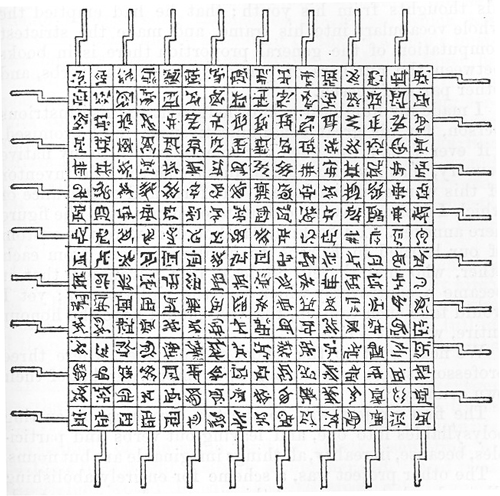
Six hours a day the young students were employed in this labour; and theprofessor showed me several volumes in large folio, already collected, ofbroken sentences, which he intended to piece together, and out of those richmaterials, to give the world a complete body of all arts and sciences; which,however, might be still improved, and much expedited, if the public would raisea fund for making and employing five hundred such frames in Lagado, and obligethe managers to contribute in common their several collections.
He assured me “that this invention had employed all his thoughts from hisyouth; that he had emptied the whole vocabulary into his frame, and made thestrictest computation of the general proportion there is in books between thenumbers of particles, nouns, and verbs, and other parts of speech.”
I made my humblest acknowledgment to this illustrious person, for his greatcommunicativeness; and promised, “if ever I had the good fortune toreturn to my native country, that I would do him justice, as the sole inventorof this wonderful machine;” the form and contrivance of which I desiredleave to delineate on paper, as in the figure here annexed. I told him,“although it were the custom of our learned in Europe to steal inventionsfrom each other, who had thereby at least this advantage, that it became acontroversy which was the right owner; yet I would take such caution, that heshould have the honour entire, without a rival.”
We next went to the school of languages, where three professors sat inconsultation upon improving that of their own country.
The first project was to shorten discourse by cutting polysyllables into one,and leaving out verbs and participles, because, in reality, all thingsimaginable are but nouns.
The other project was, a scheme for entirely abolishing all words whatsoever;and this was urged as a great advantage in point of health, as well as brevity.For it is plain, that every word we speak is, in some degree, a diminution ofour lungs by corrosion, and, consequently, contributes to the shortening of ourlives. An expedient was therefore offered, “that since words are onlynames for things, it would be more convenient for all men to carry aboutthem such things as were necessary to express a particular business they are todiscourse on.” And this invention would certainly have taken place, tothe great ease as well as health of the subject, if the women, in conjunctionwith the vulgar and illiterate, had not threatened to raise a rebellion unlessthey might be allowed the liberty to speak with their tongues, after the mannerof their forefathers; such constant irreconcilable enemies to science are thecommon people. However, many of the most learned and wise adhere to the newscheme of expressing themselves by things; which has only this inconvenienceattending it, that if a man’s business be very great, and of variouskinds, he must be obliged, in proportion, to carry a greater bundle of thingsupon his back, unless he can afford one or two strong servants to attend him. Ihave often beheld two of those sages almost sinking under the weight of theirpacks, like pedlars among us, who, when they met in the street, would lay downtheir loads, open their sacks, and hold conversation for an hour together; thenput up their implements, help each other to resume their burdens, and taketheir leave.
But for short conversations, a man may carry implements in his pockets, andunder his arms, enough to supply him; and in his house, he cannot be at a loss.Therefore the room where company meet who practise this art, is full of allthings, ready at hand, requisite to furnish matter for this kind of artificialconverse.
Another great advantage proposed by this invention was, that it would serve asa universal language, to be understood in all civilised nations, whose goodsand utensils are generally of the same kind, or nearly resembling, so thattheir uses might easily be comprehended. And thus ambassadors would bequalified to treat with foreign princes, or ministers of state, to whosetongues they were utter strangers.
I was at the mathematical school, where the master taught his pupils after amethod scarce imaginable to us in Europe. The proposition, and demonstration,were fairly written on a thin wafer, with ink composed of a cephalic tincture.This, the student was to swallow upon a fasting stomach, and for three daysfollowing, eat nothing but bread and water. As the wafer digested, the tincturemounted to his brain, bearing the proposition along with it. But the successhas not hitherto been answerable, partly by some error in the quantumorcomposition, and partly by the perverseness of lads, to whom this bolus is sonauseous, that they generally steal aside, and discharge it upwards, before itcan operate; neither have they been yet persuaded to use so long an abstinence,as the prescription requires.
CHAPTER VI.
A further account of the academy. The author proposes some improvements, whichare honourably received.
In the school of political projectors, I was but ill entertained; theprofessors appearing, in my judgment, wholly out of their senses, which is ascene that never fails to make me melancholy. These unhappy people wereproposing schemes for persuading monarchs to choose favourites upon the scoreof their wisdom, capacity, and virtue; of teaching ministers to consult thepublic good; of rewarding merit, great abilities, eminent services; ofinstructing princes to know their true interest, by placing it on the samefoundation with that of their people; of choosing for employments personsqualified to exercise them, with many other wild, impossible chimeras, thatnever entered before into the heart of man to conceive; and confirmed in me theold observation, “that there is nothing so extravagant and irrational,which some philosophers have not maintained for truth.”
But, however, I shall so far do justice to this part of the Academy, as toacknowledge that all of them were not so visionary. There was a most ingeniousdoctor, who seemed to be perfectly versed in the whole nature and system ofgovernment. This illustrious person had very usefully employed his studies, infinding out effectual remedies for all diseases and corruptions to which theseveral kinds of public administration are subject, by the vices or infirmitiesof those who govern, as well as by the licentiousness of those who are to obey.For instance: whereas all writers and reasoners have agreed, that there is astrict universal resemblance between the natural and the political body; canthere be any thing more evident, than that the health of both must bepreserved, and the diseases cured, by the same prescriptions? It is allowed,that senates and great councils are often troubled with redundant, ebullient,and other peccant humours; with many diseases of the head, and more of theheart; with strong convulsions, with grievous contractions of the nerves andsinews in both hands, but especially the right; with spleen, flatus, vertigos,and deliriums; with scrofulous tumours, full of fetid purulent matter; withsour frothy ructations: with canine appetites, and crudeness of digestion,besides many others, needless to mention. This doctor therefore proposed,“that upon the meeting of the senate, certain physicians should attend itthe three first days of their sitting, and at the close of each day’sdebate feel the pulses of every senator; after which, having maturelyconsidered and consulted upon the nature of the several maladies, and themethods of cure, they should on the fourth day return to the senate house,attended by their apothecaries stored with proper medicines; and before themembers sat, administer to each of them lenitives, aperitives, abstersives,corrosives, restringents, palliatives, laxatives, cephalalgics, icterics,apophlegmatics, acoustics, as their several cases required; and, according asthese medicines should operate, repeat, alter, or omit them, at the nextmeeting.”
This project could not be of any great expense to the public; and might in mypoor opinion, be of much use for the despatch of business, in those countrieswhere senates have any share in the legislative power; beget unanimity, shortendebates, open a few mouths which are now closed, and close many more which arenow open; curb the petulancy of the young, and correct the positiveness of theold; rouse the stupid, and damp the pert.
Again, because it is a general complaint, that the favourites of princes aretroubled with short and weak memories; the same doctor proposed, “thatwhoever attended a first minister, after having told his business, with theutmost brevity and in the plainest words, should, at his departure, give thesaid minister a tweak by the nose, or a kick in the belly, or tread on hiscorns, or lug him thrice by both ears, or run a pin into his breech; or pinchhis arm black and blue, to prevent forgetfulness; and at every levee day,repeat the same operation, till the business were done, or absolutelyrefused.”
He likewise directed, “that every senator in the great council of anation, after he had delivered his opinion, and argued in the defence of it,should be obliged to give his vote directly contrary; because if that weredone, the result would infallibly terminate in the good of the public.”
When parties in a state are violent, he offered a wonderful contrivance toreconcile them. The method is this: You take a hundred leaders of each party;you dispose them into couples of such whose heads are nearest of a size; thenlet two nice operators saw off the occiput of each couple at the same time, insuch a manner that the brain may be equally divided. Let the occiputs, thus cutoff, be interchanged, applying each to the head of his opposite party-man. Itseems indeed to be a work that requires some exactness, but the professorassured us, “that if it were dexterously performed, the cure would beinfallible.” For he argued thus: “that the two half brains beingleft to debate the matter between themselves within the space of one skull,would soon come to a good understanding, and produce that moderation, as wellas regularity of thinking, so much to be wished for in the heads of those, whoimagine they come into the world only to watch and govern its motion: and as tothe difference of brains, in quantity or quality, among those who are directorsin faction,” the doctor assured us, from his own knowledge, that“it was a perfect trifle.”
I heard a very warm debate between two professors, about the most commodiousand effectual ways and means of raising money, without grieving the subject.The first affirmed, “the justest method would be, to lay a certain taxupon vices and folly; and the sum fixed upon every man to be rated, after thefairest manner, by a jury of his neighbours.” The second was of anopinion directly contrary; “to tax those qualities of body and mind, forwhich men chiefly value themselves; the rate to be more or less, according tothe degrees of excelling; the decision whereof should be left entirely to theirown breast.” The highest tax was upon men who are the greatest favouritesof the other sex, and the assessments, according to the number and nature ofthe favours they have received; for which, they are allowed to be their ownvouchers. Wit, valour, and politeness, were likewise proposed to be largelytaxed, and collected in the same manner, by every person’s giving his ownword for the quantum of what he possessed. But as to honour, justice, wisdom,and learning, they should not be taxed at all; because they are qualificationsof so singular a kind, that no man will either allow them in his neighbour orvalue them in himself.
The women were proposed to be taxed according to their beauty and skill indressing, wherein they had the same privilege with the men, to be determined bytheir own judgment. But constancy, chastity, good sense, and good nature, werenot rated, because they would not bear the charge of collecting.
To keep senators in the interest of the crown, it was proposed that the membersshould raffle for employments; every man first taking an oath, and givingsecurity, that he would vote for the court, whether he won or not; after which,the losers had, in their turn, the liberty of raffling upon the next vacancy.Thus, hope and expectation would be kept alive; none would complain of brokenpromises, but impute their disappointments wholly to fortune, whose shouldersare broader and stronger than those of a ministry.
Another professor showed me a large paper of instructions for discovering plotsand conspiracies against the government. He advised great statesmen to examineinto the diet of all suspected persons; their times of eating; upon which sidethey lay in bed; with which hand they wipe their posteriors; take a strict viewof their excrements, and, from the colour, the odour, the taste, theconsistence, the crudeness or maturity of digestion, form a judgment of theirthoughts and designs; because men are never so serious, thoughtful, and intent,as when they are at stool, which he found by frequent experiment; for, in suchconjunctures, when he used, merely as a trial, to consider which was the bestway of murdering the king, his ordure would have a tincture of green; but quitedifferent, when he thought only of raising an insurrection, or burning themetropolis.
The whole discourse was written with great acuteness, containing manyobservations, both curious and useful for politicians; but, as I conceived, notaltogether complete. This I ventured to tell the author, and offered, if hepleased, to supply him with some additions. He received my proposition withmore compliance than is usual among writers, especially those of the projectingspecies, professing “he would be glad to receive furtherinformation.”
I told him, “that in the kingdom of Tribnia,[454a]by the natives called Langden,[454b]where I had sojourned some time in my travels, the bulk of the people consistin a manner wholly of discoverers, witnesses, informers, accusers, prosecutors,evidences, swearers, together with their several subservient and subalterninstruments, all under the colours, the conduct, and the pay of ministers ofstate, and their deputies. The plots, in that kingdom, are usually theworkmanship of those persons who desire to raise their own characters ofprofound politicians; to restore new vigour to a crazy administration; tostifle or divert general discontents; to fill their coffers with forfeitures;and raise, or sink the opinion of public credit, as either shall best answertheir private advantage. It is first agreed and settled among them, whatsuspected persons shall be accused of a plot; then, effectual care is taken tosecure all their letters and papers, and put the owners in chains. These papersare delivered to a set of artists, very dexterous in finding out the mysteriousmeanings of words, syllables, and letters: for instance, they can discover aclose stool, to signify a privy council; a flock of geese, a senate; a lamedog, an invader; a codshead; a ——; the plague, a standing army; abuzzard, a prime minister; the gout, a high priest; a gibbet, a secretary ofstate; a chamber pot, a committee of grandees; a sieve, a court lady; a broom,a revolution; a mouse-trap, an employment; a bottomless pit, a treasury; asink, a court; a cap and bells, a favourite; a broken reed, a court of justice;an empty tun, a general; a running sore, the administration.[455]
“When this method fails, they have two others more effectual, which thelearned among them call acrostics and anagrams. First, they can decipher allinitial letters into political meanings. Thus N. shall signify a plot;B. a regiment of horse; L. a fleet at sea; or, secondly, bytransposing the letters of the alphabet in any suspected paper, they can layopen the deepest designs of a discontented party. So, for example, if I shouldsay, in a letter to a friend, ‘Our brother Tom has just got thepiles,’ a skilful decipherer would discover, that the same letters whichcompose that sentence, may be analysed into the following words, ‘Resist,a plot is brought home; The tour.’ And this is the anagrammaticmethod.”
The professor made me great acknowledgments for communicating theseobservations, and promised to make honourable mention of me in his treatise.
I saw nothing in this country that could invite me to a longer continuance, andbegan to think of returning home to England.
CHAPTER VII.
The author leaves Lagado: arrives at Maldonada. No ship ready. He takes a shortvoyage to Glubbdubdrib. His reception by the governor.
The continent, of which this kingdom is a part, extends itself, as I have reasonto believe, eastward, to that unknown tract of America westward of California;and north, to the Pacific Ocean, which is not above a hundred and fifty milesfrom Lagado; where there is a good port, and much commerce with the greatisland of Luggnagg, situated to the north-west about 29 degrees north latitude,and 140 longitude. This island of Luggnagg stands south-eastward of Japan,about a hundred leagues distant. There is a strict alliance between theJapanese emperor and the king of Luggnagg; which affords frequent opportunitiesof sailing from one island to the other. I determined therefore to direct mycourse this way, in order to direct my return to Europe. I hired two mules,with a guide, to show me the way, and carry my small baggage. I took leave ofmy noble protector, who had shown me so much favour, and made me a generouspresent at my departure.
My journey was without any accident or adventure worth relating. When I arrivedat the port of Maldonada (for so it is called) there was no ship in the harbourbound for Luggnagg, nor likely to be in some time. The town is about as largeas Portsmouth. I soon fell into some acquaintance, and was very hospitablyreceived. A gentleman of distinction said to me, “that since the shipsbound for Luggnagg could not be ready in less than a month, it might be nodisagreeable amusement for me to take a trip to the little island ofGlubbdubdrib, about five leagues off to the south-west.” He offeredhimself and a friend to accompany me, and that I should be provided with asmall convenient bark for the voyage.
Glubbdubdrib, as nearly as I can interpret the word, signifies the island ofsorcerers or magicians. It is about one third as large as the Isle of Wight,and extremely fruitful: it is governed by the head of a certain tribe, who areall magicians. This tribe marries only among each other, and the eldest insuccession is prince or governor. He has a noble palace, and a park of aboutthree thousand acres, surrounded by a wall of hewn stone twenty feet high. Inthis park are several small enclosures for cattle, corn, and gardening.
The governor and his family are served and attended by domestics of a kindsomewhat unusual. By his skill in necromancy he has a power of calling whom hepleases from the dead, and commanding their service for twenty-four hours, butno longer; nor can he call the same persons up again in less than three months,except upon very extraordinary occasions.
When we arrived at the island, which was about eleven in the morning, one ofthe gentlemen who accompanied me went to the governor, and desired admittancefor a stranger, who came on purpose to have the honour of attending on hishighness. This was immediately granted, and we all three entered the gate ofthe palace between two rows of guards, armed and dressed after a very anticmanner, and with something in their countenances that made my flesh creep witha horror I cannot express. We passed through several apartments, betweenservants of the same sort, ranked on each side as before, till we came to thechamber of presence; where, after three profound obeisances, and a few generalquestions, we were permitted to sit on three stools, near the lowest step ofhis highness’s throne. He understood the language of Balnibarbi, althoughit was different from that of this island. He desired me to give him someaccount of my travels; and, to let me see that I should be treated withoutceremony, he dismissed all his attendants with a turn of his finger; at which,to my great astonishment, they vanished in an instant, like visions in a dreamwhen we awake on a sudden. I could not recover myself in some time, till thegovernor assured me, “that I should receive no hurt;” and observingmy two companions to be under no concern, who had been often entertained in thesame manner, I began to take courage, and related to his highness a shorthistory of my several adventures; yet not without some hesitation, andfrequently looking behind me to the place where I had seen those domesticspectres. I had the honour to dine with the governor, where a new set of ghostsserved up the meat, and waited at table. I now observed myself to be lessterrified than I had been in the morning. I stayed till sunset, but humblydesired his highness to excuse me for not accepting his invitation of lodgingin the palace. My two friends and I lay at a private house in the townadjoining, which is the capital of this little island; and the next morning wereturned to pay our duty to the governor, as he was pleased to command us.
After this manner we continued in the island for ten days, most part of everyday with the governor, and at night in our lodging. I soon grew so familiarizedto the sight of spirits, that after the third or fourth time they gave me noemotion at all: or, if I had any apprehensions left, my curiosity prevailedover them. For his highness the governor ordered me “to call up whateverpersons I would choose to name, and in whatever numbers, among all the deadfrom the beginning of the world to the present time, and command them to answerany questions I should think fit to ask; with this condition, that my questionsmust be confined within the compass of the times they lived in. And one thing Imight depend upon, that they would certainly tell me the truth, for lying was atalent of no use in the lower world.”
I made my humble acknowledgments to his highness for so great a favour. We werein a chamber, from whence there was a fair prospect into the park. And becausemy first inclination was to be entertained with scenes of pomp andmagnificence, I desired to see Alexander the Great at the head of his army,just after the battle of Arbela: which, upon a motion of the governor’sfinger, immediately appeared in a large field, under the window where we stood.Alexander was called up into the room: it was with great difficulty that Iunderstood his Greek, and had but little of my own. He assured me upon hishonour “that he was not poisoned, but died of a bad fever by excessivedrinking.”
Next, I saw Hannibal passing the Alps, who told me “he had not a drop ofvinegar in his camp.”
I saw Cæsar and Pompey at the head of their troops, just ready to engage. I sawthe former, in his last great triumph. I desired that the senate of Rome mightappear before me, in one large chamber, and an assembly of somewhat a later agein counterview, in another. The first seemed to be an assembly of heroes anddemigods; the other, a knot of pedlars, pick-pockets, highwaymen, and bullies.
The governor, at my request, gave the sign for Cæsar and Brutus to advancetowards us. I was struck with a profound veneration at the sight of Brutus, andcould easily discover the most consummate virtue, the greatest intrepidity andfirmness of mind, the truest love of his country, and general benevolence formankind, in every lineament of his countenance. I observed, with much pleasure,that these two persons were in good intelligence with each other; and Cæsarfreely confessed to me, “that the greatest actions of his own life werenot equal, by many degrees, to the glory of taking it away.” I had thehonour to have much conversation with Brutus; and was told, “that hisancestor Junius, Socrates, Epaminondas, Cato the younger, Sir Thomas More, andhimself were perpetually together:” a sextumvirate, to which all the agesof the world cannot add a seventh.
It would be tedious to trouble the reader with relating what vast numbers ofillustrious persons were called up to gratify that insatiable desire I had tosee the world in every period of antiquity placed before me. I chiefly fed myeyes with beholding the destroyers of tyrants and usurpers, and the restorersof liberty to oppressed and injured nations. But it is impossible to expressthe satisfaction I received in my own mind, after such a manner as to make it asuitable entertainment to the reader.
CHAPTER VIII.
A further account of Glubbdubdrib. Ancient and modern history corrected.
Having a desire to see those ancients who were most renowned for wit andlearning, I set apart one day on purpose. I proposed that Homer and Aristotlemight appear at the head of all their commentators; but these were so numerous,that some hundreds were forced to attend in the court, and outward rooms of thepalace. I knew, and could distinguish those two heroes, at first sight, notonly from the crowd, but from each other. Homer was the taller and comelierperson of the two, walked very erect for one of his age, and his eyes were themost quick and piercing I ever beheld. Aristotle stooped much, and made use ofa staff. His visage was meagre, his hair lank and thin, and his voice hollow. Isoon discovered that both of them were perfect strangers to the rest of thecompany, and had never seen or heard of them before; and I had a whisper from aghost who shall be nameless, “that these commentators always kept in themost distant quarters from their principals, in the lower world, through aconsciousness of shame and guilt, because they had so horribly misrepresentedthe meaning of those authors to posterity.” I introduced Didymus andEustathius to Homer, and prevailed on him to treat them better than perhapsthey deserved, for he soon found they wanted a genius to enter into the spiritof a poet. But Aristotle was out of all patience with the account I gave him ofScotus and Ramus, as I presented them to him; and he asked them, “whetherthe rest of the tribe were as great dunces as themselves?”
I then desired the governor to call up Descartes and Gassendi, with whom Iprevailed to explain their systems to Aristotle. This great philosopher freelyacknowledged his own mistakes in natural philosophy, because he proceeded inmany things upon conjecture, as all men must do; and he found that Gassendi,who had made the doctrine of Epicurus as palatable as he could, and thevorticesof Descartes, were equally to be exploded. He predicted thesame fate to attraction, whereof the present learned are such zealousasserters. He said, “that new systems of nature were but new fashions,which would vary in every age; and even those, who pretend to demonstrate themfrom mathematical principles, would flourish but a short period of time, and beout of vogue when that was determined.”
I spent five days in conversing with many others of the ancient learned. I sawmost of the first Roman emperors. I prevailed on the governor to call upHeliogabalus’s cooks to dress us a dinner, but they could not show usmuch of their skill, for want of materials. A helot of Agesilaus made us a dishof Spartan broth, but I was not able to get down a second spoonful.
The two gentlemen, who conducted me to the island, were pressed by theirprivate affairs to return in three days, which I employed in seeing some of themodern dead, who had made the greatest figure, for two or three hundred yearspast, in our own and other countries of Europe; and having been always a greatadmirer of old illustrious families, I desired the governor would call up adozen or two of kings, with their ancestors in order for eight or ninegenerations. But my disappointment was grievous and unexpected. For, instead ofa long train with royal diadems, I saw in one family two fiddlers, three sprucecourtiers, and an Italian prelate. In another, a barber, an abbot, and twocardinals. I have too great a veneration for crowned heads, to dwell any longeron so nice a subject. But as to counts, marquises, dukes, earls, and the like,I was not so scrupulous. And I confess, it was not without some pleasure, thatI found myself able to trace the particular features, by which certain familiesare distinguished, up to their originals. I could plainly discover whence onefamily derives a long chin; why a second has abounded with knaves for twogenerations, and fools for two more; why a third happened to be crack-brained,and a fourth to be sharpers; whence it came, what Polydore Virgil says of acertain great house, Nec vir fortis, nec femina casta; howcruelty, falsehood, and cowardice, grew to be characteristics by which certainfamilies are distinguished as much as by their coats of arms; who first broughtthe pox into a noble house, which has lineally descended scrofulous tumours totheir posterity. Neither could I wonder at all this, when I saw such aninterruption of lineages, by pages, lackeys, valets, coachmen, gamesters,fiddlers, players, captains, and pickpockets.
I was chiefly disgusted with modern history. For having strictly examined allthe persons of greatest name in the courts of princes, for a hundred yearspast, I found how the world had been misled by prostitute writers, to ascribethe greatest exploits in war, to cowards; the wisest counsel, to fools;sincerity, to flatterers; Roman virtue, to betrayers of their country; piety,to atheists; chastity, to sodomites; truth, to informers: how many innocent andexcellent persons had been condemned to death or banishment by the practisingof great ministers upon the corruption of judges, and the malice of factions:how many villains had been exalted to the highest places of trust, power,dignity, and profit: how great a share in the motions and events of courts,councils, and senates might be challenged by bawds, whores, pimps, parasites,and buffoons. How low an opinion I had of human wisdom and integrity, when Iwas truly informed of the springs and motives of great enterprises andrevolutions in the world, and of the contemptible accidents to which they owedtheir success.
Here I discovered the roguery and ignorance of those who pretend to writeanecdotes, or secret history; who send so many kings to their graves with a cupof poison; will repeat the discourse between a prince and chief minister, whereno witness was by; unlock the thoughts and cabinets of ambassadors andsecretaries of state; and have the perpetual misfortune to be mistaken. Here Idiscovered the true causes of many great events that have surprised the world;how a whore can govern the back-stairs, the back-stairs a council, and thecouncil a senate. A general confessed, in my presence, “that he got avictory purely by the force of cowardice and ill conduct;” and anadmiral, “that, for want of proper intelligence, he beat the enemy, towhom he intended to betray the fleet.” Three kings protested to me,“that in their whole reigns they never did once prefer any person ofmerit, unless by mistake, or treachery of some minister in whom they confided;neither would they do it if they were to live again:” and they showed,with great strength of reason, “that the royal throne could not besupported without corruption, because that positive, confident, restiff temper,which virtue infused into a man, was a perpetual clog to publicbusiness.”
I had the curiosity to inquire in a particular manner, by what methods greatnumbers had procured to themselves high titles of honour, and prodigiousestates; and I confined my inquiry to a very modern period: however, withoutgrating upon present times, because I would be sure to give no offence even toforeigners (for I hope the reader need not be told, that I do not in the leastintend my own country, in what I say upon this occasion,) a great number ofpersons concerned were called up; and, upon a very slight examination,discovered such a scene of infamy, that I cannot reflect upon it without someseriousness. Perjury, oppression, subornation, fraud, pandarism, and the likeinfirmities, were among the most excusable arts they had to mention; and forthese I gave, as it was reasonable, great allowance. But when some confessedthey owed their greatness and wealth to sodomy, or incest; others, to theprostituting of their own wives and daughters; others, to the betraying oftheir country or their prince; some, to poisoning; more to the perverting ofjustice, in order to destroy the innocent, I hope I may be pardoned, if thesediscoveries inclined me a little to abate of that profound veneration, which Iam naturally apt to pay to persons of high rank, who ought to be treated withthe utmost respect due to their sublime dignity, by us their inferiors.
I had often read of some great services done to princes and states, and desiredto see the persons by whom those services were performed. Upon inquiry I wastold, “that their names were to be found on no record, except a few ofthem, whom history has represented as the vilest of rogues and traitors.”As to the rest, I had never once heard of them. They all appeared with dejectedlooks, and in the meanest habit; most of them telling me, “they died inpoverty and disgrace, and the rest on a scaffold or a gibbet.”
Among others, there was one person, whose case appeared a little singular. Hehad a youth about eighteen years old standing by his side. He told me,“he had for many years been commander of a ship; and in the sea fight atActium had the good fortune to break through the enemy’s great line ofbattle, sink three of their capital ships, and take a fourth, which was thesole cause of Antony’s flight, and of the victory that ensued; that theyouth standing by him, his only son, was killed in the action.” He added,“that upon the confidence of some merit, the war being at an end, he wentto Rome, and solicited at the court of Augustus to be preferred to a greatership, whose commander had been killed; but, without any regard to hispretensions, it was given to a boy who had never seen the sea, the son ofLibertina, who waited on one of the emperor’s mistresses. Returning backto his own vessel, he was charged with neglect of duty, and the ship given to afavourite page of Publicola, the vice-admiral; whereupon he retired to a poorfarm at a great distance from Rome, and there ended his life.” I was socurious to know the truth of this story, that I desired Agrippa might becalled, who was admiral in that fight. He appeared, and confirmed the wholeaccount: but with much more advantage to the captain, whose modesty hadextenuated or concealed a great part of his merit.
I was surprised to find corruption grown so high and so quick in that empire,by the force of luxury so lately introduced; which made me less wonder at manyparallel cases in other countries, where vices of all kinds have reigned somuch longer, and where the whole praise, as well as pillage, has been engrossedby the chief commander, who perhaps had the least title to either.
As every person called up made exactly the same appearance he had done in theworld, it gave me melancholy reflections to observe how much the race ofhumankind was degenerated among us within these hundred years past; how thepox, under all its consequences and denominations had altered every lineamentof an English countenance; shortened the size of bodies, unbraced the nerves,relaxed the sinews and muscles, introduced a sallow complexion, and renderedthe flesh loose and rancid.
I descended so low, as to desire some English yeoman of the old stamp might besummoned to appear; once so famous for the simplicity of their manners, diet,and dress; for justice in their dealings; for their true spirit of liberty; fortheir valour, and love of their country. Neither could I be wholly unmoved,after comparing the living with the dead, when I considered how all these purenative virtues were prostituted for a piece of money by their grand-children;who, in selling their votes and managing at elections, have acquired every viceand corruption that can possibly be learned in a court.
CHAPTER IX.
The author returns to Maldonada. Sails to the kingdom of Luggnagg. The authorconfined. He is sent for to court. The manner of his admittance. Theking’s great lenity to his subjects.
The day of our departure being come, I took leave of his highness, the Governorof Glubbdubdrib, and returned with my two companions to Maldonada, where, aftera fortnight’s waiting, a ship was ready to sail for Luggnagg. The twogentlemen, and some others, were so generous and kind as to furnish me withprovisions, and see me on board. I was a month in this voyage. We had oneviolent storm, and were under a necessity of steering westward to get into thetrade wind, which holds for above sixty leagues. On the 21st of April, 1708, wesailed into the river of Clumegnig, which is a seaport town, at the south-eastpoint of Luggnagg. We cast anchor within a league of the town, and made asignal for a pilot. Two of them came on board in less than half an hour, bywhom we were guided between certain shoals and rocks, which are very dangerousin the passage, to a large basin, where a fleet may ride in safety within acable’s length of the town-wall.
Some of our sailors, whether out of treachery or inadvertence, had informed thepilots “that I was a stranger, and great traveller;” whereof thesegave notice to a custom-house officer, by whom I was examined very strictlyupon my landing. This officer spoke to me in the language of Balnibarbi, which,by the force of much commerce, is generally understood in that town, especiallyby seamen and those employed in the customs. I gave him a short account of someparticulars, and made my story as plausible and consistent as I could; but Ithought it necessary to disguise my country, and call myself a Hollander;because my intentions were for Japan, and I knew the Dutch were the onlyEuropeans permitted to enter into that kingdom. I therefore told the officer,“that having been shipwrecked on the coast of Balnibarbi, and cast on arock, I was received up into Laputa, or the flying island (of which he hadoften heard), and was now endeavouring to get to Japan, whence I might find aconvenience of returning to my own country.” The officer said, “Imust be confined till he could receive orders from court, for which he wouldwrite immediately, and hoped to receive an answer in a fortnight.” I wascarried to a convenient lodging with a sentry placed at the door; however, Ihad the liberty of a large garden, and was treated with humanity enough, beingmaintained all the time at the king’s charge. I was invited by severalpersons, chiefly out of curiosity, because it was reported that I came fromcountries very remote, of which they had never heard.
I hired a young man, who came in the same ship, to be an interpreter; he was anative of Luggnagg, but had lived some years at Maldonada, and was a perfectmaster of both languages. By his assistance, I was able to hold a conversationwith those who came to visit me; but this consisted only of their questions,and my answers.
The despatch came from court about the time we expected. It contained a warrantfor conducting me and my retinue to Traldragdubh, or Trildrogdrib(for it is pronounced both ways as near as I can remember), by a party of tenhorse. All my retinue was that poor lad for an interpreter, whom I persuadedinto my service, and, at my humble request, we had each of us a mule to rideon. A messenger was despatched half a day’s journey before us, to givethe king notice of my approach, and to desire, “that his majesty wouldplease to appoint a day and hour, when it would by his gracious pleasure that Imight have the honour to lick the dust before his footstool.” This is thecourt style, and I found it to be more than matter of form: for, upon myadmittance two days after my arrival, I was commanded to crawl upon my belly,and lick the floor as I advanced; but, on account of my being a stranger, carewas taken to have it made so clean, that the dust was not offensive. However,this was a peculiar grace, not allowed to any but persons of the highest rank,when they desire an admittance. Nay, sometimes the floor is strewed with duston purpose, when the person to be admitted happens to have powerful enemies atcourt; and I have seen a great lord with his mouth so crammed, that when he hadcrept to the proper distance from the throne; he was not able to speak a word.Neither is there any remedy; because it is capital for those who receive anaudience to spit or wipe their mouths in his majesty’s presence. There isindeed another custom, which I cannot altogether approve of: when the king hasa mind to put any of his nobles to death in a gentle indulgent manner, hecommands the floor to be strewed with a certain brown powder of a deadlycomposition, which being licked up, infallibly kills him in twenty-four hours.But in justice to this prince’s great clemency, and the care he has ofhis subjects’ lives (wherein it were much to be wished that the Monarchsof Europe would imitate him), it must be mentioned for his honour, that strictorders are given to have the infected parts of the floor well washed afterevery such execution, which, if his domestics neglect, they are in danger ofincurring his royal displeasure. I myself heard him give directions, that oneof his pages should be whipped, whose turn it was to give notice about washingthe floor after an execution, but maliciously had omitted it; by which neglecta young lord of great hopes, coming to an audience, was unfortunately poisoned,although the king at that time had no design against his life. But this goodprince was so gracious as to forgive the poor page his whipping, upon promisethat he would do so no more, without special orders.
To return from this digression. When I had crept within four yards of thethrone, I raised myself gently upon my knees, and then striking my foreheadseven times against the ground, I pronounced the following words, as they hadbeen taught me the night before, Ickpling gloffthrobb squutserumm blhiopmlashnalt zwin tnodbalkguffh slhiophad gurdlubh asht. This is thecompliment, established by the laws of the land, for all persons admitted tothe king’s presence. It may be rendered into English thus: “Mayyour celestial majesty outlive the sun, eleven moons and a half!” To thisthe king returned some answer, which, although I could not understand, yet Ireplied as I had been directed: Fluft drin yalerick dwuldom prastradmirpush, which properly signifies, “My tongue is in the mouth of myfriend;” and by this expression was meant, that I desired leave to bringmy interpreter; whereupon the young man already mentioned was accordinglyintroduced, by whose intervention I answered as many questions as his majestycould put in above an hour. I spoke in the Balnibarbian tongue, and myinterpreter delivered my meaning in that of Luggnagg.
The king was much delighted with my company, and ordered hisbliffmarklub, or high-chamberlain, to appoint a lodging in the court forme and my interpreter; with a daily allowance for my table, and a large purseof gold for my common expenses.
I staid three months in this country, out of perfect obedience to his majesty;who was pleased highly to favour me, and made me very honourable offers. But Ithought it more consistent with prudence and justice to pass the remainder ofmy days with my wife and family.
CHAPTER X.
The Luggnaggians commended. A particular description of the Struldbrugs, withmany conversations between the author and some eminent persons upon thatsubject.
The Luggnaggians are a polite and generous people; and although they are notwithout some share of that pride which is peculiar to all Eastern countries,yet they show themselves courteous to strangers, especially such who arecountenanced by the court. I had many acquaintance, and among persons of thebest fashion; and being always attended by my interpreter, the conversation wehad was not disagreeable.
One day, in much good company, I was asked by a person of quality,“whether I had seen any of their struldbrugs, or immortals?”I said, “I had not;” and desired he would explain to me “whathe meant by such an appellation, applied to a mortal creature.” He toldme “that sometimes, though very rarely, a child happened to be born in afamily, with a red circular spot in the forehead, directly over the lefteyebrow, which was an infallible mark that it should never die.” Thespot, as he described it, “was about the compass of a silver threepence,but in the course of time grew larger, and changed its colour; for at twelveyears old it became green, so continued till five and twenty, then turned to adeep blue: at five and forty it grew coal black, and as large as an Englishshilling; but never admitted any further alteration.” He said,“these births were so rare, that he did not believe there could be aboveeleven hundred struldbrugs, of both sexes, in the whole kingdom; of which hecomputed about fifty in the metropolis, and, among the rest, a young girl bornabout three years ago: that these productions were not peculiar to any family,but a mere effect of chance; and the children of the struldbrugsthemselves were equally mortal with the rest of the people.”
I freely own myself to have been struck with inexpressible delight, uponhearing this account: and the person who gave it me happening to understand theBalnibarbian language, which I spoke very well, I could not forbear breakingout into expressions, perhaps a little too extravagant. I cried out, as in arapture, “Happy nation, where every child hath at least a chance forbeing immortal! Happy people, who enjoy so many living examples of ancientvirtue, and have masters ready to instruct them in the wisdom of all formerages! but happiest, beyond all comparison, are those excellentstruldbrugs, who, being born exempt from that universal calamity ofhuman nature, have their minds free and disengaged, without the weight anddepression of spirits caused by the continual apprehensions of death!” Idiscovered my admiration, “that I had not observed any of theseillustrious persons at court; the black spot on the forehead being soremarkable a distinction, that I could not have easily overlooked it: and itwas impossible that his majesty, a most judicious prince, should not providehimself with a good number of such wise and able counsellors. Yet perhaps thevirtue of those reverend sages was too strict for the corrupt and libertinemanners of a court: and we often find by experience, that young men are tooopinionated and volatile to be guided by the sober dictates of their seniors.However, since the king was pleased to allow me access to his royal person, Iwas resolved, upon the very first occasion, to deliver my opinion to him onthis matter freely and at large, by the help of my interpreter; and whether hewould please to take my advice or not, yet in one thing I was determined, thathis majesty having frequently offered me an establishment in this country, Iwould, with great thankfulness, accept the favour, and pass my life here in theconversation of those superior beings the struldbrugs, if they wouldplease to admit me.”
The gentleman to whom I addressed my discourse, because (as I have alreadyobserved) he spoke the language of Balnibarbi, said to me, with a sort of asmile which usually arises from pity to the ignorant, “that he was gladof any occasion to keep me among them, and desired my permission to explain tothe company what I had spoke.” He did so, and they talked together forsome time in their own language, whereof I understood not a syllable, neithercould I observe by their countenances, what impression my discourse had made onthem. After a short silence, the same person told me, “that his friendsand mine (so he thought fit to express himself) were very much pleased with thejudicious remarks I had made on the great happiness and advantages of immortallife, and they were desirous to know, in a particular manner, what scheme ofliving I should have formed to myself, if it had fallen to my lot to have beenborn a struldbrug.”
I answered, “it was easy to be eloquent on so copious and delightful asubject, especially to me, who had been often apt to amuse myself with visionsof what I should do, if I were a king, a general, or a great lord: and uponthis very case, I had frequently run over the whole system how I should employmyself, and pass the time, if I were sure to live for ever.
“That, if it had been my good fortune to come into the world astruldbrug, as soon as I could discover my own happiness, byunderstanding the difference between life and death, I would first resolve, byall arts and methods, whatsoever, to procure myself riches. In the pursuit ofwhich, by thrift and management, I might reasonably expect, in about twohundred years, to be the wealthiest man in the kingdom. In the second place, Iwould, from my earliest youth, apply myself to the study of arts and sciences,by which I should arrive in time to excel all others in learning. Lastly, Iwould carefully record every action and event of consequence, that happened inthe public, impartially draw the characters of the several successions ofprinces and great ministers of state, with my own observations on every point.I would exactly set down the several changes in customs, language, fashions ofdress, diet, and diversions. By all which acquirements, I should be a livingtreasure of knowledge and wisdom, and certainly become the oracle of thenation.
“I would never marry after threescore, but live in a hospitable manner,yet still on the saving side. I would entertain myself in forming and directingthe minds of hopeful young men, by convincing them, from my own remembrance,experience, and observation, fortified by numerous examples, of the usefulnessof virtue in public and private life. But my choice and constant companionsshould be a set of my own immortal brotherhood; among whom, I would elect adozen from the most ancient, down to my own contemporaries. Where any of thesewanted fortunes, I would provide them with convenient lodges round my ownestate, and have some of them always at my table; only mingling a few of themost valuable among you mortals, whom length of time would harden me to losewith little or no reluctance, and treat your posterity after the same manner;just as a man diverts himself with the annual succession of pinks and tulips inhis garden, without regretting the loss of those which withered the precedingyear.
“These struldbrugsand I would mutually communicate ourobservations and memorials, through the course of time; remark the severalgradations by which corruption steals into the world, and oppose it in everystep, by giving perpetual warning and instruction to mankind; which, added tothe strong influence of our own example, would probably prevent that continualdegeneracy of human nature so justly complained of in all ages.
“Add to this, the pleasure of seeing the various revolutions of statesand empires; the changes in the lower and upper world; ancient cities in ruins,and obscure villages become the seats of kings; famous rivers lessening intoshallow brooks; the ocean leaving one coast dry, and overwhelming another; thediscovery of many countries yet unknown; barbarity overrunning the politestnations, and the most barbarous become civilized. I should then see thediscovery of the longitude, the perpetual motion, the universal medicine, andmany other great inventions, brought to the utmost perfection.
“What wonderful discoveries should we make in astronomy, by outliving andconfirming our own predictions; by observing the progress and return of comets,with the changes of motion in the sun, moon, and stars!”
I enlarged upon many other topics, which the natural desire of endless life,and sublunary happiness, could easily furnish me with. When I had ended, andthe sum of my discourse had been interpreted, as before, to the rest of thecompany, there was a good deal of talk among them in the language of thecountry, not without some laughter at my expense. At last, the same gentlemanwho had been my interpreter, said, “he was desired by the rest to set meright in a few mistakes, which I had fallen into through the common imbecilityof human nature, and upon that allowance was less answerable for them. Thatthis breed of struldbrugswas peculiar to their country, for there wereno such people either in Balnibarbi or Japan, where he had the honour to beambassador from his majesty, and found the natives in both those kingdoms veryhard to believe that the fact was possible: and it appeared from myastonishment when he first mentioned the matter to me, that I received it as athing wholly new, and scarcely to be credited. That in the two kingdoms abovementioned, where, during his residence, he had conversed very much, he observedlong life to be the universal desire and wish of mankind. That whoever had onefoot in the grave was sure to hold back the other as strongly as he could. Thatthe oldest had still hopes of living one day longer, and looked on death as thegreatest evil, from which nature always prompted him to retreat. Only in thisisland of Luggnagg the appetite for living was not so eager, from the continualexample of the struldbrugsbefore their eyes.
“That the system of living contrived by me, was unreasonable and unjust;because it supposed a perpetuity of youth, health, and vigour, which no mancould be so foolish to hope, however extravagant he may be in his wishes. Thatthe question therefore was not, whether a man would choose to be always in theprime of youth, attended with prosperity and health; but how he would pass aperpetual life under all the usual disadvantages which old age brings alongwith it. For although few men will avow their desires of being immortal, uponsuch hard conditions, yet in the two kingdoms before mentioned, of Balnibarbiand Japan, he observed that every man desired to put off death some timelonger, let it approach ever so late: and he rarely heard of any man who diedwillingly, except he were incited by the extremity of grief or torture. And heappealed to me, whether in those countries I had travelled, as well as my own,I had not observed the same general disposition.”
After this preface, he gave me a particular account of the struldbrugsamong them. He said, “they commonly acted like mortals till about thirtyyears old; after which, by degrees, they grew melancholy and dejected,increasing in both till they came to fourscore. This he learned from their ownconfession: for otherwise, there not being above two or three of that speciesborn in an age, they were too few to form a general observation by. When theycame to fourscore years, which is reckoned the extremity of living in thiscountry, they had not only all the follies and infirmities of other old men,but many more which arose from the dreadful prospect of never dying. They werenot only opinionative, peevish, covetous, morose, vain, talkative, butincapable of friendship, and dead to all natural affection, which neverdescended below their grandchildren. Envy and impotent desires are theirprevailing passions. But those objects against which their envy seemsprincipally directed, are the vices of the younger sort and the deaths of theold. By reflecting on the former, they find themselves cut off from allpossibility of pleasure; and whenever they see a funeral, they lament andrepine that others have gone to a harbour of rest to which they themselvesnever can hope to arrive. They have no remembrance of anything but what theylearned and observed in their youth and middle-age, and even that is veryimperfect; and for the truth or particulars of any fact, it is safer to dependon common tradition, than upon their best recollections. The least miserableamong them appear to be those who turn to dotage, and entirely lose theirmemories; these meet with more pity and assistance, because they want many badqualities which abound in others.
“If a struldbrughappen to marry one of his own kind, the marriageis dissolved of course, by the courtesy of the kingdom, as soon as the youngerof the two comes to be fourscore; for the law thinks it a reasonableindulgence, that those who are condemned, without any fault of their own, to aperpetual continuance in the world, should not have their misery doubled by theload of a wife.
“As soon as they have completed the term of eighty years, they are lookedon as dead in law; their heirs immediately succeed to their estates; only asmall pittance is reserved for their support; and the poor ones are maintainedat the public charge. After that period, they are held incapable of anyemployment of trust or profit; they cannot purchase lands, or take leases;neither are they allowed to be witnesses in any cause, either civil orcriminal, not even for the decision of meers and bounds.
“At ninety, they lose their teeth and hair; they have at that age nodistinction of taste, but eat and drink whatever they can get, without relishor appetite. The diseases they were subject to still continue, withoutincreasing or diminishing. In talking, they forget the common appellation ofthings, and the names of persons, even of those who are their nearest friendsand relations. For the same reason, they never can amuse themselves withreading, because their memory will not serve to carry them from the beginningof a sentence to the end; and by this defect, they are deprived of the onlyentertainment whereof they might otherwise be capable.
“The language of this country being always upon the flux, thestruldbrugsof one age do not understand those of another; neither arethey able, after two hundred years, to hold any conversation (farther than by afew general words) with their neighbours the mortals; and thus they lie underthe disadvantage of living like foreigners in their own country.”
This was the account given me of the struldbrugs, as near as I canremember. I afterwards saw five or six of different ages, the youngest notabove two hundred years old, who were brought to me at several times by some ofmy friends; but although they were told, “that I was a great traveller,and had seen all the world,” they had not the least curiosity to ask me aquestion; only desired “I would give them slumskudask,” or atoken of remembrance; which is a modest way of begging, to avoid the law, thatstrictly forbids it, because they are provided for by the public, althoughindeed with a very scanty allowance.
They are despised and hated by all sorts of people. When one of them is born,it is reckoned ominous, and their birth is recorded very particularly so thatyou may know their age by consulting the register, which, however, has not beenkept above a thousand years past, or at least has been destroyed by time orpublic disturbances. But the usual way of computing how old they are, is byasking them what kings or great persons they can remember, and then consultinghistory; for infallibly the last prince in their mind did not begin his reignafter they were fourscore years old.
They were the most mortifying sight I ever beheld; and the women more horriblethan the men. Besides the usual deformities in extreme old age, they acquiredan additional ghastliness, in proportion to their number of years, which is notto be described; and among half a dozen, I soon distinguished which was theeldest, although there was not above a century or two between them.
The reader will easily believe, that from what I had heard and seen, my keenappetite for perpetuity of life was much abated. I grew heartily ashamed of thepleasing visions I had formed; and thought no tyrant could invent a death intowhich I would not run with pleasure, from such a life. The king heard of allthat had passed between me and my friends upon this occasion, and rallied mevery pleasantly; wishing I could send a couple of struldbrugsto my owncountry, to arm our people against the fear of death; but this, it seems, isforbidden by the fundamental laws of the kingdom, or else I should have beenwell content with the trouble and expense of transporting them.
I could not but agree, that the laws of this kingdom relative to thestruldbrugswere founded upon the strongest reasons, and such as anyother country would be under the necessity of enacting, in the likecircumstances. Otherwise, as avarice is the necessary consequence of old age,those immortals would in time become proprietors of the whole nation, andengross the civil power, which, for want of abilities to manage, must end inthe ruin of the public.
CHAPTER XI.
The author leaves Luggnagg, and sails to Japan. From thence he returns in aDutch ship to Amsterdam, and from Amsterdam to England.
I thought this account of the struldbrugsmight be some entertainment tothe reader, because it seems to be a little out of the common way; at least Ido not remember to have met the like in any book of travels that has come to myhands; and if I am deceived, my excuse must be, that it is necessary fortravellers who describe the same country, very often to agree in dwelling onthe same particulars, without deserving the censure of having borrowed ortranscribed from those who wrote before them.
There is indeed a perpetual commerce between this kingdom and the great empireof Japan; and it is very probable, that the Japanese authors may have givensome account of the struldbrugs; but my stay in Japan was so short, andI was so entirely a stranger to the language, that I was not qualified to makeany inquiries. But I hope the Dutch, upon this notice, will be curious and ableenough to supply my defects.
His majesty having often pressed me to accept some employment in his court, andfinding me absolutely determined to return to my native country, was pleased togive me his license to depart; and honoured me with a letter of recommendation,under his own hand, to the Emperor of Japan. He likewise presented me with fourhundred and forty-four large pieces of gold (this nation delighting in evennumbers), and a red diamond, which I sold in England for eleven hundred pounds.
On the 6th day of May, 1709, I took a solemn leave of his majesty, and all myfriends. This prince was so gracious as to order a guard to conduct me toGlanguenstald, which is a royal port to the south-west part of the island. Insix days I found a vessel ready to carry me to Japan, and spent fifteen days inthe voyage. We landed at a small port-town called Xamoschi, situated on thesouth-east part of Japan; the town lies on the western point, where there is anarrow strait leading northward into a long arm of the sea, upon the north-westpart of which, Yedo, the metropolis, stands. At landing, I showed thecustom-house officers my letter from the king of Luggnagg to his imperialmajesty. They knew the seal perfectly well; it was as broad as the palm of myhand. The impression was, A king lifting up a lame beggar from theearth. The magistrates of the town, hearing of my letter, received me as apublic minister. They provided me with carriages and servants, and bore mycharges to Yedo; where I was admitted to an audience, and delivered my letter,which was opened with great ceremony, and explained to the Emperor by aninterpreter, who then gave me notice, by his majesty’s order, “thatI should signify my request, and, whatever it were, it should be granted, forthe sake of his royal brother of Luggnagg.” This interpreter was a personemployed to transact affairs with the Hollanders. He soon conjectured, by mycountenance, that I was a European, and therefore repeated his majesty’scommands in Low Dutch, which he spoke perfectly well. I answered, as I hadbefore determined, “that I was a Dutch merchant, shipwrecked in a veryremote country, whence I had travelled by sea and land to Luggnagg, and thentook shipping for Japan; where I knew my countrymen often traded, and with someof these I hoped to get an opportunity of returning into Europe: I thereforemost humbly entreated his royal favour, to give order that I should beconducted in safety to Nangasac.” To this I added another petition,“that for the sake of my patron the king of Luggnagg, his majesty wouldcondescend to excuse my performing the ceremony imposed on my countrymen, oftrampling upon the crucifix, because I had been thrown into his kingdom by mymisfortunes, without any intention of trading.” When this latter petitionwas interpreted to the Emperor, he seemed a little surprised; and said,“he believed I was the first of my countrymen who ever made any scruplein this point; and that he began to doubt, whether I was a real Hollander, ornot; but rather suspected I must be a Christian. However, for the reasons I hadoffered, but chiefly to gratify the king of Luggnagg by an uncommon mark of hisfavour, he would comply with the singularity of my humour; but the affair mustbe managed with dexterity, and his officers should be commanded to let me pass,as it were by forgetfulness. For he assured me, that if the secret should bediscovered by my countrymen the Dutch, they would cut my throat in thevoyage.” I returned my thanks, by the interpreter, for so unusual afavour; and some troops being at that time on their march to Nangasac, thecommanding officer had orders to convey me safe thither, with particularinstructions about the business of the crucifix.
On the 9th day of June, 1709, I arrived at Nangasac, after a very long andtroublesome journey. I soon fell into the company of some Dutch sailorsbelonging to the Amboyna, of Amsterdam, a stout ship of 450 tons. I had livedlong in Holland, pursuing my studies at Leyden, and I spoke Dutch well. Theseamen soon knew from whence I came last: they were curious to inquire into myvoyages and course of life. I made up a story as short and probable as I could,but concealed the greatest part. I knew many persons in Holland. I was able toinvent names for my parents, whom I pretended to be obscure people in theprovince of Gelderland. I would have given the captain (one Theodorus Vangrult)what he pleased to ask for my voyage to Holland; but understanding I was asurgeon, he was contented to take half the usual rate, on condition that Iwould serve him in the way of my calling. Before we took shipping, I was oftenasked by some of the crew, whether I had performed the ceremony abovementioned. I evaded the question by general answers; “that I hadsatisfied the Emperor and court in all particulars.” However, a maliciousrogue of a skipper went to an officer, and pointing to me, told him, “Ihad not yet trampled on the crucifix;” but the other, who had receivedinstructions to let me pass, gave the rascal twenty strokes on the shoulderswith a bamboo; after which I was no more troubled with such questions.
Nothing happened worth mentioning in this voyage. We sailed with a fair wind tothe Cape of Good Hope, where we staid only to take in fresh water. On the 10thof April, 1710, we arrived safe at Amsterdam, having lost only three men bysickness in the voyage, and a fourth, who fell from the foremast into the sea,not far from the coast of Guinea. From Amsterdam I soon after set sail forEngland, in a small vessel belonging to that city.
On the 16th of April, 1710, we put in at the Downs. I landed next morning, andsaw once more my native country, after an absence of five years and six monthscomplete. I went straight to Redriff, where I arrived the same day at two inthe afternoon, and found my wife and family in good health.
PART IV. A VOYAGE TO THE COUNTRY OF THEHOUYHNHNMS.
CHAPTER I.
The author sets out as captain of a ship. His men conspire against him, confinehim a long time to his cabin, and set him on shore in an unknown land. Hetravels up into the country. The Yahoos, a strange sort of animal, described.The author meets two Houyhnhnms.
I continued at home with my wife and children about five months in a very happycondition, if I could have learned the lesson of knowing when I was well. Ileft my poor wife big with child, and accepted an advantageous offer made me tobe captain of the Adventurer, a stout merchantman of 350 tons: for I understoodnavigation well, and being grown weary of a surgeon’s employment at sea,which, however, I could exercise upon occasion, I took a skilful young man ofthat calling, one Robert Purefoy, into my ship. We set sail from Portsmouthupon the 7th day of August, 1710; on the 14th we met with Captain Pocock, ofBristol, at Teneriffe, who was going to the bay of Campechy to cut logwood. Onthe 16th, he was parted from us by a storm; I heard since my return, that hisship foundered, and none escaped but one cabin boy. He was an honest man, and agood sailor, but a little too positive in his own opinions, which was the causeof his destruction, as it has been with several others; for if he had followedmy advice, he might have been safe at home with his family at this time, aswell as myself.
I had several men who died in my ship of calentures, so that I was forced toget recruits out of Barbadoes and the Leeward Islands, where I touched, by thedirection of the merchants who employed me; which I had soon too much cause torepent: for I found afterwards, that most of them had been buccaneers. I hadfifty hands on board; and my orders were, that I should trade with the Indiansin the South-Sea, and make what discoveries I could. These rogues, whom I hadpicked up, debauched my other men, and they all formed a conspiracy to seizethe ship, and secure me; which they did one morning, rushing into my cabin, andbinding me hand and foot, threatening to throw me overboard, if I offered tostir. I told them, “I was their prisoner, and would submit.” Thisthey made me swear to do, and then they unbound me, only fastening one of mylegs with a chain, near my bed, and placed a sentry at my door with his piececharged, who was commanded to shoot me dead if I attempted my liberty. Theysent me down victuals and drink, and took the government of the ship tothemselves. Their design was to turn pirates, and plunder the Spaniards, whichthey could not do till they got more men. But first they resolved to sell thegoods in the ship, and then go to Madagascar for recruits, several among themhaving died since my confinement. They sailed many weeks, and traded with theIndians; but I knew not what course they took, being kept a close prisoner inmy cabin, and expecting nothing less than to be murdered, as they oftenthreatened me.
Upon the 9th day of May, 1711, one James Welch came down to my cabin, and said,“he had orders from the captain to set me ashore.” I expostulatedwith him, but in vain; neither would he so much as tell me who their newcaptain was. They forced me into the long-boat, letting me put on my best suitof clothes, which were as good as new, and take a small bundle of linen, but noarms, except my hanger; and they were so civil as not to search my pockets,into which I conveyed what money I had, with some other little necessaries.They rowed about a league, and then set me down on a strand. I desired them totell me what country it was. They all swore, “they knew no more thanmyself;” but said, “that the captain” (as they called him)“was resolved, after they had sold the lading, to get rid of me in thefirst place where they could discover land.” They pushed off immediately,advising me to make haste for fear of being overtaken by the tide, and so bademe farewell.
In this desolate condition I advanced forward, and soon got upon firm ground,where I sat down on a bank to rest myself, and consider what I had best do.When I was a little refreshed, I went up into the country, resolving to delivermyself to the first savages I should meet, and purchase my life from them bysome bracelets, glass rings, and other toys, which sailors usually providethemselves with in those voyages, and whereof I had some about me. The land wasdivided by long rows of trees, not regularly planted, but naturally growing;there was great plenty of grass, and several fields of oats. I walked verycircumspectly, for fear of being surprised, or suddenly shot with an arrow frombehind, or on either side. I fell into a beaten road, where I saw many tractsof human feet, and some of cows, but most of horses. At last I beheld severalanimals in a field, and one or two of the same kind sitting in trees. Theirshape was very singular and deformed, which a little discomposed me, so that Ilay down behind a thicket to observe them better. Some of them coming forwardnear the place where I lay, gave me an opportunity of distinctly marking theirform. Their heads and breasts were covered with a thick hair, some frizzled,and others lank; they had beards like goats, and a long ridge of hair downtheir backs, and the fore parts of their legs and feet; but the rest of theirbodies was bare, so that I might see their skins, which were of a brown buffcolour. They had no tails, nor any hair at all on their buttocks, except aboutthe anus, which, I presume, nature had placed there to defend them as they saton the ground, for this posture they used, as well as lying down, and oftenstood on their hind feet. They climbed high trees as nimbly as a squirrel, forthey had strong extended claws before and behind, terminating in sharp points,and hooked. They would often spring, and bound, and leap, with prodigiousagility. The females were not so large as the males; they had long lank hair ontheir heads, but none on their faces, nor any thing more than a sort of down onthe rest of their bodies, except about the anus and pudenda. The dugs hungbetween their forefeet, and often reached almost to the ground as they walked.The hair of both sexes was of several colours, brown, red, black, and yellow.Upon the whole, I never beheld, in all my travels, so disagreeable an animal,or one against which I naturally conceived so strong an antipathy. So that,thinking I had seen enough, full of contempt and aversion, I got up, andpursued the beaten road, hoping it might direct me to the cabin of some Indian.I had not got far, when I met one of these creatures full in my way, and comingup directly to me. The ugly monster, when he saw me, distorted several ways,every feature of his visage, and stared, as at an object he had never seenbefore; then approaching nearer, lifted up his fore-paw, whether out ofcuriosity or mischief I could not tell; but I drew my hanger, and gave him agood blow with the flat side of it, for I durst not strike with the edge,fearing the inhabitants might be provoked against me, if they should come toknow that I had killed or maimed any of their cattle. When the beast felt thesmart, he drew back, and roared so loud, that a herd of at least forty cameflocking about me from the next field, howling and making odious faces; but Iran to the body of a tree, and leaning my back against it, kept them off bywaving my hanger. Several of this cursed brood, getting hold of the branchesbehind, leaped up into the tree, whence they began to discharge theirexcrements on my head; however, I escaped pretty well by sticking close to thestem of the tree, but was almost stifled with the filth, which fell about me onevery side.
In the midst of this distress, I observed them all to run away on a sudden asfast as they could; at which I ventured to leave the tree and pursue the road,wondering what it was that could put them into this fright. But looking on myleft hand, I saw a horse walking softly in the field; which my persecutorshaving sooner discovered, was the cause of their flight. The horse started alittle, when he came near me, but soon recovering himself, looked full in myface with manifest tokens of wonder; he viewed my hands and feet, walking roundme several times. I would have pursued my journey, but he placed himselfdirectly in the way, yet looking with a very mild aspect, never offering theleast violence. We stood gazing at each other for some time; at last I took theboldness to reach my hand towards his neck with a design to stroke it, usingthe common style and whistle of jockeys, when they are going to handle astrange horse. But this animal seemed to receive my civilities with disdain,shook his head, and bent his brows, softly raising up his right fore-foot toremove my hand. Then he neighed three or four times, but in so different acadence, that I almost began to think he was speaking to himself, in somelanguage of his own.
While he and I were thus employed, another horse came up; who applying himselfto the first in a very formal manner, they gently struck each other’sright hoof before, neighing several times by turns, and varying the sound,which seemed to be almost articulate. They went some paces off, as if it wereto confer together, walking side by side, backward and forward, like personsdeliberating upon some affair of weight, but often turning their eyes towardsme, as it were to watch that I might not escape. I was amazed to see suchactions and behaviour in brute beasts; and concluded with myself, that if theinhabitants of this country were endued with a proportionable degree of reason,they must needs be the wisest people upon earth. This thought gave me so muchcomfort, that I resolved to go forward, until I could discover some house orvillage, or meet with any of the natives, leaving the two horses to discoursetogether as they pleased. But the first, who was a dapple gray, observing me tosteal off, neighed after me in so expressive a tone, that I fancied myself tounderstand what he meant; whereupon I turned back, and came near to him toexpect his farther commands: but concealing my fear as much as I could, for Ibegan to be in some pain how this adventure might terminate; and the readerwill easily believe I did not much like my present situation.
The two horses came up close to me, looking with great earnestness upon my faceand hands. The gray steed rubbed my hat all round with his right fore-hoof, anddiscomposed it so much that I was forced to adjust it better by taking it offand settling it again; whereat, both he and his companion (who was a brown bay)appeared to be much surprised: the latter felt the lappet of my coat, andfinding it to hang loose about me, they both looked with new signs of wonder.He stroked my right hand, seeming to admire the softness and colour; but hesqueezed it so hard between his hoof and his pastern, that I was forced toroar; after which they both touched me with all possible tenderness. They wereunder great perplexity about my shoes and stockings, which they felt veryoften, neighing to each other, and using various gestures, not unlike those ofa philosopher, when he would attempt to solve some new and difficultphenomenon.
Upon the whole, the behaviour of these animals was so orderly and rational, soacute and judicious, that I at last concluded they must needs be magicians, whohad thus metamorphosed themselves upon some design, and seeing a stranger inthe way, resolved to divert themselves with him; or, perhaps, were reallyamazed at the sight of a man so very different in habit, feature, andcomplexion, from those who might probably live in so remote a climate. Upon thestrength of this reasoning, I ventured to address them in the following manner:“Gentlemen, if you be conjurers, as I have good cause to believe, you canunderstand my language; therefore I make bold to let your worships know that Iam a poor distressed Englishman, driven by his misfortunes upon your coast; andI entreat one of you to let me ride upon his back, as if he were a real horse,to some house or village where I can be relieved. In return of which favour, Iwill make you a present of this knife and bracelet,” taking them out ofmy pocket. The two creatures stood silent while I spoke, seeming to listen withgreat attention, and when I had ended, they neighed frequently towards eachother, as if they were engaged in serious conversation. I plainly observed thattheir language expressed the passions very well, and the words might, withlittle pains, be resolved into an alphabet more easily than the Chinese.
I could frequently distinguish the word Yahoo, which was repeated byeach of them several times: and although it was impossible for me to conjecturewhat it meant, yet while the two horses were busy in conversation, Iendeavoured to practise this word upon my tongue; and as soon as they weresilent, I boldly pronounced Yahooin a loud voice, imitating at the sametime, as near as I could, the neighing of a horse; at which they were bothvisibly surprised; and the gray repeated the same word twice, as if he meant toteach me the right accent; wherein I spoke after him as well as I could, andfound myself perceivably to improve every time, though very far from any degreeof perfection. Then the bay tried me with a second word, much harder to bepronounced; but reducing it to the English orthography, may be spelt thus,Houyhnhnm. I did not succeed in this so well as in the former; but aftertwo or three farther trials, I had better fortune; and they both appearedamazed at my capacity.
After some further discourse, which I then conjectured might relate to me, thetwo friends took their leaves, with the same compliment of striking eachother’s hoof; and the gray made me signs that I should walk before him;wherein I thought it prudent to comply, till I could find a better director.When I offered to slacken my pace, he would cry hhuun hhuun: I guessedhis meaning, and gave him to understand, as well as I could, “that I wasweary, and not able to walk faster;” upon which he would stand a while tolet me rest.
CHAPTER II.
The author conducted by a Houyhnhnm to his house. The house described. Theauthor’s reception. The food of the Houyhnhnms. The author in distressfor want of meat, is at last relieved. His manner of feeding in this country.
Having travelled about three miles, we came to a long kind of building, made oftimber stuck in the ground, and wattled across; the roof was low and coveredwith straw. I now began to be a little comforted; and took out some toys, whichtravellers usually carry for presents to the savage Indians of America, andother parts, in hopes the people of the house would be thereby encouraged toreceive me kindly. The horse made me a sign to go in first; it was a large roomwith a smooth clay floor, and a rack and manger, extending the whole length onone side. There were three nags and two mares, not eating, but some of themsitting down upon their hams, which I very much wondered at; but wondered moreto see the rest employed in domestic business; these seemed but ordinarycattle. However, this confirmed my first opinion, that a people who could sofar civilize brute animals, must needs excel in wisdom all the nations of theworld. The gray came in just after, and thereby prevented any ill treatmentwhich the others might have given me. He neighed to them several times in astyle of authority, and received answers.
Beyond this room there were three others, reaching the length of the house, towhich you passed through three doors, opposite to each other, in the manner ofa vista. We went through the second room towards the third. Here the graywalked in first, beckoning me to attend: I waited in the second room, and gotready my presents for the master and mistress of the house; they were twoknives, three bracelets of false pearls, a small looking-glass, and a beadnecklace. The horse neighed three or four times, and I waited to hear someanswers in a human voice, but I heard no other returns than in the samedialect, only one or two a little shriller than his. I began to think that thishouse must belong to some person of great note among them, because thereappeared so much ceremony before I could gain admittance. But, that a man ofquality should be served all by horses, was beyond my comprehension. I fearedmy brain was disturbed by my sufferings and misfortunes. I roused myself, andlooked about me in the room where I was left alone: this was furnished like thefirst, only after a more elegant manner. I rubbed my eyes often, but the sameobjects still occurred. I pinched my arms and sides to awake myself, hoping Imight be in a dream. I then absolutely concluded, that all these appearancescould be nothing else but necromancy and magic. But I had no time to pursuethese reflections; for the gray horse came to the door, and made me a sign tofollow him into the third room where I saw a very comely mare, together with acolt and foal, sitting on their haunches upon mats of straw, not unartfullymade, and perfectly neat and clean.
The mare soon after my entrance rose from her mat, and coming up close, afterhaving nicely observed my hands and face, gave me a most contemptuous look; andturning to the horse, I heard the word Yahoooften repeated betwixtthem; the meaning of which word I could not then comprehend, although it wasthe first I had learned to pronounce. But I was soon better informed, to myeverlasting mortification; for the horse, beckoning to me with his head, andrepeating the hhuun, hhuun, as he did upon the road, which Iunderstood was to attend him, led me out into a kind of court, where wasanother building, at some distance from the house. Here we entered, and I sawthree of those detestable creatures, which I first met after my landing,feeding upon roots, and the flesh of some animals, which I afterwards found tobe that of asses and dogs, and now and then a cow, dead by accident or disease.They were all tied by the neck with strong withes, fastened to a beam; theyheld their food between the claws of their forefeet, and tore it with theirteeth.
The master horse ordered a sorrel nag, one of his servants, to untie thelargest of these animals, and take him into the yard. The beast and I werebrought close together, and by our countenances diligently compared both bymaster and servant, who thereupon repeated several times the word Yahoo.My horror and astonishment are not to be described, when I observed in thisabominable animal, a perfect human figure: the face of it indeed was flat andbroad, the nose depressed, the lips large, and the mouth wide; but thesedifferences are common to all savage nations, where the lineaments of thecountenance are distorted, by the natives suffering their infants to liegrovelling on the earth, or by carrying them on their backs, nuzzling withtheir face against the mothers’ shoulders. The forefeet of theYahoodiffered from my hands in nothing else but the length of thenails, the coarseness and brownness of the palms, and the hairiness on thebacks. There was the same resemblance between our feet, with the samedifferences; which I knew very well, though the horses did not, because of myshoes and stockings; the same in every part of our bodies except as tohairiness and colour, which I have already described.
The great difficulty that seemed to stick with the two horses, was to see therest of my body so very different from that of a Yahoo, for which I wasobliged to my clothes, whereof they had no conception. The sorrel nag offeredme a root, which he held (after their manner, as we shall describe in itsproper place) between his hoof and pastern; I took it in my hand, and, havingsmelt it, returned it to him again as civilly as I could. He brought out of theYahoos’ kennel a piece of ass’s flesh; but it smelt sooffensively that I turned from it with loathing: he then threw it to theYahoo, by whom it was greedily devoured. He afterwards showed me a wispof hay, and a fetlock full of oats; but I shook my head, to signify thatneither of these were food for me. And indeed I now apprehended that I mustabsolutely starve, if I did not get to some of my own species; for as to thosefilthy Yahoos, although there were few greater lovers of mankind at thattime than myself, yet I confess I never saw any sensitive being so detestableon all accounts; and the more I came near them the more hateful they grew,while I stayed in that country. This the master horse observed by my behaviour,and therefore sent the Yahooback to his kennel. He then put hisfore-hoof to his mouth, at which I was much surprised, although he did it withease, and with a motion that appeared perfectly natural, and made other signs,to know what I would eat; but I could not return him such an answer as he wasable to apprehend; and if he had understood me, I did not see how it waspossible to contrive any way for finding myself nourishment. While we were thusengaged, I observed a cow passing by, whereupon I pointed to her, and expresseda desire to go and milk her. This had its effect; for he led me back into thehouse, and ordered a mare-servant to open a room, where a good store of milklay in earthen and wooden vessels, after a very orderly and cleanly manner. Shegave me a large bowlful, of which I drank very heartily, and found myself wellrefreshed.
About noon, I saw coming towards the house a kind of vehicle drawn like asledge by four Yahoos. There was in it an old steed, who seemed to be ofquality; he alighted with his hind-feet forward, having by accident got a hurtin his left fore-foot. He came to dine with our horse, who received him withgreat civility. They dined in the best room, and had oats boiled in milk forthe second course, which the old horse ate warm, but the rest cold. Theirmangers were placed circular in the middle of the room, and divided intoseveral partitions, round which they sat on their haunches, upon bosses ofstraw. In the middle was a large rack, with angles answering to every partitionof the manger; so that each horse and mare ate their own hay, and their ownmash of oats and milk, with much decency and regularity. The behaviour of theyoung colt and foal appeared very modest, and that of the master and mistressextremely cheerful and complaisant to their guest. The gray ordered me to standby him; and much discourse passed between him and his friend concerning me, asI found by the stranger’s often looking on me, and the frequentrepetition of the word Yahoo.
I happened to wear my gloves, which the master gray observing, seemedperplexed, discovering signs of wonder what I had done to my forefeet. He puthis hoof three or four times to them, as if he would signify, that I shouldreduce them to their former shape, which I presently did, pulling off both mygloves, and putting them into my pocket. This occasioned farther talk; and Isaw the company was pleased with my behaviour, whereof I soon found the goodeffects. I was ordered to speak the few words I understood; and while they wereat dinner, the master taught me the names for oats, milk, fire, water, and someothers, which I could readily pronounce after him, having from my youth a greatfacility in learning languages.
When dinner was done, the master horse took me aside, and by signs and wordsmade me understand the concern he was in that I had nothing to eat. Oats intheir tongue are called hlunnh. This word I pronounced two or threetimes; for although I had refused them at first, yet, upon second thoughts, Iconsidered that I could contrive to make of them a kind of bread, which mightbe sufficient, with milk, to keep me alive, till I could make my escape to someother country, and to creatures of my own species. The horse immediatelyordered a white mare servant of his family to bring me a good quantity of oatsin a sort of wooden tray. These I heated before the fire, as well as I could,and rubbed them till the husks came off, which I made a shift to winnow fromthe grain. I ground and beat them between two stones; then took water, and madethem into a paste or cake, which I toasted at the fire and eat warm with milk.It was at first a very insipid diet, though common enough in many parts ofEurope, but grew tolerable by time; and having been often reduced to hard farein my life, this was not the first experiment I had made how easily nature issatisfied. And I cannot but observe, that I never had one hour’s sicknesswhile I stayed in this island. It is true, I sometimes made a shift to catch arabbit, or bird, by springs made of Yahoo’shairs; and I oftengathered wholesome herbs, which I boiled, and ate as salads with my bread; andnow and then, for a rarity, I made a little butter, and drank the whey. I wasat first at a great loss for salt, but custom soon reconciled me to the want ofit; and I am confident that the frequent use of salt among us is an effect ofluxury, and was first introduced only as a provocative to drink, except whereit is necessary for preserving flesh in long voyages, or in places remote fromgreat markets; for we observe no animal to be fond of it but man, and as tomyself, when I left this country, it was a great while before I could endurethe taste of it in anything that I ate.
This is enough to say upon the subject of my diet, wherewith other travellersfill their books, as if the readers were personally concerned whether we farewell or ill. However, it was necessary to mention this matter, lest the worldshould think it impossible that I could find sustenance for three years in sucha country, and among such inhabitants.
When it grew towards evening, the master horse ordered a place for me to lodgein; it was but six yards from the house and separated from the stable of theYahoos. Here I got some straw, and covering myself with my own clothes,slept very sound. But I was in a short time better accommodated, as the readershall know hereafter, when I come to treat more particularly about my way ofliving.
CHAPTER III.
The author studies to learn the language. The Houyhnhnm, his master, assists inteaching him. The language described. Several Houyhnhnms of quality come out ofcuriosity to see the author. He gives his master a short account of his voyage.
My principal endeavour was to learn the language, which my master (for so Ishall henceforth call him), and his children, and every servant of his house,were desirous to teach me; for they looked upon it as a prodigy, that a bruteanimal should discover such marks of a rational creature. I pointed to everything, and inquired the name of it, which I wrote down in my journal-book whenI was alone, and corrected my bad accent by desiring those of the family topronounce it often. In this employment, a sorrel nag, one of theunder-servants, was very ready to assist me.
In speaking, they pronounced through the nose and throat, and their languageapproaches nearest to the High-Dutch, or German, of any I know in Europe; butis much more graceful and significant. The emperor Charles V. made almost thesame observation, when he said “that if he were to speak to his horse, itshould be in High-Dutch.”
The curiosity and impatience of my master were so great, that he spent manyhours of his leisure to instruct me. He was convinced (as he afterwards toldme) that I must be a Yahoo; but my teachableness, civility, andcleanliness, astonished him; which were qualities altogether opposite to thoseanimals. He was most perplexed about my clothes, reasoning sometimes withhimself, whether they were a part of my body: for I never pulled them off tillthe family were asleep, and got them on before they waked in the morning. Mymaster was eager to learn “whence I came; how I acquired thoseappearances of reason, which I discovered in all my actions; and to know mystory from my own mouth, which he hoped he should soon do by the greatproficiency I made in learning and pronouncing their words andsentences.” To help my memory, I formed all I learned into the Englishalphabet, and writ the words down, with the translations. This last, after sometime, I ventured to do in my master’s presence. It cost me much troubleto explain to him what I was doing; for the inhabitants have not the least ideaof books or literature.
In about ten weeks time, I was able to understand most of his questions; and inthree months, could give him some tolerable answers. He was extremely curiousto know “from what part of the country I came, and how I was taught toimitate a rational creature; because the Yahoos(whom he saw I exactlyresembled in my head, hands, and face, that were only visible), with someappearance of cunning, and the strongest disposition to mischief, were observedto be the most unteachable of all brutes.” I answered, “that I cameover the sea, from a far place, with many others of my own kind, in a greathollow vessel made of the bodies of trees: that my companions forced me to landon this coast, and then left me to shift for myself.” It was with somedifficulty, and by the help of many signs, that I brought him to understand me.He replied, “that I must needs be mistaken, or that I said the thingwhich was not;” for they have no word in their language to express lyingor falsehood. “He knew it was impossible that there could be a countrybeyond the sea, or that a parcel of brutes could move a wooden vessel whitherthey pleased upon water. He was sure no Houyhnhnmalive could make sucha vessel, nor would trust Yahoosto manage it.”
The word Houyhnhnm, in their tongue, signifies a horse, and, inits etymology, the perfection of nature. I told my master, “that Iwas at a loss for expression, but would improve as fast as I could; and hoped,in a short time, I should be able to tell him wonders.” He was pleased todirect his own mare, his colt, and foal, and the servants of the family, totake all opportunities of instructing me; and every day, for two or threehours, he was at the same pains himself. Several horses and mares of quality inthe neighbourhood came often to our house, upon the report spread of “awonderful Yahoo, that could speak like a Houyhnhnm, and seemed,in his words and actions, to discover some glimmerings of reason.” Thesedelighted to converse with me: they put many questions, and received suchanswers as I was able to return. By all these advantages I made so great aprogress, that, in five months from my arrival I understood whatever wasspoken, and could express myself tolerably well.
The Houyhnhnms, who came to visit my master out of a design of seeingand talking with me, could hardly believe me to be a right Yahoo,because my body had a different covering from others of my kind. They wereastonished to observe me without the usual hair or skin, except on my head,face, and hands; but I discovered that secret to my master upon an accidentwhich happened about a fortnight before.
I have already told the reader, that every night, when the family were gone tobed, it was my custom to strip, and cover myself with my clothes. It happened,one morning early, that my master sent for me by the sorrel nag, who was hisvalet. When he came I was fast asleep, my clothes fallen off on one side, andmy shirt above my waist. I awaked at the noise he made, and observed him todeliver his message in some disorder; after which he went to my master, and ina great fright gave him a very confused account of what he had seen. This Ipresently discovered, for, going as soon as I was dressed to pay my attendanceupon his honour, he asked me “the meaning of what his servant hadreported, that I was not the same thing when I slept, as I appeared to be atother times; that his valet assured him, some part of me was white, someyellow, at least not so white, and some brown.”
I had hitherto concealed the secret of my dress, in order to distinguishmyself, as much as possible, from that cursed race of Yahoos; but now Ifound it in vain to do so any longer. Besides, I considered that my clothes andshoes would soon wear out, which already were in a declining condition, andmust be supplied by some contrivance from the hides of Yahoos, or otherbrutes; whereby the whole secret would be known. I therefore told my master,“that in the country whence I came, those of my kind always covered theirbodies with the hairs of certain animals prepared by art, as well for decencyas to avoid the inclemencies of air, both hot and cold; of which, as to my ownperson, I would give him immediate conviction, if he pleased to command me:only desiring his excuse, if I did not expose those parts that nature taught usto conceal.” He said, “my discourse was all very strange, butespecially the last part; for he could not understand, why nature should teachus to conceal what nature had given; that neither himself nor family wereashamed of any parts of their bodies; but, however, I might do as Ipleased.” Whereupon I first unbuttoned my coat, and pulled it off. I didthe same with my waistcoat. I drew off my shoes, stockings, and breeches. I letmy shirt down to my waist, and drew up the bottom; fastening it like a girdleabout my middle, to hide my nakedness.
My master observed the whole performance with great signs of curiosity andadmiration. He took up all my clothes in his pastern, one piece after another,and examined them diligently; he then stroked my body very gently, and lookedround me several times; after which, he said, it was plain I must be a perfectYahoo; but that I differed very much from the rest of my species in thesoftness, whiteness, and smoothness of my skin; my want of hair in severalparts of my body; the shape and shortness of my claws behind and before; and myaffectation of walking continually on my two hinder feet. He desired to see nomore; and gave me leave to put on my clothes again, for I was shuddering withcold.
I expressed my uneasiness at his giving me so often the appellation ofYahoo, an odious animal, for which I had so utter a hatred and contempt:I begged he would forbear applying that word to me, and make the same order inhis family and among his friends whom he suffered to see me. I requestedlikewise, “that the secret of my having a false covering to my body,might be known to none but himself, at least as long as my present clothingshould last; for as to what the sorrel nag, his valet, had observed, his honourmight command him to conceal it.”
All this my master very graciously consented to; and thus the secret was kepttill my clothes began to wear out, which I was forced to supply by severalcontrivances that shall hereafter be mentioned. In the meantime, he desired“I would go on with my utmost diligence to learn their language, becausehe was more astonished at my capacity for speech and reason, than at the figureof my body, whether it were covered or not;” adding, “that hewaited with some impatience to hear the wonders which I promised to tellhim.”
From thenceforward he doubled the pains he had been at to instruct me: hebrought me into all company, and made them treat me with civility;“because,” as he told them, privately, “this would put meinto good humour, and make me more diverting.”
Every day, when I waited on him, beside the trouble he was at in teaching, hewould ask me several questions concerning myself, which I answered as well as Icould, and by these means he had already received some general ideas, thoughvery imperfect. It would be tedious to relate the several steps by which Iadvanced to a more regular conversation; but the first account I gave of myselfin any order and length was to this purpose:
“That I came from a very far country, as I already had attempted to tellhim, with about fifty more of my own species; that we travelled upon the seasin a great hollow vessel made of wood, and larger than his honour’shouse. I described the ship to him in the best terms I could, and explained, bythe help of my handkerchief displayed, how it was driven forward by the wind.That upon a quarrel among us, I was set on shore on this coast, where I walkedforward, without knowing whither, till he delivered me from the persecution ofthose execrable Yahoos.” He asked me, “who made the ship,and how it was possible that the Houyhnhnmsof my country would leave itto the management of brutes?” My answer was, “that I durst proceedno further in my relation, unless he would give me his word and honour that hewould not be offended, and then I would tell him the wonders I had so oftenpromised.” He agreed; and I went on by assuring him, that the ship wasmade by creatures like myself; who, in all the countries I had travelled, aswell as in my own, were the only governing rational animals; and that upon myarrival hither, I was as much astonished to see the Houyhnhnmsact likerational beings, as he, or his friends, could be, in finding some marks ofreason in a creature he was pleased to call a Yahoo; to which I owned myresemblance in every part, but could not account for their degenerate andbrutal nature. I said farther, “that if good fortune ever restored me tomy native country, to relate my travels hither, as I resolved to do, everybodywould believe, that I said the thing that was not, that I invented the storyout of my own head; and (with all possible respect to himself, his family, andfriends, and under his promise of not being offended) our countrymen wouldhardly think it probable that a Houyhnhnmshould be the presidingcreature of a nation, and a Yahoothe brute.”
CHAPTER IV.
The Houyhnhnms’ notion of truth and falsehood. The author’sdiscourse disapproved by his master. The author gives a more particular accountof himself, and the accidents of his voyage.
My master heard me with great appearances of uneasiness in his countenance;because doubting, or not believing, are so little known in this country,that the inhabitants cannot tell how to behave themselves under suchcircumstances. And I remember, in frequent discourses with my master concerningthe nature of manhood in other parts of the world, having occasion to talk oflyingand false representation, it was with much difficulty thathe comprehended what I meant, although he had otherwise a most acute judgment.For he argued thus: “that the use of speech was to make us understand oneanother, and to receive information of facts; now, if any one said the thingwhich was not, these ends were defeated, because I cannot properly be saidto understand him; and I am so far from receiving information, that he leavesme worse than in ignorance; for I am led to believe a thing black, when it iswhite, and short, when it is long.” And these were all the notions he hadconcerning that faculty of lying, so perfectly well understood, and souniversally practised, among human creatures.
To return from this digression. When I asserted that the Yahooswere theonly governing animals in my country, which my master said was altogether pasthis conception, he desired to know, “whether we had Houyhnhnmsamong us, and what was their employment?” I told him, “we had greatnumbers; that in summer they grazed in the fields, and in winter were kept inhouses with hay and oats, where Yahooservants were employed to rubtheir skins smooth, comb their manes, pick their feet, serve them with food,and make their beds.” “I understand you well,” said mymaster: “it is now very plain, from all you have spoken, that whatevershare of reason the Yahoospretend to, the Houyhnhnmsare yourmasters; I heartily wish our Yahooswould be so tractable.” Ibegged “his honour would please to excuse me from proceeding any further,because I was very certain that the account he expected from me would be highlydispleasing.” But he insisted in commanding me to let him know the bestand the worst. I told him “he should be obeyed.” I owned“that the Houyhnhnmsamong us, whom we called horses, were themost generous and comely animals we had; that they excelled in strength andswiftness; and when they belonged to persons of quality, were employed intravelling, racing, or drawing chariots; they were treated with much kindnessand care, till they fell into diseases, or became foundered in the feet; butthen they were sold, and used to all kind of drudgery till they died; afterwhich their skins were stripped, and sold for what they were worth, and theirbodies left to be devoured by dogs and birds of prey. But the common race ofhorses had not so good fortune, being kept by farmers and carriers, and othermean people, who put them to greater labour, and fed them worse.” Idescribed, as well as I could, our way of riding; the shape and use of abridle, a saddle, a spur, and a whip; of harness and wheels. I added,“that we fastened plates of a certain hard substance, called iron, at thebottom of their feet, to preserve their hoofs from being broken by the stonyways, on which we often travelled.”
My master, after some expressions of great indignation, wondered “how wedared to venture upon a Houyhnhnm’sback; for he was sure, thatthe weakest servant in his house would be able to shake off the strongestYahoo; or by lying down and rolling on his back, squeeze the brute todeath.” I answered “that our horses were trained up, from three orfour years old, to the several uses we intended them for; that if any of themproved intolerably vicious, they were employed for carriages; that they wereseverely beaten, while they were young, for any mischievous tricks; that themales, designed for the common use of riding or draught, were generallycastrated about two years after their birth, to take down their spirits, andmake them more tame and gentle; that they were indeed sensible of rewards andpunishments; but his honour would please to consider, that they had not theleast tincture of reason, any more than the Yahoosin thiscountry.”
It put me to the pains of many circumlocutions, to give my master a right ideaof what I spoke; for their language does not abound in variety of words,because their wants and passions are fewer than among us. But it is impossibleto express his noble resentment at our savage treatment of the Houyhnhnmrace; particularly after I had explained the manner and use of castratinghorses among us, to hinder them from propagating their kind, and to render themmore servile. He said, “if it were possible there could be any countrywhere Yahoosalone were endued with reason, they certainly must be thegoverning animal; because reason in time will always prevail against brutalstrength. But, considering the frame of our bodies, and especially of mine, hethought no creature of equal bulk was so ill-contrived for employing thatreason in the common offices of life;” whereupon he desired to know“whether those among whom I lived resembled me, or the Yahoosofhis country?” I assured him, “that I was as well shaped as most ofmy age; but the younger, and the females, were much more soft and tender, andthe skins of the latter generally as white as milk.” He said, “Idiffered indeed from other Yahoos, being much more cleanly, and notaltogether so deformed; but, in point of real advantage, he thought I differedfor the worse: that my nails were of no use either to my fore or hinder feet;as to my forefeet, he could not properly call them by that name, for he neverobserved me to walk upon them; that they were too soft to bear the ground; thatI generally went with them uncovered; neither was the covering I sometimes woreon them of the same shape, or so strong as that on my feet behind: that I couldnot walk with any security, for if either of my hinder feet slipped, I mustinevitably fall.” He then began to find fault with other parts of mybody: “the flatness of my face, the prominence of my nose, my eyesplaced directly in front, so that I could not look on either side withoutturning my head: that I was not able to feed myself, without lifting one of myforefeet to my mouth: and therefore nature had placed those joints to answerthat necessity. He knew not what could be the use of those several clefts anddivisions in my feet behind; that these were too soft to bear the hardness andsharpness of stones, without a covering made from the skin of some other brute;that my whole body wanted a fence against heat and cold, which I was forced toput on and off every day, with tediousness and trouble: and lastly, that heobserved every animal in this country naturally to abhor the Yahoos,whom the weaker avoided, and the stronger drove from them. So that, supposingus to have the gift of reason, he could not see how it were possible to curethat natural antipathy, which every creature discovered against us; norconsequently how we could tame and render them serviceable. However, hewould,” as he said, “debate the matter no farther, because he wasmore desirous to know my own story, the country where I was born, and theseveral actions and events of my life, before I came hither.”
I assured him, “how extremely desirous I was that he should be satisfiedon every point; but I doubted much, whether it would be possible for me toexplain myself on several subjects, whereof his honour could have noconception; because I saw nothing in his country to which I could resemblethem; that, however, I would do my best, and strive to express myself bysimilitudes, humbly desiring his assistance when I wanted proper words;”which he was pleased to promise me.
I said, “my birth was of honest parents, in an island called England;which was remote from his country, as many days’ journey as the strongestof his honour’s servants could travel in the annual course of the sun;that I was bred a surgeon, whose trade it is to cure wounds and hurts in thebody, gotten by accident or violence; that my country was governed by a femaleman, whom we called queen; that I left it to get riches, whereby I mightmaintain myself and family, when I should return; that, in my last voyage, Iwas commander of the ship, and had about fifty Yahoosunder me, many ofwhich died at sea, and I was forced to supply them by others picked out fromseveral nations; that our ship was twice in danger of being sunk, the firsttime by a great storm, and the second by striking against a rock.” Heremy master interposed, by asking me, “how I could persuade strangers, outof different countries, to venture with me, after the losses I had sustained,and the hazards I had run?” I said, “they were fellows of desperatefortunes, forced to fly from the places of their birth on account of theirpoverty or their crimes. Some were undone by lawsuits; others spent all theyhad in drinking, whoring, and gaming; others fled for treason; many for murder,theft, poisoning, robbery, perjury, forgery, coining false money, forcommitting rapes, or sodomy; for flying from their colours, or deserting to theenemy; and most of them had broken prison; none of these durst return to theirnative countries, for fear of being hanged, or of starving in a jail; andtherefore they were under the necessity of seeking a livelihood in otherplaces.”
During this discourse, my master was pleased to interrupt me several times. Ihad made use of many circumlocutions in describing to him the nature of theseveral crimes for which most of our crew had been forced to fly their country.This labour took up several days’ conversation, before he was able tocomprehend me. He was wholly at a loss to know what could be the use ornecessity of practising those vices. To clear up which, I endeavoured to givesome ideas of the desire of power and riches; of the terrible effects of lust,intemperance, malice, and envy. All this I was forced to define and describe byputting cases and making suppositions. After which, like one whose imaginationwas struck with something never seen or heard of before, he would lift up hiseyes with amazement and indignation. Power, government, war, law, punishment,and a thousand other things, had no terms wherein that language could expressthem, which made the difficulty almost insuperable, to give my master anyconception of what I meant. But being of an excellent understanding, muchimproved by contemplation and converse, he at last arrived at a competentknowledge of what human nature, in our parts of the world, is capable toperform, and desired I would give him some particular account of that landwhich we call Europe, but especially of my own country.
CHAPTER V.
The author at his master’s command, informs him of the state of England.The causes of war among the princes of Europe. The author begins to explain theEnglish constitution.
The reader may please to observe, that the following extract of manyconversations I had with my master, contains a summary of the most materialpoints which were discoursed at several times for above two years; his honouroften desiring fuller satisfaction, as I farther improved in theHouyhnhnmtongue. I laid before him, as well as I could, the whole stateof Europe; I discoursed of trade and manufactures, of arts and sciences; andthe answers I gave to all the questions he made, as they arose upon severalsubjects, were a fund of conversation not to be exhausted. But I shall hereonly set down the substance of what passed between us concerning my owncountry, reducing it in order as well as I can, without any regard to time orother circumstances, while I strictly adhere to truth. My only concern is, thatI shall hardly be able to do justice to my master’s arguments andexpressions, which must needs suffer by my want of capacity, as well as by atranslation into our barbarous English.
In obedience, therefore, to his honour’s commands, I related to him theRevolution under the Prince of Orange; the long war with France, entered intoby the said prince, and renewed by his successor, the present queen, whereinthe greatest powers of Christendom were engaged, and which still continued: Icomputed, at his request, “that about a million of Yahoosmighthave been killed in the whole progress of it; and perhaps a hundred or morecities taken, and five times as many ships burnt or sunk.”
He asked me, “what were the usual causes or motives that made one countrygo to war with another?” I answered “they were innumerable; but Ishould only mention a few of the chief. Sometimes the ambition of princes, whonever think they have land or people enough to govern; sometimes the corruptionof ministers, who engage their master in a war, in order to stifle or divertthe clamour of the subjects against their evil administration. Difference inopinions has cost many millions of lives: for instance, whether flesh be bread,or bread be flesh; whether the juice of a certain berry be blood or wine;whether whistling be a vice or a virtue; whether it be better to kiss a post,or throw it into the fire; what is the best colour for a coat, whether black,white, red, or gray; and whether it should be long or short, narrow or wide,dirty or clean; with many more. Neither are any wars so furious and bloody, orof so long a continuance, as those occasioned by difference in opinion,especially if it be in things indifferent.
“Sometimes the quarrel between two princes is to decide which of themshall dispossess a third of his dominions, where neither of them pretend to anyright. Sometimes one prince quarrels with another for fear the other shouldquarrel with him. Sometimes a war is entered upon, because the enemy is toostrong; and sometimes, because he is too weak. Sometimes our neighbours wantthe things which we have, or have the things which we want, and we both fight,till they take ours, or give us theirs. It is a very justifiable cause of awar, to invade a country after the people have been wasted by famine, destroyedby pestilence, or embroiled by factions among themselves. It is justifiable toenter into war against our nearest ally, when one of his towns lies convenientfor us, or a territory of land, that would render our dominions round andcomplete. If a prince sends forces into a nation, where the people are poor andignorant, he may lawfully put half of them to death, and make slaves of therest, in order to civilize and reduce them from their barbarous way of living.It is a very kingly, honourable, and frequent practice, when one prince desiresthe assistance of another, to secure him against an invasion, that theassistant, when he has driven out the invader, should seize on the dominionshimself, and kill, imprison, or banish, the prince he came to relieve. Allianceby blood, or marriage, is a frequent cause of war between princes; and thenearer the kindred is, the greater their disposition to quarrel; poor nationsare hungry, and rich nations are proud; and pride and hunger will ever be atvariance. For these reasons, the trade of a soldier is held the most honourableof all others; because a soldier is a Yahoohired to kill, in coldblood, as many of his own species, who have never offended him, as possibly hecan.
“There is likewise a kind of beggarly princes in Europe, not able to makewar by themselves, who hire out their troops to richer nations, for so much aday to each man; of which they keep three-fourths to themselves, and it is thebest part of their maintenance: such are those in many northern parts ofEurope.”
“What you have told me,” said my master, “upon the subject ofwar, does indeed discover most admirably the effects of that reason you pretendto: however, it is happy that the shame is greater than the danger; and thatnature has left you utterly incapable of doing much mischief. For, your mouthslying flat with your faces, you can hardly bite each other to any purpose,unless by consent. Then as to the claws upon your feet before and behind, theyare so short and tender, that one of our Yahooswould drive a dozen ofyours before him. And therefore, in recounting the numbers of those who havebeen killed in battle, I cannot but think you have said the thing which isnot.”
I could not forbear shaking my head, and smiling a little at his ignorance. Andbeing no stranger to the art of war, I gave him a description of cannons,culverins, muskets, carabines, pistols, bullets, powder, swords, bayonets,battles, sieges, retreats, attacks, undermines, countermines, bombardments, seafights, ships sunk with a thousand men, twenty thousand killed on each side,dying groans, limbs flying in the air, smoke, noise, confusion, trampling todeath under horses’ feet, flight, pursuit, victory; fields strewed withcarcases, left for food to dogs and wolves and birds of prey; plundering,stripping, ravishing, burning, and destroying. And to set forth the valour ofmy own dear countrymen, I assured him, “that I had seen them blow up ahundred enemies at once in a siege, and as many in a ship, and beheld the deadbodies drop down in pieces from the clouds, to the great diversion of thespectators.”
I was going on to more particulars, when my master commanded me silence. Hesaid, “whoever understood the nature of Yahoos, might easilybelieve it possible for so vile an animal to be capable of every action I hadnamed, if their strength and cunning equalled their malice. But as my discoursehad increased his abhorrence of the whole species, so he found it gave him adisturbance in his mind to which he was wholly a stranger before. He thoughthis ears, being used to such abominable words, might, by degrees, admit themwith less detestation: that although he hated the Yahoosof thiscountry, yet he no more blamed them for their odious qualities, than he did agnnayh(a bird of prey) for its cruelty, or a sharp stone for cuttinghis hoof. But when a creature pretending to reason could be capable of suchenormities, he dreaded lest the corruption of that faculty might be worse thanbrutality itself. He seemed therefore confident, that, instead of reason wewere only possessed of some quality fitted to increase our natural vices; asthe reflection from a troubled stream returns the image of an ill-shapen body,not only larger but more distorted.”
He added, “that he had heard too much upon the subject of war, both inthis and some former discourses. There was another point, which a littleperplexed him at present. I had informed him, that some of our crew left theircountry on account of being ruined by law; that I had already explained themeaning of the word; but he was at a loss how it should come to pass, that thelaw, which was intended for every man’s preservation, should be anyman’s ruin. Therefore he desired to be further satisfied what I meant bylaw, and the dispensers thereof, according to the present practice in my owncountry; because he thought nature and reason were sufficient guides for areasonable animal, as we pretended to be, in showing us what we ought to do,and what to avoid.”
I assured his honour, “that law was a science in which I had not muchconversed, further than by employing advocates, in vain, upon some injusticesthat had been done me: however, I would give him all the satisfaction I wasable.”
I said, “there was a society of men among us, bred up from their youth inthe art of proving, by words multiplied for the purpose, that white is black,and black is white, according as they are paid. To this society all the rest ofthe people are slaves. For example, if my neighbour has a mind to my cow, hehas a lawyer to prove that he ought to have my cow from me. I must then hireanother to defend my right, it being against all rules of law that any manshould be allowed to speak for himself. Now, in this case, I, who am the rightowner, lie under two great disadvantages: first, my lawyer, being practisedalmost from his cradle in defending falsehood, is quite out of his element whenhe would be an advocate for justice, which is an unnatural office he alwaysattempts with great awkwardness, if not with ill-will. The second disadvantageis, that my lawyer must proceed with great caution, or else he will bereprimanded by the judges, and abhorred by his brethren, as one that wouldlessen the practice of the law. And therefore I have but two methods topreserve my cow. The first is, to gain over my adversary’s lawyer with adouble fee, who will then betray his client by insinuating that he hath justiceon his side. The second way is for my lawyer to make my cause appear as unjustas he can, by allowing the cow to belong to my adversary: and this, if it beskilfully done, will certainly bespeak the favour of the bench. Now your honouris to know, that these judges are persons appointed to decide all controversiesof property, as well as for the trial of criminals, and picked out from themost dexterous lawyers, who are grown old or lazy; and having been biassed alltheir lives against truth and equity, lie under such a fatal necessity offavouring fraud, perjury, and oppression, that I have known some of them refusea large bribe from the side where justice lay, rather than injure the faculty,by doing any thing unbecoming their nature or their office.
“It is a maxim among these lawyers that whatever has been done before,may legally be done again: and therefore they take special care to record allthe decisions formerly made against common justice, and the general reason ofmankind. These, under the name of precedents, they produce as authorities tojustify the most iniquitous opinions; and the judges never fail of directingaccordingly.
“In pleading, they studiously avoid entering into the merits of thecause; but are loud, violent, and tedious, in dwelling upon all circumstanceswhich are not to the purpose. For instance, in the case already mentioned; theynever desire to know what claim or title my adversary has to my cow; butwhether the said cow were red or black; her horns long or short; whether thefield I graze her in be round or square; whether she was milked at home orabroad; what diseases she is subject to, and the like; after which they consultprecedents, adjourn the cause from time to time, and in ten, twenty, or thirtyyears, come to an issue.
“It is likewise to be observed, that this society has a peculiar cant andjargon of their own, that no other mortal can understand, and wherein all theirlaws are written, which they take special care to multiply; whereby they havewholly confounded the very essence of truth and falsehood, of right and wrong;so that it will take thirty years to decide, whether the field left me by myancestors for six generations belongs to me, or to a stranger three hundredmiles off.
“In the trial of persons accused for crimes against the state, the methodis much more short and commendable: the judge first sends to sound thedisposition of those in power, after which he can easily hang or save acriminal, strictly preserving all due forms of law.”
Here my master interposing, said, “it was a pity, that creatures endowedwith such prodigious abilities of mind, as these lawyers, by the description Igave of them, must certainly be, were not rather encouraged to be instructorsof others in wisdom and knowledge.” In answer to which I assured hishonour, “that in all points out of their own trade, they were usually themost ignorant and stupid generation among us, the most despicable in commonconversation, avowed enemies to all knowledge and learning, and equallydisposed to pervert the general reason of mankind in every other subject ofdiscourse as in that of their own profession.”
CHAPTER VI.
A continuation of the state of England under Queen Anne. The character of afirst minister of state in European courts.
My master was yet wholly at a loss to understand what motives could incite thisrace of lawyers to perplex, disquiet, and weary themselves, and engage in aconfederacy of injustice, merely for the sake of injuring their fellow-animals;neither could he comprehend what I meant in saying, they did it for hire.Whereupon I was at much pains to describe to him the use of money, thematerials it was made of, and the value of the metals; “that when aYahoohad got a great store of this precious substance, he was able topurchase whatever he had a mind to; the finest clothing, the noblest houses,great tracts of land, the most costly meats and drinks, and have his choice ofthe most beautiful females. Therefore since money alone was able to perform allthese feats, our Yahoosthought they could never have enough of it tospend, or to save, as they found themselves inclined, from their natural benteither to profusion or avarice; that the rich man enjoyed the fruit of the poorman’s labour, and the latter were a thousand to one in proportion to theformer; that the bulk of our people were forced to live miserably, by labouringevery day for small wages, to make a few live plentifully.”
I enlarged myself much on these, and many other particulars to the samepurpose; but his honour was still to seek; for he went upon a supposition, thatall animals had a title to their share in the productions of the earth, andespecially those who presided over the rest. Therefore he desired I would lethim know, “what these costly meats were, and how any of us happened towant them?” Whereupon I enumerated as many sorts as came into my head,with the various methods of dressing them, which could not be done withoutsending vessels by sea to every part of the world, as well for liquors to drinkas for sauces and innumerable other conveniences. I assured him “thatthis whole globe of earth must be at least three times gone round before one ofour better female Yahooscould get her breakfast, or a cup to put itin.” He said “that must needs be a miserable country which cannotfurnish food for its own inhabitants. But what he chiefly wondered at was, howsuch vast tracts of ground as I described should be wholly without fresh water,and the people put to the necessity of sending over the sea for drink.” Ireplied “that England (the dear place of my nativity) was computed toproduce three times the quantity of food more than its inhabitants are able toconsume, as well as liquors extracted from grain, or pressed out of the fruitof certain trees, which made excellent drink, and the same proportion in everyother convenience of life. But, in order to feed the luxury and intemperance ofthe males, and the vanity of the females, we sent away the greatest part of ournecessary things to other countries, whence, in return, we brought thematerials of diseases, folly, and vice, to spend among ourselves. Hence itfollows of necessity, that vast numbers of our people are compelled to seektheir livelihood by begging, robbing, stealing, cheating, pimping, flattering,suborning, forswearing, forging, gaming, lying, fawning, hectoring, voting,scribbling, star-gazing, poisoning, whoring, canting, libelling, freethinking,and the like occupations:” every one of which terms I was at much painsto make him understand.
“That wine was not imported among us from foreign countries to supply thewant of water or other drinks, but because it was a sort of liquid which madeus merry by putting us out of our senses, diverted all melancholy thoughts,begat wild extravagant imaginations in the brain, raised our hopes and banishedour fears, suspended every office of reason for a time, and deprived us of theuse of our limbs, till we fell into a profound sleep; although it must beconfessed, that we always awaked sick and dispirited; and that the use of thisliquor filled us with diseases which made our lives uncomfortable and short.
“But beside all this, the bulk of our people supported themselves byfurnishing the necessities or conveniences of life to the rich and to eachother. For instance, when I am at home, and dressed as I ought to be, I carryon my body the workmanship of a hundred tradesmen; the building and furnitureof my house employ as many more, and five times the number to adorn mywife.”
I was going on to tell him of another sort of people, who get their livelihoodby attending the sick, having, upon some occasions, informed his honour thatmany of my crew had died of diseases. But here it was with the utmostdifficulty that I brought him to apprehend what I meant. “He could easilyconceive, that a Houyhnhnm, grew weak and heavy a few days before hisdeath, or by some accident might hurt a limb; but that nature, who works allthings to perfection, should suffer any pains to breed in our bodies, hethought impossible, and desired to know the reason of so unaccountable anevil.”
I told him “we fed on a thousand things which operated contrary to eachother; that we ate when we were not hungry, and drank without the provocationof thirst; that we sat whole nights drinking strong liquors, without eating abit, which disposed us to sloth, inflamed our bodies, and precipitated orprevented digestion; that prostitute female Yahoosacquired a certainmalady, which bred rottenness in the bones of those who fell into theirembraces; that this, and many other diseases, were propagated from father toson; so that great numbers came into the world with complicated maladies uponthem; that it would be endless to give him a catalogue of all diseases incidentto human bodies, for they would not be fewer than five or six hundred, spreadover every limb and joint—in short, every part, external and intestine,having diseases appropriated to itself. To remedy which, there was a sort ofpeople bred up among us in the profession, or pretence, of curing the sick. Andbecause I had some skill in the faculty, I would, in gratitude to his honour,let him know the whole mystery and method by which they proceed.
“Their fundamental is, that all diseases arise from repletion; whencethey conclude, that a great evacuation of the body is necessary, either throughthe natural passage or upwards at the mouth. Their next business is from herbs,minerals, gums, oils, shells, salts, juices, sea-weed, excrements, barks oftrees, serpents, toads, frogs, spiders, dead men’s flesh and bones,birds, beasts, and fishes, to form a composition, for smell and taste, the mostabominable, nauseous, and detestable, they can possibly contrive, which thestomach immediately rejects with loathing, and this they call a vomit; or else,from the same store-house, with some other poisonous additions, they command usto take in at the orifice above or below (just as the physician then happens tobe disposed) a medicine equally annoying and disgustful to the bowels; which,relaxing the belly, drives down all before it; and this they call a purge, or aclyster. For nature (as the physicians allege) having intended the superioranterior orifice only for the intromission of solids and liquids, and theinferior posterior for ejection, these artists ingeniously considering that inall diseases nature is forced out of her seat, therefore, to replace her in it,the body must be treated in a manner directly contrary, by interchanging theuse of each orifice; forcing solids and liquids in at the anus, and makingevacuations at the mouth.
“But, besides real diseases, we are subject to many that are onlyimaginary, for which the physicians have invented imaginary cures; these havetheir several names, and so have the drugs that are proper for them; and withthese our female Yahoosare always infested.
“One great excellency in this tribe, is their skill at prognostics,wherein they seldom fail; their predictions in real diseases, when they rise toany degree of malignity, generally portending death, which is always in theirpower, when recovery is not: and therefore, upon any unexpected signs ofamendment, after they have pronounced their sentence, rather than be accused asfalse prophets, they know how to approve their sagacity to the world, by aseasonable dose.
“They are likewise of special use to husbands and wives who are grownweary of their mates; to eldest sons, to great ministers of state, and often toprinces.”
I had formerly, upon occasion, discoursed with my master upon the nature ofgovernment in general, and particularly of our own excellent constitution,deservedly the wonder and envy of the whole world. But having here accidentallymentioned a minister of state, he commanded me, some time after, to inform him,“what species of YahooI particularly meant by thatappellation.”
I told him, “that a first or chief minister of state, who was the personI intended to describe, was the creature wholly exempt from joy and grief, loveand hatred, pity and anger; at least, makes use of no other passions, but aviolent desire of wealth, power, and titles; that he applies his words to alluses, except to the indication of his mind; that he never tells a truth butwith an intent that you should take it for a lie; nor a lie, but with a designthat you should take it for a truth; that those he speaks worst of behind theirbacks are in the surest way of preferment; and whenever he begins to praise youto others, or to yourself, you are from that day forlorn. The worst mark youcan receive is a promise, especially when it is confirmed with an oath; afterwhich, every wise man retires, and gives over all hopes.
“There are three methods, by which a man may rise to be chief minister.The first is, by knowing how, with prudence, to dispose of a wife, a daughter,or a sister; the second, by betraying or undermining his predecessor; and thethird is, by a furious zeal, in public assemblies, against the corruptions ofthe court. But a wise prince would rather choose to employ those who practisethe last of these methods; because such zealots prove always the mostobsequious and subservient to the will and passions of their master. That theseministers, having all employments at their disposal, preserve themselves inpower, by bribing the majority of a senate or great council; and at last, by anexpedient, called an act of indemnity” (whereof I described the nature tohim), “they secure themselves from after-reckonings, and retire from thepublic laden with the spoils of the nation.
“The palace of a chief minister is a seminary to breed up others in hisown trade: the pages, lackeys, and porters, by imitating their master, becomeministers of state in their several districts, and learn to excel in the threeprincipal ingredients, of insolence, lying, and bribery. Accordingly, they havea subaltern court paid to them by persons of the best rank; and sometimes bythe force of dexterity and impudence, arrive, through several gradations, to besuccessors to their lord.
“He is usually governed by a decayed wench, or favourite footman, who arethe tunnels through which all graces are conveyed, and may properly be called,in the last resort, the governors of the kingdom.”
One day, in discourse, my master, having heard me mention the nobility of mycountry, was pleased to make me a compliment which I could not pretend todeserve: “that he was sure I must have been born of some noble family,because I far exceeded in shape, colour, and cleanliness, all the Yahoosof his nation, although I seemed to fail in strength and agility, which must beimputed to my different way of living from those other brutes; and besides Iwas not only endowed with the faculty of speech, but likewise with somerudiments of reason, to a degree that, with all his acquaintance, I passed fora prodigy.”
He made me observe, “that among the Houyhnhnms, the white, thesorrel, and the iron-gray, were not so exactly shaped as the bay, thedapple-gray, and the black; nor born with equal talents of mind, or a capacityto improve them; and therefore continued always in the condition of servants,without ever aspiring to match out of their own race, which in that countrywould be reckoned monstrous and unnatural.”
I made his honour my most humble acknowledgments for the good opinion he waspleased to conceive of me, but assured him at the same time, “that mybirth was of the lower sort, having been born of plain honest parents, who werejust able to give me a tolerable education; that nobility, among us, wasaltogether a different thing from the idea he had of it; that our youngnoblemen are bred from their childhood in idleness and luxury; that, as soon asyears will permit, they consume their vigour, and contract odious diseasesamong lewd females; and when their fortunes are almost ruined, they marry somewoman of mean birth, disagreeable person, and unsound constitution (merely forthe sake of money), whom they hate and despise. That the productions of suchmarriages are generally scrofulous, rickety, or deformed children; by whichmeans the family seldom continues above three generations, unless the wifetakes care to provide a healthy father, among her neighbours or domestics, inorder to improve and continue the breed. That a weak diseased body, a meagrecountenance, and sallow complexion, are the true marks of noble blood; and ahealthy robust appearance is so disgraceful in a man of quality, that the worldconcludes his real father to have been a groom or a coachman. The imperfectionsof his mind run parallel with those of his body, being a composition of spleen,dullness, ignorance, caprice, sensuality, and pride.
“Without the consent of this illustrious body, no law can be enacted,repealed, or altered: and these nobles have likewise the decision of all ourpossessions, without appeal.”[514]
CHAPTER VII.
The author’s great love of his native country. His master’sobservations upon the constitution and administration of England, as describedby the author, with parallel cases and comparisons. His master’sobservations upon human nature.
The reader may be disposed to wonder how I could prevail on myself to give sofree a representation of my own species, among a race of mortals who arealready too apt to conceive the vilest opinion of humankind, from that entirecongruity between me and their Yahoos. But I must freely confess, thatthe many virtues of those excellent quadrupeds, placed in opposite view tohuman corruptions, had so far opened my eyes and enlarged my understanding,that I began to view the actions and passions of man in a very different light,and to think the honour of my own kind not worth managing; which, besides, itwas impossible for me to do, before a person of so acute a judgment as mymaster, who daily convinced me of a thousand faults in myself, whereof I hadnot the least perception before, and which, with us, would never be numberedeven among human infirmities. I had likewise learned, from his example, anutter detestation of all falsehood or disguise; and truth appeared so amiableto me, that I determined upon sacrificing every thing to it.
Let me deal so candidly with the reader as to confess that there was yet a muchstronger motive for the freedom I took in my representation of things. I hadnot yet been a year in this country before I contracted such a love andveneration for the inhabitants, that I entered on a firm resolution never toreturn to humankind, but to pass the rest of my life among these admirableHouyhnhnms, in the contemplation and practice of every virtue, where Icould have no example or incitement to vice. But it was decreed by fortune, myperpetual enemy, that so great a felicity should not fall to my share. However,it is now some comfort to reflect, that in what I said of my countrymen, Iextenuated their faults as much as I durst before so strict an examiner; andupon every article gave as favourable a turn as the matter would bear. For,indeed, who is there alive that will not be swayed by his bias and partialityto the place of his birth?
I have related the substance of several conversations I had with my masterduring the greatest part of the time I had the honour to be in his service; buthave, indeed, for brevity sake, omitted much more than is here set down.
When I had answered all his questions, and his curiosity seemed to be fullysatisfied, he sent for me one morning early, and commanded me to sit down atsome distance (an honour which he had never before conferred upon me). He said,“he had been very seriously considering my whole story, as far as itrelated both to myself and my country; that he looked upon us as a sort ofanimals, to whose share, by what accident he could not conjecture, some smallpittance of reason had fallen, whereof we made no other use, than by itsassistance, to aggravate our natural corruptions, and to acquire new ones,which nature had not given us; that we disarmed ourselves of the few abilitiesshe had bestowed; had been very successful in multiplying our original wants,and seemed to spend our whole lives in vain endeavours to supply them by ourown inventions; that, as to myself, it was manifest I had neither the strengthnor agility of a common Yahoo; that I walked infirmly on my hinder feet;had found out a contrivance to make my claws of no use or defence, and toremove the hair from my chin, which was intended as a shelter from the sun andthe weather: lastly, that I could neither run with speed, nor climb trees likemy brethren,” as he called them, “the Yahoosin his country.
“That our institutions of government and law were plainly owing to ourgross defects in reason, and by consequence in virtue; because reason alone issufficient to govern a rational creature; which was, therefore, a character wehad no pretence to challenge, even from the account I had given of my ownpeople; although he manifestly perceived, that, in order to favour them, I hadconcealed many particulars, and often said the thing which was not.
“He was the more confirmed in this opinion, because, he observed, that asI agreed in every feature of my body with other Yahoos, except where itwas to my real disadvantage in point of strength, speed, and activity, theshortness of my claws, and some other particulars where nature had no part; sofrom the representation I had given him of our lives, our manners, and ouractions, he found as near a resemblance in the disposition of our minds.”He said, “the Yahooswere known to hate one another, more thanthey did any different species of animals; and the reason usually assigned was,the odiousness of their own shapes, which all could see in the rest, but not inthemselves. He had therefore begun to think it not unwise in us to cover ourbodies, and by that invention conceal many of our deformities from each other,which would else be hardly supportable. But he now found he had been mistaken,and that the dissensions of those brutes in his country were owing to the samecause with ours, as I had described them. For if,” said he, “youthrow among five Yahoosas much food as would be sufficient for fifty,they will, instead of eating peaceably, fall together by the ears, each singleone impatient to have all to itself; and therefore a servant was usuallyemployed to stand by while they were feeding abroad, and those kept at homewere tied at a distance from each other: that if a cow died of age or accident,before a Houyhnhnmcould secure it for his own Yahoos, those inthe neighbourhood would come in herds to seize it, and then would ensue such abattle as I had described, with terrible wounds made by their claws on bothsides, although they seldom were able to kill one another, for want of suchconvenient instruments of death as we had invented. At other times, the likebattles have been fought between the Yahoosof several neighbourhoods,without any visible cause; those of one district watching all opportunities tosurprise the next, before they are prepared. But if they find their project hasmiscarried, they return home, and, for want of enemies, engage in what I call acivil war among themselves.
“That in some fields of his country there are certain shining stones ofseveral colours, whereof the Yahoosare violently fond: and when part ofthese stones is fixed in the earth, as it sometimes happens, they will dig withtheir claws for whole days to get them out; then carry them away, and hide themby heaps in their kennels; but still looking round with great caution, for feartheir comrades should find out their treasure.” My master said, “hecould never discover the reason of this unnatural appetite, or how these stonescould be of any use to a Yahoo; but now he believed it might proceedfrom the same principle of avarice which I had ascribed to mankind. That he hadonce, by way of experiment, privately removed a heap of these stones from theplace where one of his Yahooshad buried it; whereupon the sordidanimal, missing his treasure, by his loud lamenting brought the whole herd tothe place, there miserably howled, then fell to biting and tearing the rest,began to pine away, would neither eat, nor sleep, nor work, till he ordered aservant privately to convey the stones into the same hole, and hide them asbefore; which, when his Yahoohad found, he presently recovered hisspirits and good humour, but took good care to remove them to a better hidingplace, and has ever since been a very serviceable brute.”
My master further assured me, which I also observed myself, “that in thefields where the shining stones abound, the fiercest and most frequent battlesare fought, occasioned by perpetual inroads of the neighbouringYahoos.”
He said, “it was common, when two Yahoosdiscovered such a stonein a field, and were contending which of them should be the proprietor, a thirdwould take the advantage, and carry it away from them both;” which mymaster would needs contend to have some kind of resemblance with our suits atlaw; wherein I thought it for our credit not to undeceive him; since thedecision he mentioned was much more equitable than many decrees among us;because the plaintiff and defendant there lost nothing beside the stone theycontended for: whereas our courts of equity would never have dismissed thecause, while either of them had any thing left.
My master, continuing his discourse, said, “there was nothing thatrendered the Yahoosmore odious, than their undistinguishing appetite todevour every thing that came in their way, whether herbs, roots, berries, thecorrupted flesh of animals, or all mingled together: and it was peculiar intheir temper, that they were fonder of what they could get by rapine orstealth, at a greater distance, than much better food provided for them athome. If their prey held out, they would eat till they were ready to burst;after which, nature had pointed out to them a certain root that gave them ageneral evacuation.
“There was also another kind of root, very juicy, but somewhat rare anddifficult to be found, which the Yahoossought for with much eagerness,and would suck it with great delight; it produced in them the same effects thatwine has upon us. It would make them sometimes hug, and sometimes tear oneanother; they would howl, and grin, and chatter, and reel, and tumble, and thenfall asleep in the mud.”
I did indeed observe that the Yahooswere the only animals in thiscountry subject to any diseases; which, however, were much fewer than horseshave among us, and contracted, not by any ill-treatment they meet with, but bythe nastiness and greediness of that sordid brute. Neither has their languageany more than a general appellation for those maladies, which is borrowed fromthe name of the beast, and called hnea-yahoo, or Yahoo’sevil; and the cure prescribed is a mixture of their own dung and urine,forcibly put down the Yahoo’sthroat. This I have since oftenknown to have been taken with success, and do here freely recommend it to mycountrymen for the public good, as an admirable specific against all diseasesproduced by repletion.
“As to learning, government, arts, manufactures, and the like,” mymaster confessed, “he could find little or no resemblance between theYahoosof that country and those in ours; for he only meant to observewhat parity there was in our natures. He had heard, indeed, some curiousHouyhnhnmsobserve, that in most herds there was a sort of rulingYahoo(as among us there is generally some leading or principal stag ina park), who was always more deformed in body, and mischievous in disposition,than any of the rest; that this leader had usually a favourite as like himselfas he could get, whose employment was to lick his master’s feet andposteriors, and drive the female Yahoosto his kennel; for which he wasnow and then rewarded with a piece of ass’s flesh. This favourite ishated by the whole herd, and therefore, to protect himself, keeps always nearthe person of his leader. He usually continues in office till a worse can befound; but the very moment he is discarded, his successor, at the head of allthe Yahoosin that district, young and old, male and female, come in abody, and discharge their excrements upon him from head to foot. But how farthis might be applicable to our courts, and favourites, and ministers of state,my master said I could best determine.”
I durst make no return to this malicious insinuation, which debased humanunderstanding below the sagacity of a common hound, who has judgment enough todistinguish and follow the cry of the ablest dog in the pack, without beingever mistaken.
My master told me, “there were some qualities remarkable in theYahoos, which he had not observed me to mention, or at least veryslightly, in the accounts I had given of humankind.” He said,“those animals, like other brutes, had their females in common; but inthis they differed, that the she Yahoowould admit the males while shewas pregnant; and that the hes would quarrel and fight with the females, asfiercely as with each other; both which practices were such degrees of infamousbrutality, as no other sensitive creature ever arrived at.
“Another thing he wondered at in the Yahoos, was their strangedisposition to nastiness and dirt; whereas there appears to be a natural loveof cleanliness in all other animals.” As to the two former accusations, Iwas glad to let them pass without any reply, because I had not a word to offerupon them in defence of my species, which otherwise I certainly had done frommy own inclinations. But I could have easily vindicated humankind from theimputation of singularity upon the last article, if there had been any swine inthat country (as unluckily for me there were not), which, although it may be asweeter quadruped than a Yahoo, cannot, I humbly conceive, in justice,pretend to more cleanliness; and so his honour himself must have owned, if hehad seen their filthy way of feeding, and their custom of wallowing andsleeping in the mud.
My master likewise mentioned another quality which his servants had discoveredin several Yahoos, and to him was wholly unaccountable. He said, “a fancywould sometimes take a Yahooto retire into a corner, to lie down, andhowl, and groan, and spurn away all that came near him, although he were youngand fat, wanted neither food nor water, nor did the servant imagine what couldpossibly ail him. And the only remedy they found was, to set him to hard work,after which he would infallibly come to himself.” To this I was silentout of partiality to my own kind; yet here I could plainly discover the trueseeds of spleen, which only seizes on the lazy, the luxurious, and the rich;who, if they were forced to undergo the same regimen, I would undertake for thecure.
His honour had further observed, “that a female Yahoowould oftenstand behind a bank or a bush, to gaze on the young males passing by, and thenappear, and hide, using many antic gestures and grimaces, at which time it wasobserved that she had a most offensive smell; and when any of the malesadvanced, would slowly retire, looking often back, and with a counterfeit showof fear, run off into some convenient place, where she knew the male wouldfollow her.
“At other times, if a female stranger came among them, three or four ofher own sex would get about her, and stare, and chatter, and grin, and smellher all over; and then turn off with gestures, that seemed to express contemptand disdain.”
Perhaps my master might refine a little in these speculations, which he haddrawn from what he observed himself, or had been told him by others; however, Icould not reflect without some amazement, and much sorrow, that the rudimentsof lewdness, coquetry, censure, and scandal, should have place by instinct inwomankind.
I expected every moment that my master would accuse the Yahoosof thoseunnatural appetites in both sexes, so common among us. But nature, it seems,has not been so expert a school-mistress; and these politer pleasures areentirely the productions of art and reason on our side of the globe.
CHAPTER VIII.
The author relates several particulars of the Yahoos. The great virtuesof the Houyhnhnms. The education and exercise of their youth. Theirgeneral assembly.
As I ought to have understood human nature much better than I supposed itpossible for my master to do, so it was easy to apply the character he gave ofthe Yahoosto myself and my countrymen; and I believed I could yet makefurther discoveries, from my own observation. I therefore often begged hishonour to let me go among the herds of Yahoosin the neighbourhood; towhich he always very graciously consented, being perfectly convinced that thehatred I bore these brutes would never suffer me to be corrupted by them; andhis honour ordered one of his servants, a strong sorrel nag, very honest andgood-natured, to be my guard; without whose protection I durst not undertakesuch adventures. For I have already told the reader how much I was pestered bythese odious animals, upon my first arrival; and I afterwards failed verynarrowly, three or four times, of falling into their clutches, when I happenedto stray at any distance without my hanger. And I have reason to believe theyhad some imagination that I was of their own species, which I often assistedmyself by stripping up my sleeves, and showing my naked arms and breast intheir sight, when my protector was with me. At which times they would approachas near as they durst, and imitate my actions after the manner of monkeys, butever with great signs of hatred; as a tame jackdaw with cap and stockings isalways persecuted by the wild ones, when he happens to be got among them.
They are prodigiously nimble from their infancy. However, I once caught a youngmale of three years old, and endeavoured, by all marks of tenderness, to makeit quiet; but the little imp fell a squalling and scratching and biting withsuch violence, that I was forced to let it go; and it was high time, for awhole troop of old ones came about us at the noise, but finding the cub wassafe (for away it ran), and my sorrel nag being by, they durst not venture nearus. I observed the young animal’s flesh to smell very rank, and the stinkwas somewhat between a weasel and a fox, but much more disagreeable. I forgotanother circumstance (and perhaps I might have the reader’s pardon if itwere wholly omitted), that while I held the odious vermin in my hands, itvoided its filthy excrements of a yellow liquid substance all over my clothes;but by good fortune there was a small brook hard by, where I washed myself asclean as I could; although I durst not come into my master’s presenceuntil I were sufficiently aired.
By what I could discover, the Yahoosappear to be the most unteachableof all animals, their capacity never reaching higher than to draw or carryburdens. Yet I am of opinion this defect arises chiefly from a perverse,restive disposition; for they are cunning, malicious, treacherous, andrevengeful. They are strong and hardy, but of a cowardly spirit, and, byconsequence, insolent, abject, and cruel. It is observed, that the red hairedof both sexes are more libidinous and mischievous than the rest, whom yet theymuch exceed in strength and activity.
The Houyhnhnmskeep the Yahoosfor present use in huts not farfrom the house; but the rest are sent abroad to certain fields, where they digup roots, eat several kinds of herbs, and search about for carrion, orsometimes catch weasels and luhimuhs(a sort of wild rat), which theygreedily devour. Nature has taught them to dig deep holes with their nails onthe side of a rising ground, wherein they lie by themselves; only the kennelsof the females are larger, sufficient to hold two or three cubs.
They swim from their infancy like frogs, and are able to continue long underwater, where they often take fish, which the females carry home to their young.And, upon this occasion, I hope the reader will pardon my relating an oddadventure.
Being one day abroad with my protector the sorrel nag, and the weatherexceeding hot, I entreated him to let me bathe in a river that was near. Heconsented, and I immediately stripped myself stark naked, and went down softlyinto the stream. It happened that a young female Yahoo, standing behinda bank, saw the whole proceeding, and inflamed by desire, as the nag and Iconjectured, came running with all speed, and leaped into the water, withinfive yards of the place where I bathed. I was never in my life so terriblyfrightened. The nag was grazing at some distance, not suspecting any harm. Sheembraced me after a most fulsome manner. I roared as loud as I could, and thenag came galloping towards me, whereupon she quitted her grasp, with the utmostreluctancy, and leaped upon the opposite bank, where she stood gazing andhowling all the time I was putting on my clothes.
This was a matter of diversion to my master and his family, as well as ofmortification to myself. For now I could no longer deny that I was a realYahooin every limb and feature, since the females had a naturalpropensity to me, as one of their own species. Neither was the hair of thisbrute of a red colour (which might have been some excuse for an appetite alittle irregular), but black as a sloe, and her countenance did not make anappearance altogether so hideous as the rest of her kind; for I think she couldnot be above eleven years old.
Having lived three years in this country, the reader, I suppose, will expectthat I should, like other travellers, give him some account of the manners andcustoms of its inhabitants, which it was indeed my principal study to learn.
As these noble Houyhnhnmsare endowed by nature with a generaldisposition to all virtues, and have no conceptions or ideas of what is evil ina rational creature, so their grand maxim is, to cultivate reason, and to bewholly governed by it. Neither is reason among them a point problematical, aswith us, where men can argue with plausibility on both sides of the question,but strikes you with immediate conviction; as it must needs do, where it is notmingled, obscured, or discoloured, by passion and interest. I remember it waswith extreme difficulty that I could bring my master to understand the meaningof the word opinion, or how a point could be disputable; because reason taughtus to affirm or deny only where we are certain; and beyond our knowledge wecannot do either. So that controversies, wranglings, disputes, andpositiveness, in false or dubious propositions, are evils unknown among theHouyhnhnms. In the like manner, when I used to explain to him ourseveral systems of natural philosophy, he would laugh, “that a creaturepretending to reason, should value itself upon the knowledge of otherpeople’s conjectures, and in things where that knowledge, if it werecertain, could be of no use.” Wherein he agreed entirely with thesentiments of Socrates, as Plato delivers them; which I mention as the highesthonour I can do that prince of philosophers. I have often since reflected, whatdestruction such doctrine would make in the libraries of Europe; and how manypaths of fame would be then shut up in the learned world.
Friendship and benevolence are the two principal virtues among theHouyhnhnms; and these not confined to particular objects, but universalto the whole race; for a stranger from the remotest part is equally treatedwith the nearest neighbour, and wherever he goes, looks upon himself as athome. They preserve decency and civility in the highest degrees, but arealtogether ignorant of ceremony. They have no fondness for their colts orfoals, but the care they take in educating them proceeds entirely from thedictates of reason. And I observed my master to show the same affection to hisneighbour’s issue, that he had for his own. They will have it that natureteaches them to love the whole species, and it is reason only that makes adistinction of persons, where there is a superior degree of virtue.
When the matron Houyhnhnmshave produced one of each sex, they no longeraccompany with their consorts, except they lose one of their issue by somecasualty, which very seldom happens; but in such a case they meet again; orwhen the like accident befalls a person whose wife is past bearing, some othercouple bestow on him one of their own colts, and then go together again untilthe mother is pregnant. This caution is necessary, to prevent the country frombeing overburdened with numbers. But the race of inferior Houyhnhnms,bred up to be servants, is not so strictly limited upon this article: these areallowed to produce three of each sex, to be domestics in the noble families.
In their marriages, they are exactly careful to choose such colours as will notmake any disagreeable mixture in the breed. Strength is chiefly valued in themale, and comeliness in the female; not upon the account of love, but topreserve the race from degenerating; for where a female happens to excel instrength, a consort is chosen, with regard to comeliness.
Courtship, love, presents, jointures, settlements have no place in theirthoughts, or terms whereby to express them in their language. The young couplemeet, and are joined, merely because it is the determination of their parentsand friends; it is what they see done every day, and they look upon it as oneof the necessary actions of a reasonable being. But the violation of marriage,or any other unchastity, was never heard of; and the married pair pass theirlives with the same friendship and mutual benevolence, that they bear to allothers of the same species who come in their way, without jealousy, fondness,quarrelling, or discontent.
In educating the youth of both sexes, their method is admirable, and highlydeserves our imitation. These are not suffered to taste a grain of oats, exceptupon certain days, till eighteen years old; nor milk, but very rarely; and insummer they graze two hours in the morning, and as many in the evening, whichtheir parents likewise observe; but the servants are not allowed above halfthat time, and a great part of their grass is brought home, which they eat atthe most convenient hours, when they can be best spared from work.
Temperance, industry, exercise, and cleanliness, are the lessons equallyenjoined to the young ones of both sexes: and my master thought it monstrous inus, to give the females a different kind of education from the males, except insome articles of domestic management; whereby, as he truly observed, one halfof our natives were good for nothing but bringing children into the world; andto trust the care of our children to such useless animals, he said, was yet agreater instance of brutality.
But the Houyhnhnmstrain up their youth to strength, speed, andhardiness, by exercising them in running races up and down steep hills, andover hard stony grounds; and when they are all in a sweat, they are ordered toleap over head and ears into a pond or river. Four times a year the youth of acertain district meet to show their proficiency in running and leaping, andother feats of strength and agility; where the victor is rewarded with a songin his or her praise. On this festival, the servants drive a herd ofYahoosinto the field, laden with hay, and oats, and milk, for a repastto the Houyhnhnms; after which, these brutes are immediately driven backagain, for fear of being noisome to the assembly.
Every fourth year, at the vernal equinox, there is a representative council ofthe whole nation, which meets in a plain about twenty miles from our house, andcontinues about five or six days. Here they inquire into the state andcondition of the several districts; whether they abound or be deficient in hayor oats, or cows, or Yahoos; and wherever there is any want (which isbut seldom) it is immediately supplied by unanimous consent and contribution.Here likewise the regulation of children is settled: as for instance, if aHouyhnhnmhas two males, he changes one of them with another that hastwo females; and when a child has been lost by any casualty, where the motheris past breeding, it is determined what family in the district shall breedanother to supply the loss.
CHAPTER IX.
A grand debate at the general assembly of the Houyhnhnms, and how it wasdetermined. The learning of the Houyhnhnms. Their buildings. Theirmanner of burials. The defectiveness of their language.
One of these grand assemblies was held in my time, about three months before mydeparture, whither my master went as the representative of our district. Inthis council was resumed their old debate, and indeed the only debate that everhappened in their country; whereof my master, after his return, gave me a veryparticular account.
The question to be debated was, “whether the Yahoosshould beexterminated from the face of the earth?” One of the members for theaffirmative offered several arguments of great strength and weight, alleging,“that as the Yahooswere the most filthy, noisome, and deformedanimals which nature ever produced, so they were the most restive andindocible, mischievous and malicious; they would privately suck the teats ofthe Houyhnhnms’cows, kill and devour their cats, trample downtheir oats and grass, if they were not continually watched, and commit athousand other extravagancies.” He took notice of a general tradition,“that Yahooshad not been always in their country; but that manyages ago, two of these brutes appeared together upon a mountain; whetherproduced by the heat of the sun upon corrupted mud and slime, or from the oozeand froth of the sea, was never known; that these Yahoosengendered, andtheir brood, in a short time, grew so numerous as to overrun and infest thewhole nation; that the Houyhnhnms, to get rid of this evil, made ageneral hunting, and at last enclosed the whole herd; and destroying the elder,every Houyhnhnmkept two young ones in a kennel, and brought them tosuch a degree of tameness, as an animal, so savage by nature, can be capable ofacquiring, using them for draught and carriage; that there seemed to be muchtruth in this tradition, and that those creatures could not beyinhniamshy(or aboriginesof the land), because of the violenthatred the Houyhnhnms, as well as all other animals, bore them, which,although their evil disposition sufficiently deserved, could never have arrivedat so high a degree if they had been aborigines, or else they would havelong since been rooted out; that the inhabitants, taking a fancy to use theservice of the Yahoos, had, very imprudently, neglected to cultivate thebreed of asses, which are a comely animal, easily kept, more tame and orderly,without any offensive smell, strong enough for labour, although they yield tothe other in agility of body, and if their braying be no agreeable sound, it isfar preferable to the horrible howlings of the Yahoos.”
Several others declared their sentiments to the same purpose, when my masterproposed an expedient to the assembly, whereof he had indeed borrowed the hintfrom me. “He approved of the tradition mentioned by the honourable memberwho spoke before, and affirmed, that the two Yahoossaid to be seenfirst among them, had been driven thither over the sea; that coming to land,and being forsaken by their companions, they retired to the mountains, anddegenerating by degrees, became in process of time much more savage than thoseof their own species in the country whence these two originals came. The reasonof this assertion was, that he had now in his possession a certain wonderfulYahoo(meaning myself) which most of them had heard of, and many of themhad seen. He then related to them how he first found me; that my body was allcovered with an artificial composure of the skins and hairs of other animals;that I spoke in a language of my own, and had thoroughly learned theirs; that Ihad related to him the accidents which brought me thither; that when he saw mewithout my covering, I was an exact Yahooin every part, only of awhiter colour, less hairy, and with shorter claws. He added, how I hadendeavoured to persuade him, that in my own and other countries, theYahoosacted as the governing, rational animal, and held theHouyhnhnmsin servitude; that he observed in me all the qualities of aYahoo, only a little more civilized by some tincture of reason, which,however, was in a degree as far inferior to the Houyhnhnmrace, as theYahoosof their country were to me; that, among other things, Imentioned a custom we had of castrating Houyhnhnmswhen they were young,in order to render them tame; that the operation was easy and safe; that it wasno shame to learn wisdom from brutes, as industry is taught by the ant, andbuilding by the swallow (for so I translate the word lyhannh, althoughit be a much larger fowl); that this invention might be practised upon theyounger Yahooshere, which besides rendering them tractable and fitterfor use, would in an age put an end to the whole species, without destroyinglife; that in the mean time the Houyhnhnmsshould be exhorted tocultivate the breed of asses, which, as they are in all respects more valuablebrutes, so they have this advantage, to be fit for service at five years old,which the others are not till twelve.”
This was all my master thought fit to tell me, at that time, of what passed inthe grand council. But he was pleased to conceal one particular, which relatedpersonally to myself, whereof I soon felt the unhappy effect, as the readerwill know in its proper place, and whence I date all the succeeding misfortunesof my life.
The Houyhnhnmshave no letters, and consequently their knowledge is alltraditional. But there happening few events of any moment among a people sowell united, naturally disposed to every virtue, wholly governed by reason, andcut off from all commerce with other nations, the historical part is easilypreserved without burdening their memories. I have already observed that theyare subject to no diseases, and therefore can have no need of physicians.However, they have excellent medicines, composed of herbs, to cure accidentalbruises and cuts in the pastern or frog of the foot, by sharp stones, as wellas other maims and hurts in the several parts of the body.
They calculate the year by the revolution of the sun and moon, but use nosubdivisions into weeks. They are well enough acquainted with the motions ofthose two luminaries, and understand the nature of eclipses; and this is theutmost progress of their astronomy.
In poetry, they must be allowed to excel all other mortals; wherein thejustness of their similes, and the minuteness as well as exactness of theirdescriptions, are indeed inimitable. Their verses abound very much in both ofthese, and usually contain either some exalted notions of friendship andbenevolence or the praises of those who were victors in races and other bodilyexercises. Their buildings, although very rude and simple, are notinconvenient, but well contrived to defend them from all injuries of cold andheat. They have a kind of tree, which at forty years old loosens in the root,and falls with the first storm: it grows very straight, and being pointed likestakes with a sharp stone (for the Houyhnhnmsknow not the use of iron),they stick them erect in the ground, about ten inches asunder, and then weavein oat straw, or sometimes wattles, between them. The roof is made after thesame manner, and so are the doors.
The Houyhnhnmsuse the hollow part, between the pastern and the hoof oftheir fore-foot, as we do our hands, and this with greater dexterity than Icould at first imagine. I have seen a white mare of our family thread a needle(which I lent her on purpose) with that joint. They milk their cows, reap theiroats, and do all the work which requires hands, in the same manner. They have akind of hard flints, which, by grinding against other stones, they form intoinstruments, that serve instead of wedges, axes, and hammers. With tools madeof these flints, they likewise cut their hay, and reap their oats, which theregrow naturally in several fields; the Yahoosdraw home the sheaves incarriages, and the servants tread them in certain covered huts to get out thegrain, which is kept in stores. They make a rude kind of earthen and woodenvessels, and bake the former in the sun.
If they can avoid casualties, they die only of old age, and are buried in theobscurest places that can be found, their friends and relations expressingneither joy nor grief at their departure; nor does the dying person discoverthe least regret that he is leaving the world, any more than if he were uponreturning home from a visit to one of his neighbours. I remember my masterhaving once made an appointment with a friend and his family to come to hishouse, upon some affair of importance: on the day fixed, the mistress and hertwo children came very late; she made two excuses, first for her husband, who,as she said, happened that very morning to shnuwnh. The word is stronglyexpressive in their language, but not easily rendered into English; itsignifies, “to retire to his first mother.” Her excuse for notcoming sooner, was, that her husband dying late in the morning, she was a goodwhile consulting her servants about a convenient place where his body should belaid; and I observed, she behaved herself at our house as cheerfully as therest. She died about three months after.
They live generally to seventy, or seventy-five years, very seldom tofourscore. Some weeks before their death, they feel a gradual decay; butwithout pain. During this time they are much visited by their friends, becausethey cannot go abroad with their usual ease and satisfaction. However, aboutten days before their death, which they seldom fail in computing, they returnthe visits that have been made them by those who are nearest in theneighbourhood, being carried in a convenient sledge drawn by Yahoos;which vehicle they use, not only upon this occasion, but when they grow old,upon long journeys, or when they are lamed by any accident: and therefore whenthe dying Houyhnhnmsreturn those visits, they take a solemn leave oftheir friends, as if they were going to some remote part of the country, wherethey designed to pass the rest of their lives.
I know not whether it may be worth observing, that the Houyhnhnmshaveno word in their language to express any thing that is evil, except what theyborrow from the deformities or ill qualities of the Yahoos. Thus theydenote the folly of a servant, an omission of a child, a stone that cuts theirfeet, a continuance of foul or unseasonable weather, and the like, by adding toeach the epithet of Yahoo. For instance, hhnm Yahoo; whnaholmYahoo, ynlhmndwihlma Yahoo, and an ill-contrived houseynholmhnmrohlnw Yahoo.
I could, with great pleasure, enlarge further upon the manners and virtues ofthis excellent people; but intending in a short time to publish a volume byitself, expressly upon that subject, I refer the reader thither; and, in themean time, proceed to relate my own sad catastrophe.
CHAPTER X.
The author’s economy, and happy life among the Houyhnhnms. His greatimprovement in virtue by conversing with them. Their conversations. The authorhas notice given him by his master, that he must depart from the country. Hefalls into a swoon for grief; but submits. He contrives and finishes a canoe bythe help of a fellow-servant, and puts to sea at a venture.
I had settled my little economy to my own heart’s content. My master hadordered a room to be made for me, after their manner, about six yards from thehouse: the sides and floors of which I plastered with clay, and covered withrush-mats of my own contriving. I had beaten hemp, which there grows wild, andmade of it a sort of ticking; this I filled with the feathers of several birdsI had taken with springes made of Yahoos’hairs, and wereexcellent food. I had worked two chairs with my knife, the sorrel nag helpingme in the grosser and more laborious part. When my clothes were worn to rags, Imade myself others with the skins of rabbits, and of a certain beautifulanimal, about the same size, called nnuhnoh, the skin of which iscovered with a fine down. Of these I also made very tolerable stockings. Isoled my shoes with wood, which I cut from a tree, and fitted to theupper-leather; and when this was worn out, I supplied it with the skins ofYahoosdried in the sun. I often got honey out of hollow trees, which Imingled with water, or ate with my bread. No man could more verify the truth ofthese two maxims, “That nature is very easily satisfied;” and,“That necessity is the mother of invention.” I enjoyed perfecthealth of body, and tranquillity of mind; I did not feel the treachery orinconstancy of a friend, nor the injuries of a secret or open enemy. I had nooccasion of bribing, flattering, or pimping, to procure the favour of any greatman, or of his minion; I wanted no fence against fraud or oppression: here wasneither physician to destroy my body, nor lawyer to ruin my fortune; noinformer to watch my words and actions, or forge accusations against me forhire: here were no gibers, censurers, backbiters, pickpockets, highwaymen,housebreakers, attorneys, bawds, buffoons, gamesters, politicians, wits,splenetics, tedious talkers, controvertists, ravishers, murderers, robbers,virtuosos; no leaders, or followers, of party and faction; no encouragers tovice, by seducement or examples; no dungeon, axes, gibbets, whipping-posts, orpillories; no cheating shopkeepers or mechanics; no pride, vanity, oraffectation; no fops, bullies, drunkards, strolling whores, or poxes; noranting, lewd, expensive wives; no stupid, proud pedants; no importunate,overbearing, quarrelsome, noisy, roaring, empty, conceited, swearingcompanions; no scoundrels raised from the dust upon the merit of their vices,or nobility thrown into it on account of their virtues; no lords, fiddlers,judges, or dancing-masters.
I had the favour of being admitted to several Houyhnhnms, who came tovisit or dine with my master; where his honour graciously suffered me to waitin the room, and listen to their discourse. Both he and his company would oftendescend to ask me questions, and receive my answers. I had also sometimes thehonour of attending my master in his visits to others. I never presumed tospeak, except in answer to a question; and then I did it with inward regret,because it was a loss of so much time for improving myself; but I wasinfinitely delighted with the station of an humble auditor in suchconversations, where nothing passed but what was useful, expressed in thefewest and most significant words; where, as I have already said, the greatestdecency was observed, without the least degree of ceremony; where no personspoke without being pleased himself, and pleasing his companions; where therewas no interruption, tediousness, heat, or difference of sentiments. They havea notion, that when people are met together, a short silence does much improveconversation: this I found to be true; for during those little intermissions oftalk, new ideas would arise in their minds, which very much enlivened thediscourse. Their subjects are generally on friendship and benevolence, onorder and economy; sometimes upon the visible operations of nature, or ancienttraditions; upon the bounds and limits of virtue; upon the unerring rules ofreason, or upon some determinations to be taken at the next great assembly: andoften upon the various excellences of poetry. I may add, without vanity, thatmy presence often gave them sufficient matter for discourse, because itafforded my master an occasion of letting his friends into the history of meand my country, upon which they were all pleased to descant, in a manner notvery advantageous to humankind: and for that reason I shall not repeat whatthey said; only I may be allowed to observe, that his honour, to my greatadmiration, appeared to understand the nature of Yahoosmuch better thanmyself. He went through all our vices and follies, and discovered many, which Ihad never mentioned to him, by only supposing what qualities a Yahoooftheir country, with a small proportion of reason, might be capable of exerting;and concluded, with too much probability, “how vile, as well asmiserable, such a creature must be.”
I freely confess, that all the little knowledge I have of any value, wasacquired by the lectures I received from my master, and from hearing thediscourses of him and his friends; to which I should be prouder to listen, thanto dictate to the greatest and wisest assembly in Europe. I admired thestrength, comeliness, and speed of the inhabitants; and such a constellation ofvirtues, in such amiable persons, produced in me the highest veneration. Atfirst, indeed, I did not feel that natural awe, which the Yahoosand allother animals bear toward them; but it grew upon me by degrees, much soonerthan I imagined, and was mingled with a respectful love and gratitude, thatthey would condescend to distinguish me from the rest of my species.
When I thought of my family, my friends, my countrymen, or the human race ingeneral, I considered them, as they really were, Yahoosin shape anddisposition, perhaps a little more civilized, and qualified with the gift ofspeech; but making no other use of reason, than to improve and multiply thosevices whereof their brethren in this country had only the share that natureallotted them. When I happened to behold the reflection of my own form in alake or fountain, I turned away my face in horror and detestation of myself,and could better endure the sight of a common Yahoothan of my ownperson. By conversing with the Houyhnhnms, and looking upon them withdelight, I fell to imitate their gait and gesture, which is now grown into ahabit; and my friends often tell me, in a blunt way, “that I trot like ahorse;” which, however, I take for a great compliment. Neither shall Idisown, that in speaking I am apt to fall into the voice and manner of theHouyhnhnms, and hear myself ridiculed on that account, without the leastmortification.
In the midst of all this happiness, and when I looked upon myself to be fullysettled for life, my master sent for me one morning a little earlier than hisusual hour. I observed by his countenance that he was in some perplexity, andat a loss how to begin what he had to speak. After a short silence, he told me,“he did not know how I would take what he was going to say: that in thelast general assembly, when the affair of the Yahooswas entered upon,the representatives had taken offence at his keeping a Yahoo(meaningmyself) in his family, more like a Houyhnhnmthan a brute animal; thathe was known frequently to converse with me, as if he could receive someadvantage or pleasure in my company; that such a practice was not agreeable toreason or nature, or a thing ever heard of before among them; the assembly didtherefore exhort him either to employ me like the rest of my species, orcommand me to swim back to the place whence I came: that the first of theseexpedients was utterly rejected by all the Houyhnhnmswho had ever seenme at his house or their own; for they alleged, that because I had somerudiments of reason, added to the natural pravity of those animals, it was tobe feared I might be able to seduce them into the woody and mountainous partsof the country, and bring them in troops by night to destroy theHouyhnhnms’cattle, as being naturally of the ravenous kind, andaverse from labour.”
My master added, “that he was daily pressed by the Houyhnhnmsofthe neighbourhood to have the assembly’s exhortation executed, which hecould not put off much longer. He doubted it would be impossible for me to swimto another country; and therefore wished I would contrive some sort of vehicle,resembling those I had described to him, that might carry me on the sea; inwhich work I should have the assistance of his own servants, as well as thoseof his neighbours.” He concluded, “that for his own part, he couldhave been content to keep me in his service as long as I lived; because hefound I had cured myself of some bad habits and dispositions, by endeavouring,as far as my inferior nature was capable, to imitate theHouyhnhnms.”
I should here observe to the reader, that a decree of the general assembly inthis country is expressed by the word hnhloayn, which signifies anexhortation, as near as I can render it; for they have no conception how arational creature can be compelled, but only advised, or exhorted; because noperson can disobey reason, without giving up his claim to be a rationalcreature.
I was struck with the utmost grief and despair at my master’s discourse;and being unable to support the agonies I was under, I fell into a swoon at hisfeet. When I came to myself, he told me “that he concluded I had beendead;” for these people are subject to no such imbecilities of nature. Ianswered in a faint voice, “that death would have been too great ahappiness; that although I could not blame the assembly’s exhortation, orthe urgency of his friends; yet, in my weak and corrupt judgment, I thought itmight consist with reason to have been less rigorous; that I could not swim aleague, and probably the nearest land to theirs might be distant above ahundred: that many materials, necessary for making a small vessel to carry meoff, were wholly wanting in this country; which, however, I would attempt, inobedience and gratitude to his honour, although I concluded the thing to beimpossible, and therefore looked on myself as already devoted to destruction;that the certain prospect of an unnatural death was the least of my evils; for,supposing I should escape with life by some strange adventure, how could Ithink with temper of passing my days among Yahoos, and relapsing into myold corruptions, for want of examples to lead and keep me within the paths ofvirtue? That I knew too well upon what solid reasons all the determinations ofthe wise Houyhnhnmswere founded, not to be shaken by arguments of mine,a miserable Yahoo; and therefore, after presenting him with my humblethanks for the offer of his servants’ assistance in making a vessel, anddesiring a reasonable time for so difficult a work, I told him I wouldendeavour to preserve a wretched being; and if ever I returned to England, wasnot without hopes of being useful to my own species, by celebrating the praisesof the renowned Houyhnhnms, and proposing their virtues to the imitationof mankind.”
My master, in a few words, made me a very gracious reply; allowed me the spaceof two months to finish my boat; and ordered the sorrel nag, my fellow-servant(for so, at this distance, I may presume to call him), to follow myinstruction; because I told my master, “that his help would besufficient, and I knew he had a tenderness for me.”
In his company, my first business was to go to that part of the coast where myrebellious crew had ordered me to be set on shore. I got upon a height, andlooking on every side into the sea, fancied I saw a small island toward thenorth-east. I took out my pocket glass, and could then clearly distinguish itabove five leagues off, as I computed; but it appeared to the sorrel nag to beonly a blue cloud: for as he had no conception of any country beside his own,so he could not be as expert in distinguishing remote objects at sea, as we whoso much converse in that element.
After I had discovered this island, I considered no further; but resolved itshould, if possible, be the first place of my banishment, leaving theconsequence to fortune.
I returned home, and consulting with the sorrel nag, we went into a copse atsome distance, where I with my knife, and he with a sharp flint, fastened veryartificially after their manner, to a wooden handle, cut down several oakwattles, about the thickness of a walking-staff, and some larger pieces. But Ishall not trouble the reader with a particular description of my own mechanics;let it suffice to say, that in six weeks time with the help of the sorrel nag,who performed the parts that required most labour, I finished a sort of Indiancanoe, but much larger, covering it with the skins of Yahoos, wellstitched together with hempen threads of my own making. My sail was likewisecomposed of the skins of the same animal; but I made use of the youngest Icould get, the older being too tough and thick; and I likewise provided myselfwith four paddles. I laid in a stock of boiled flesh, of rabbits and fowls, andtook with me two vessels, one filled with milk and the other with water.
I tried my canoe in a large pond, near my master’s house, and thencorrected in it what was amiss; stopping all the chinks withYahoos’tallow, till I found it staunch, and able to bear me andmy freight; and, when it was as complete as I could possibly make it, I had itdrawn on a carriage very gently by Yahoosto the sea-side, under theconduct of the sorrel nag and another servant.
When all was ready, and the day came for my departure, I took leave of mymaster and lady and the whole family, my eyes flowing with tears, and my heartquite sunk with grief. But his honour, out of curiosity, and, perhaps, (if Imay speak without vanity,) partly out of kindness, was determined to see me inmy canoe, and got several of his neighbouring friends to accompany him. I wasforced to wait above an hour for the tide; and then observing the wind veryfortunately bearing toward the island to which I intended to steer my course, Itook a second leave of my master; but as I was going to prostrate myself tokiss his hoof, he did me the honour to raise it gently to my mouth. I am notignorant how much I have been censured for mentioning this last particular.Detractors are pleased to think it improbable, that so illustrious a personshould descend to give so great a mark of distinction to a creature so inferioras I. Neither have I forgotten how apt some travellers are to boast ofextraordinary favours they have received. But, if these censurers were betteracquainted with the noble and courteous disposition of the Houyhnhnms,they would soon change their opinion.
I paid my respects to the rest of the Houyhnhnmsin his honour’scompany; then getting into my canoe, I pushed off from shore.
CHAPTER XI.
The author’s dangerous voyage. He arrives at New Holland, hoping tosettle there. Is wounded with an arrow by one of the natives. Is seized andcarried by force into a Portuguese ship. The great civilities of the captain.The author arrives at England.
I began this desperate voyage on February 15, 1714–15, at nineo’clock in the morning. The wind was very favourable; however, I made useat first only of my paddles; but considering I should soon be weary, and thatthe wind might chop about, I ventured to set up my little sail; and thus, withthe help of the tide, I went at the rate of a league and a half an hour, asnear as I could guess. My master and his friends continued on the shore till Iwas almost out of sight; and I often heard the sorrel nag (who always loved me)crying out, “Hnuy illa nyha, majah Yahoo;”“Take care of thyself, gentle Yahoo.”
My design was, if possible, to discover some small island uninhabited, yetsufficient, by my labour, to furnish me with the necessaries of life, which Iwould have thought a greater happiness, than to be first minister in thepolitest court of Europe; so horrible was the idea I conceived of returning tolive in the society, and under the government of Yahoos. For in such asolitude as I desired, I could at least enjoy my own thoughts, and reflect withdelight on the virtues of those inimitable Houyhnhnms, without anopportunity of degenerating into the vices and corruptions of my own species.
The reader may remember what I related, when my crew conspired against me, andconfined me to my cabin; how I continued there several weeks without knowingwhat course we took; and when I was put ashore in the long-boat, how thesailors told me, with oaths, whether true or false, “that they knew notin what part of the world we were.” However, I did then believe us to beabout 10 degrees southward of the Cape of Good Hope, or about 45 degreessouthern latitude, as I gathered from some general words I overheard amongthem, being I supposed to the south-east in their intended voyage toMadagascar. And although this were little better than conjecture, yet Iresolved to steer my course eastward, hoping to reach the south-west coast ofNew Holland, and perhaps some such island as I desired lying westward of it.The wind was full west, and by six in the evening I computed I had goneeastward at least eighteen leagues; when I spied a very small island about halfa league off, which I soon reached. It was nothing but a rock, with one creeknaturally arched by the force of tempests. Here I put in my canoe, and climbinga part of the rock, I could plainly discover land to the east, extending fromsouth to north. I lay all night in my canoe; and repeating my voyage early inthe morning, I arrived in seven hours to the south-east point of New Holland.This confirmed me in the opinion I have long entertained, that the maps andcharts place this country at least three degrees more to the east than itreally is; which thought I communicated many years ago to my worthy friend, Mr.Herman Moll, and gave him my reasons for it, although he has rather chosen tofollow other authors.
I saw no inhabitants in the place where I landed, and being unarmed, I wasafraid of venturing far into the country. I found some shellfish on the shore,and ate them raw, not daring to kindle a fire, for fear of being discovered bythe natives. I continued three days feeding on oysters and limpets, to save myown provisions; and I fortunately found a brook of excellent water, which gaveme great relief.
On the fourth day, venturing out early a little too far, I saw twenty or thirtynatives upon a height not above five hundred yards from me. They were starknaked, men, women, and children, round a fire, as I could discover by thesmoke. One of them spied me, and gave notice to the rest; five of them advancedtoward me, leaving the women and children at the fire. I made what haste Icould to the shore, and, getting into my canoe, shoved off: the savages,observing me retreat, ran after me; and before I could get far enough into thesea, discharged an arrow which wounded me deeply on the inside of my left knee:I shall carry the mark to my grave. I apprehended the arrow might be poisoned,and paddling out of the reach of their darts (being a calm day), I made a shiftto suck the wound, and dress it as well as I could.
I was at a loss what to do, for I durst not return to the same landing-place,but stood to the north, and was forced to paddle, for the wind, though verygentle, was against me, blowing north-west. As I was looking about for a securelanding-place, I saw a sail to the north-north-east, which appearing everyminute more visible, I was in some doubt whether I should wait for them or not;but at last my detestation of the Yahoorace prevailed: and turning mycanoe, I sailed and paddled together to the south, and got into the same creekwhence I set out in the morning, choosing rather to trust myself among thesebarbarians, than live with European Yahoos. I drew up my canoe as closeas I could to the shore, and hid myself behind a stone by the little brook,which, as I have already said, was excellent water.
The ship came within half a league of this creek, and sent her long-boat withvessels to take in fresh water (for the place, it seems, was very well known);but I did not observe it, till the boat was almost on shore; and it was toolate to seek another hiding-place. The seamen at their landing observed mycanoe, and rummaging it all over, easily conjectured that the owner could notbe far off. Four of them, well armed, searched every cranny and lurking-hole,till at last they found me flat on my face behind the stone. They gazed awhilein admiration at my strange uncouth dress; my coat made of skins, mywooden-soled shoes, and my furred stockings; whence, however, they concluded, Iwas not a native of the place, who all go naked. One of the seamen, inPortuguese, bid me rise, and asked who I was. I understood that language verywell, and getting upon my feet, said, “I was a poor Yahoobanishedfrom the Houyhnhnms, and desired they would please to let medepart.” They admired to hear me answer them in their own tongue, and sawby my complexion I must be a European; but were at a loss to know what I meantby Yahoosand Houyhnhnms; and at the same time fell a-laughing atmy strange tone in speaking, which resembled the neighing of a horse. Itrembled all the while betwixt fear and hatred. I again desired leave todepart, and was gently moving to my canoe; but they laid hold of me, desiringto know, “what country I was of? whence I came?” with many otherquestions. I told them “I was born in England, whence I came about fiveyears ago, and then their country and ours were at peace. I therefore hopedthey would not treat me as an enemy, since I meant them no harm, but was a poorYahooseeking some desolate place where to pass the remainder of hisunfortunate life.”
When they began to talk, I thought I never heard or saw any thing moreunnatural; for it appeared to me as monstrous as if a dog or a cow should speakin England, or a Yahooin Houyhnhnmland. The honest Portuguesewere equally amazed at my strange dress, and the odd manner of delivering mywords, which, however, they understood very well. They spoke to me with greathumanity, and said, “they were sure the captain would carry megratisto Lisbon, whence I might return to my own country; that two ofthe seamen would go back to the ship, inform the captain of what they had seen,and receive his orders; in the mean time, unless I would give my solemn oathnot to fly, they would secure me by force. I thought it best to comply withtheir proposal. They were very curious to know my story, but I gave them verylittle satisfaction, and they all conjectured that my misfortunes had impairedmy reason. In two hours the boat, which went laden with vessels of water,returned, with the captain’s command to fetch me on board. I fell on myknees to preserve my liberty; but all was in vain; and the men, having tied mewith cords, heaved me into the boat, whence I was taken into the ship, andthence into the captain’s cabin.
His name was Pedro de Mendez; he was a very courteous and generous person. Heentreated me to give some account of myself, and desired to know what I wouldeat or drink; said, “I should be used as well as himself;” andspoke so many obliging things, that I wondered to find such civilities from aYahoo. However, I remained silent and sullen; I was ready to faint atthe very smell of him and his men. At last I desired something to eat out of myown canoe; but he ordered me a chicken, and some excellent wine, and thendirected that I should be put to bed in a very clean cabin. I would not undressmyself, but lay on the bed-clothes, and in half an hour stole out, when Ithought the crew was at dinner, and getting to the side of the ship, was goingto leap into the sea, and swim for my life, rather than continue amongYahoos. But one of the seamen prevented me, and having informed thecaptain, I was chained to my cabin.
After dinner, Don Pedro came to me, and desired to know my reason for sodesperate an attempt; assured me, “he only meant to do me all the servicehe was able;” and spoke so very movingly, that at last I descended totreat him like an animal which had some little portion of reason. I gave him avery short relation of my voyage; of the conspiracy against me by my own men;of the country where they set me on shore, and of my five years residencethere. All which he looked upon as if it were a dream or a vision; whereat Itook great offence; for I had quite forgot the faculty of lying, so peculiar toYahoos, in all countries where they preside, and, consequently, theirdisposition of suspecting truth in others of their own species. I asked him,“whether it were the custom in his country to say the thing which wasnot?” I assured him, “I had almost forgot what he meant byfalsehood, and if I had lived a thousand years in Houyhnhnmland, Ishould never have heard a lie from the meanest servant; that I was altogetherindifferent whether he believed me or not; but, however, in return for hisfavours, I would give so much allowance to the corruption of his nature, as toanswer any objection he would please to make, and then he might easily discoverthe truth.”
The captain, a wise man, after many endeavours to catch me tripping in somepart of my story, at last began to have a better opinion of my veracity. But headded, “that since I professed so inviolable an attachment to truth, Imust give him my word and honour to bear him company in this voyage, withoutattempting any thing against my life; or else he would continue me a prisonertill we arrived at Lisbon.” I gave him the promise he required; but atthe same time protested, “that I would suffer the greatest hardships,rather than return to live among Yahoos.”
Our voyage passed without any considerable accident. In gratitude to thecaptain, I sometimes sat with him, at his earnest request, and strove toconceal my antipathy against humankind, although it often broke out; which hesuffered to pass without observation. But the greatest part of the day Iconfined myself to my cabin, to avoid seeing any of the crew. The captain hadoften entreated me to strip myself of my savage dress, and offered to lend methe best suit of clothes he had. This I would not be prevailed on to accept,abhorring to cover myself with any thing that had been on the back of aYahoo. I only desired he would lend me two clean shirts, which, havingbeen washed since he wore them, I believed would not so much defile me. These Ichanged every second day, and washed them myself.
We arrived at Lisbon, Nov. 5, 1715. At our landing, the captain forced me tocover myself with his cloak, to prevent the rabble from crowding about me. Iwas conveyed to his own house; and at my earnest request he led me up to thehighest room backwards. I conjured him “to conceal from all persons whatI had told him of the Houyhnhnms; because the least hint of such a storywould not only draw numbers of people to see me, but probably put me in dangerof being imprisoned, or burnt by the Inquisition.” The captain persuadedme to accept a suit of clothes newly made; but I would not suffer the tailor totake my measure; however, Don Pedro being almost of my size, they fitted mewell enough. He accoutred me with other necessaries, all new, which I aired fortwenty-four hours before I would use them.
The captain had no wife, nor above three servants, none of which were sufferedto attend at meals; and his whole deportment was so obliging, added to verygood human understanding, that I really began to tolerate his company. Hegained so far upon me, that I ventured to look out of the back window. Bydegrees I was brought into another room, whence I peeped into the street, butdrew my head back in a fright. In a week’s time he seduced me down to thedoor. I found my terror gradually lessened, but my hatred and contempt seemedto increase. I was at last bold enough to walk the street in his company, butkept my nose well stopped with rue, or sometimes with tobacco.
In ten days, Don Pedro, to whom I had given some account of my domesticaffairs, put it upon me, as a matter of honour and conscience, “that Iought to return to my native country, and live at home with my wife andchildren.” He told me, “there was an English ship in the port justready to sail, and he would furnish me with all things necessary.” Itwould be tedious to repeat his arguments, and my contradictions. He said,“it was altogether impossible to find such a solitary island as I desiredto live in; but I might command in my own house, and pass my time in a manneras recluse as I pleased.”
I complied at last, finding I could not do better. I left Lisbon the 24th dayof November, in an English merchantman, but who was the master I neverinquired. Don Pedro accompanied me to the ship, and lent me twenty pounds. Hetook kind leave of me, and embraced me at parting, which I bore as well as Icould. During this last voyage I had no commerce with the master or any of hismen; but, pretending I was sick, kept close in my cabin. On the fifth ofDecember, 1715, we cast anchor in the Downs, about nine in the morning, and atthree in the afternoon I got safe to my house at Rotherhith.[546]
My wife and family received me with great surprise and joy, because theyconcluded me certainly dead; but I must freely confess the sight of them filledme only with hatred, disgust, and contempt; and the more, by reflecting on thenear alliance I had to them. For although, since my unfortunate exile from theHouyhnhnmcountry, I had compelled myself to tolerate the sight ofYahoos, and to converse with Don Pedro de Mendez, yet my memory andimagination were perpetually filled with the virtues and ideas of those exaltedHouyhnhnms. And when I began to consider that, by copulating with one ofthe Yahoospecies I had become a parent of more, it struck me with theutmost shame, confusion, and horror.
As soon as I entered the house, my wife took me in her arms, and kissed me; atwhich, having not been used to the touch of that odious animal for so manyyears, I fell into a swoon for almost an hour. At the time I am writing, it isfive years since my last return to England. During the first year, I could notendure my wife or children in my presence; the very smell of them wasintolerable; much less could I suffer them to eat in the same room. To thishour they dare not presume to touch my bread, or drink out of the same cup,neither was I ever able to let one of them take me by the hand. The first moneyI laid out was to buy two young stone-horses, which I keep in a good stable;and next to them, the groom is my greatest favourite, for I feel my spiritsrevived by the smell he contracts in the stable. My horses understand metolerably well; I converse with them at least four hours every day. They arestrangers to bridle or saddle; they live in great amity with me and friendshipto each other.
CHAPTER XII.
The author’s veracity. His design in publishing this work. His censure ofthose travellers who swerve from the truth. The author clears himself from anysinister ends in writing. An objection answered. The method of plantingcolonies. His native country commended. The right of the crown to thosecountries described by the author is justified. The difficulty of conqueringthem. The author takes his last leave of the reader; proposes his manner ofliving for the future; gives good advice, and concludes.
Thus, gentle reader, I have given thee a faithful history of my travels forsixteen years and above seven months: wherein I have not been so studious ofornament as of truth. I could, perhaps, like others, have astonished thee withstrange improbable tales; but I rather chose to relate plain matter of fact, inthe simplest manner and style; because my principal design was to inform, andnot to amuse thee.
It is easy for us who travel into remote countries, which are seldom visited byEnglishmen or other Europeans, to form descriptions of wonderful animals bothat sea and land. Whereas a traveller’s chief aim should be to make menwiser and better, and to improve their minds by the bad, as well as good,example of what they deliver concerning foreign places.
I could heartily wish a law was enacted, that every traveller, before he werepermitted to publish his voyages, should be obliged to make oath before theLord High Chancellor, that all he intended to print was absolutely true to thebest of his knowledge; for then the world would no longer be deceived, as itusually is, while some writers, to make their works pass the better upon thepublic, impose the grossest falsities on the unwary reader. I have perusedseveral books of travels with great delight in my younger days; but havingsince gone over most parts of the globe, and been able to contradict manyfabulous accounts from my own observation, it has given me a great disgustagainst this part of reading, and some indignation to see the credulity ofmankind so impudently abused. Therefore, since my acquaintance were pleased tothink my poor endeavours might not be unacceptable to my country, I imposed onmyself, as a maxim never to be swerved from, that I would strictly adhere totruth; neither indeed can I be ever under the least temptation to vary from it,while I retain in my mind the lectures and example of my noble master and theother illustrious Houyhnhnmsof whom I had so long the honour to be anhumble hearer.
—Nec si miserum Fortuna Sinonem
Finxit, vanum etiam, mendacemque improba finget.
I know very well, how little reputation is to be got bywritings which require neither genius nor learning, nor indeed any othertalent, except a good memory, or an exact journal. I know likewise, thatwriters of travels, like dictionary-makers, are sunk into oblivion by theweight and bulk of those who come last, and therefore lie uppermost. And it ishighly probable, that such travellers, who shall hereafter visit the countriesdescribed in this work of mine, may, by detecting my errors (if there be any),and adding many new discoveries of their own, jostle me out of vogue, and standin my place, making the world forget that ever I was an author. This indeedwould be too great a mortification, if I wrote for fame: but as my soleintention was the public good, I cannot be altogether disappointed. For who canread of the virtues I have mentioned in the glorious Houyhnhnms, withoutbeing ashamed of his own vices, when he considers himself as the reasoning,governing animal of his country? I shall say nothing of those remote nationswhere Yahoospreside; among which the least corrupted are theBrobdingnagians; whose wise maxims in morality and government it wouldbe our happiness to observe. But I forbear descanting further, and rather leavethe judicious reader to his own remarks and application.
I am not a little pleased that this work of mine can possibly meet with nocensurers: for what objections can be made against a writer, who relates onlyplain facts, that happened in such distant countries, where we have not theleast interest, with respect either to trade or negotiations? I have carefullyavoided every fault with which common writers of travels are often too justlycharged. Besides, I meddle not the least with any party, but write withoutpassion, prejudice, or ill-will against any man, or number of men, whatsoever.I write for the noblest end, to inform and instruct mankind; over whom I may,without breach of modesty, pretend to some superiority, from the advantages Ireceived by conversing so long among the most accomplished Houyhnhnms. Iwrite without any view to profit or praise. I never suffer a word to pass thatmay look like reflection, or possibly give the least offence, even to those whoare most ready to take it. So that I hope I may with justice pronounce myselfan author perfectly blameless; against whom the tribes of Answerers,Considerers, Observers, Reflectors, Detectors, Remarkers, will never be able tofind matter for exercising their talents.
I confess, it was whispered to me, “that I was bound in duty, as asubject of England, to have given in a memorial to a secretary of state at myfirst coming over; because, whatever lands are discovered by a subject belongto the crown.” But I doubt whether our conquests in the countries I treatof would be as easy as those of Ferdinando Cortez over the naked Americans. TheLilliputians, I think, are hardly worth the charge of a fleet and armyto reduce them; and I question whether it might be prudent or safe to attemptthe Brobdingnagians; or whether an English army would be much at theirease with the Flying Island over their heads. The Houyhnhnmsindeedappear not to be so well prepared for war, a science to which they are perfectstrangers, and especially against missive weapons. However, supposing myself tobe a minister of state, I could never give my advice for invading them. Theirprudence, unanimity, unacquaintedness with fear, and their love of theircountry, would amply supply all defects in the military art. Imagine twentythousand of them breaking into the midst of an European army, confounding theranks, overturning the carriages, battering the warriors’ faces intomummy by terrible yerks from their hinder hoofs. For they would well deservethe character given to Augustus, Recalcitrat undique tutus. But, insteadof proposals for conquering that magnanimous nation, I rather wish they were ina capacity, or disposition, to send a sufficient number of their inhabitantsfor civilizing Europe, by teaching us the first principles of honour, justice,truth, temperance, public spirit, fortitude, chastity, friendship, benevolence,and fidelity. The names of all which virtues are still retained among us inmost languages, and are to be met with in modern, as well as ancient authors;which I am able to assert from my own small reading.
But I had another reason, which made me less forward to enlarge hismajesty’s dominions by my discoveries. To say the truth, I had conceiveda few scruples with relation to the distributive justice of princes upon thoseoccasions. For instance, a crew of pirates are driven by a storm they know notwhither; at length a boy discovers land from the topmast; they go on shore torob and plunder, they see a harmless people, are entertained with kindness;they give the country a new name; they take formal possession of it for theirking; they set up a rotten plank, or a stone, for a memorial; they murder twoor three dozen of the natives, bring away a couple more, by force, for asample; return home, and get their pardon. Here commences a new dominionacquired with a title by divine right. Ships are sent with the firstopportunity; the natives driven out or destroyed; their princes tortured todiscover their gold; a free license given to all acts of inhumanity and lust,the earth reeking with the blood of its inhabitants: and this execrable crew ofbutchers, employed in so pious an expedition, is a modern colony, sent toconvert and civilize an idolatrous and barbarous people!
But this description, I confess, does by no means affect the British nation,who may be an example to the whole world for their wisdom, care, and justice inplanting colonies; their liberal endowments for the advancement of religion andlearning; their choice of devout and able pastors to propagate Christianity;their caution in stocking their provinces with people of sober lives andconversations from this the mother kingdom; their strict regard to thedistribution of justice, in supplying the civil administration through alltheir colonies with officers of the greatest abilities, utter strangers tocorruption; and, to crown all, by sending the most vigilant and virtuousgovernors, who have no other views than the happiness of the people over whomthey preside, and the honour of the king their master.
But as those countries which I have described do not appear to have any desireof being conquered and enslaved, murdered or driven out by colonies, nor aboundeither in gold, silver, sugar, or tobacco, I did humbly conceive, they were byno means proper objects of our zeal, our valour, or our interest. However, ifthose whom it more concerns think fit to be of another opinion, I am ready todepose, when I shall be lawfully called, that no European did ever visit thosecountries before me. I mean, if the inhabitants ought to be believed, unless adispute may arise concerning the two Yahoos, said to have been seen manyyears ago upon a mountain in Houyhnhnmland, from whence the opinion is,that the race of those brutes hath descended; and these, for anything I know,may have been English, which indeed I was apt to suspect from the lineaments oftheir posterity’s countenances, although very much defaced. But, how farthat will go to make out a title, I leave to the learned in colony-law.
But, as to the formality of taking possession in my sovereign’s name, itnever came once into my thoughts; and if it had, yet, as my affairs then stood,I should perhaps, in point of prudence and self-preservation, have put it offto a better opportunity.
Having thus answered the only objection that can ever be raised against me as atraveller, I here take a final leave of all my courteous readers, and return toenjoy my own speculations in my little garden at Redriff; to apply thoseexcellent lessons of virtue which I learned among the Houyhnhnms; toinstruct the Yahoosof my own family, as far as I shall find themdocible animals; to behold my figure often in a glass, and thus, if possible,habituate myself by time to tolerate the sight of a human creature; to lamentthe brutality to Houyhnhnmsin my own country, but always treat theirpersons with respect, for the sake of my noble master, his family, his friends,and the whole Houyhnhnmrace, whom these of ours have the honour toresemble in all their lineaments, however their intellectuals came todegenerate.
I began last week to permit my wife to sit at dinner with me, at the farthestend of a long table; and to answer (but with the utmost brevity) the fewquestions I asked her. Yet, the smell of a Yahoocontinuing veryoffensive, I always keep my nose well stopped with rue, lavender, or tobaccoleaves. And, although it be hard for a man late in life to remove old habits, Iam not altogether out of hopes, in some time, to suffer a neighbourYahooin my company, without the apprehensions I am yet under of histeeth or his claws.
My reconcilement to the Yahoo-kind in general might not be so difficult,if they would be content with those vices and follies only which nature hasentitled them to. I am not in the least provoked at the sight of a lawyer, apickpocket, a colonel, a fool, a lord, a gamester, a politician, a whoremonger,a physician, an evidence, a suborner, an attorney, a traitor, or the like; thisis all according to the due course of things: but when I behold a lump ofdeformity and diseases, both in body and mind, smitten with pride, itimmediately breaks all the measures of my patience; neither shall I be everable to comprehend how such an animal, and such a vice, could tally together.The wise and virtuous Houyhnhnms, who abound in all excellences that canadorn a rational creature, have no name for this vice in their language, whichhas no terms to express any thing that is evil, except those whereby theydescribe the detestable qualities of their Yahoos, among which they werenot able to distinguish this of pride, for want of thoroughly understandinghuman nature, as it shows itself in other countries where that animal presides.But I, who had more experience, could plainly observe some rudiments of itamong the wild Yahoos.
But the Houyhnhnms, who live under the government of reason, are nomore proud of the good qualities they possess, than I should be for not wantinga leg or an arm; which no man in his wits would boast of, although he must bemiserable without them. I dwell the longer upon this subject from the desire Ihave to make the society of an English Yahooby any means notinsupportable; and therefore I here entreat those who have any tincture of thisabsurd vice, that they will not presume to come in my sight.
FOOTNOTES:
[301]A stang is a pole or perch; sixteen feet and a half.
[330]An act of parliament has been since passed by which some breaches of trust havebeen made capital.
[454a]Britannia.—Sir W. Scott.
[454b]London.—Sir W. Scott.
[455]This is the revised text adopted by Dr. Hawksworth (1766). The above paragraphin the original editions (1726) takes another form, commencing:—“Itold him that should I happen to live in a kingdom where lots were invogue,” &c. The names Tribnia and Langden are not mentioned, and the“close stool” and its signification do not occur.
[514]This paragraph is not in the original editions.
[546]The original editions and Hawksworth’s have Rotherhith here, thoughearlier in the work, Redriff is said to have been Gulliver’s home inEngland.

 Related articles


 Featured reads



 Hot news
 Follow us
